A quick and easy infographic that provides sound advice from Alzheimer’s Association (USA) on what you can do to love your brain! 😀
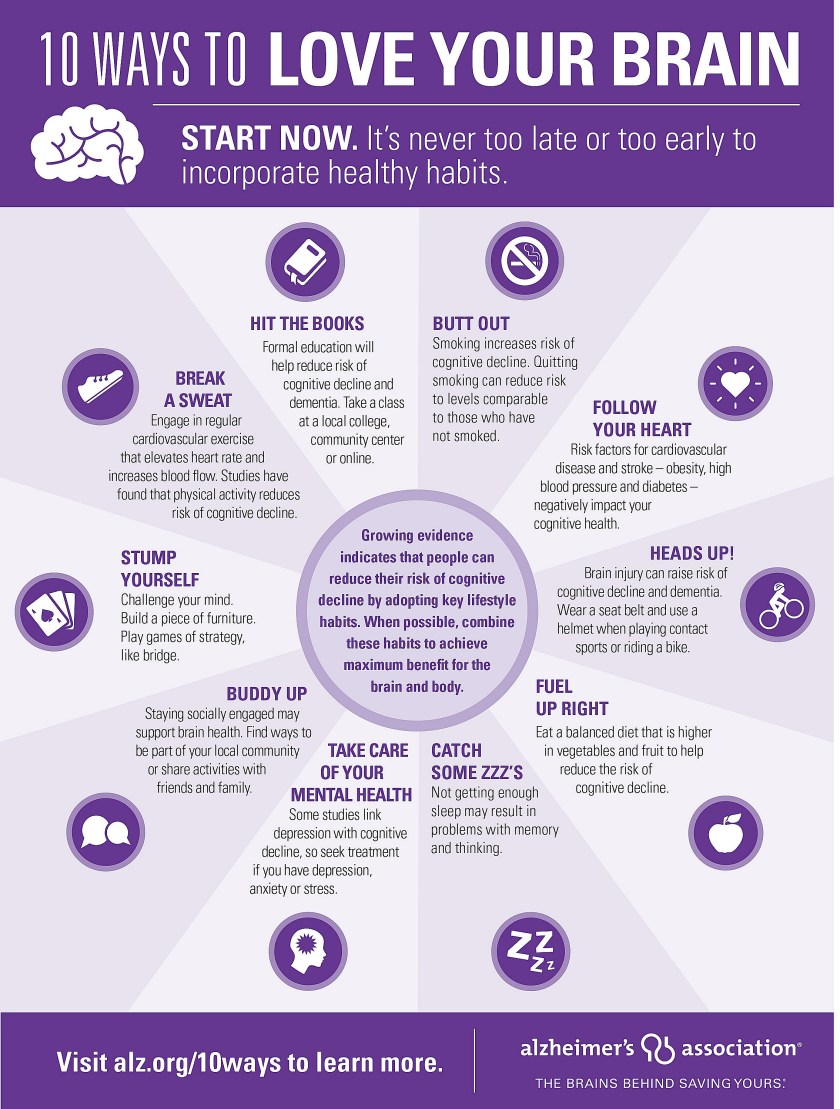
A quick and easy infographic that provides sound advice from Alzheimer’s Association (USA) on what you can do to love your brain! 😀
Good news for a lot of us in Asia whose probiotics drinking habits may be a daily run of the mill affair. From a young age, my parents would bottle me up with a small bottle of Yakult or Vitagen. These days if you walk into any 7-Eleven in Singapore, Korea, Japan or Taiwan you should be able to find a yoghurt drink rich with probiotics or just a probiotic supplement. Most of us in Asia would at least have heard of Lactobacillus acidophilus from our Yakult ads on television growing up.
New research published in the renown journal, Frontiers in Aging Neuroscience have shown that our daily dose of probiotics may have a positive impact on cognition. More research has to be carried out of course given this study is relatively new. The research, a randomised, double-blind controlled study conducted with 60 people living with dementia within a 12 week period. According to the study the participants consumed 200ml of probiotic milk daily containing Lactobacillus acidophilus, Lactobacillus casei, Bifidobacterium bifidum, and Lactobacillus fermentum.
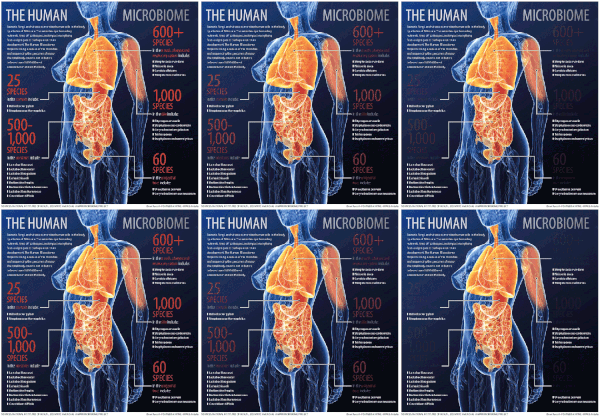
Below is an infographic from the Internation Association for Probiotics and Prebiotics.

Looks like our recommended daily dose of probiotics may be doing us more good after all.
Reference:
Elmira Akbari, Zatollah Asemi, Reza Daneshvar Kakhaki, Fereshteh Bahmani, Ebrahim Kouchaki, Omid Reza Tamtaji, Gholam Ali Hamidi, Mahmoud Salami. Effect of Probiotic Supplementation on Cognitive Function and Metabolic Status in Alzheimer’s Disease: A Randomized, Double-Blind and Controlled Trial. Frontiers in Aging Neuroscience, 2016; 8 DOI: 10.3389/fnagi.2016.00256
http://journal.frontiersin.org/article/10.3389/fnagi.2016.00256/pdf
 Alzheimer’s Australia Victoria launched an online dementia support website (http://www.helpwithdementia.org.au/) that brings together health services such as counselling, public health education and social programmes for people living with dementia, their families and carers through the web.
Given that 85% of general internet users in Australia utilise the net for communication activities, research and networking, it is only logical that health services for people with dementia and their significant others should extend to the web (Australian Communications and Media Authority 2015).
The great thing about online technology is that everything is literally at your fingertips. Especially for the tech saver person with dementia or caregiver. I know some of the readers are thinking; people who are older adults are not tech savvy. That is not true. 46 percent of older adults in Australia are already internet users (Australian Bureau of Statistics 2014). This platform (http://www.helpwithdementia.org.au/) is a life saver. Face to face services are no doubt great for people who can make the time and effort to travel for a session.
The ease of having services in the comfort of your own home is great. Going for services is really stressful and sometimes people or service providers forget that. There’s the stress of making time to travel, arranging transport, the stress of leaving your loved one alone, the anxiety experienced during the process of travelling, worrying about the cost of travel, taking time off from work or from an important social responsibility (Looking after your grandkids), the list goes on.
There are 50 million and one things to worry about. With an online site, I could be reading or watching about information on dementia sitting on the couch with my loved one or even just in my pyjamas in bed. There’s apparently 16 expert videos available on the site to help people understand about dementia.
There’s counselling that can be done through e-mail or there’s the option of a video conference. Or if you like to keep it casual there’s always the forum where you can hook up with a social network and exchange thoughts and read about people’s experiences on specific topics.
An online support platform is a great idea, and I hope to see more platforms that can cater to the needs of the online community. Youths and children these days are much more connected than I am and perhaps this medium might also be a way to connect to the younger generation to spread the news about having a healthier happier brain. Health prevention campaigns really need to take their heads out of the sand in tech-savvy countries, save the trees and really understand the people. Traditional means of health promotion is important but we also have to embrace the new wave of social media and technology and extend our care into the digital realm.
Source: Home – Alzheimer’s Australia Vic

Yesterday’s post about seniors taking their own lives really hit a nerve and today, like a ray of sunshine, this article appeared in the Today’s papers online. It’s heartwarming to know that more is being done to create inclusion in the community.
A really great article by Dr Thang Leng Leng about a cool program happening in Singapore, the enabling village. I hope it will take off and be highly successful among the Singaporean community. An inclusive society is definitely the way to go! It’s also really good to know that NTUC LearningHub has started training 100 supermarket frontline staff to help senior customers, and especially in the areas of dementia. Good on you NTUC!
 At this month’s opening of the Enabling Village — Singapore’s first community space for people with disabilities — Prime Minister Lee Hsien Loong called on Singaporeans to continue building a more inclusive society by valuing everyone, and through active citizenship.
Source: Promoting social connections at supermarkets | TODAYonline
The Straits times reported that there’s a 60% increase in seniors in Singapore taking their own lives. I hope Singaporeans are not going to take a back seat after reading the article, instead, I’m hopeful that fellow Singaporeans will be saying how can we all do our part to help?
We as a community need to work on social inclusion, work on de-stigmatising the negative stereotypes of ageing, mental health and chronic illness.
We know what we need to do, we know it takes a community effort, a top down and bottom up approach. From policy to public education to infrastructure, it takes a community, it takes a kampong, it takes heart.
We saw Singaporeans come together for events like SG50, stand strong during the SARS, we have sailed through one economic crisis after another, standing strong together as a nation, and yet we have let our elders down.
We’ve taken on NIMBY attitudes, mental illness is still feared and jeered, and we continue to expect others to manage these issues and not prevent them. We all can play a part as Singaporeans to provide support and care, in fact there’s research that indicates that caring can contribute to our own positive well-being (Jagger, Carol et al. 2015).
We need to stop managing issues and work to prevent them, to help fellow older Singaporeans to live well, to live comfortably, with dignity and respect. To feel accepted, included, and be part of the greater community. It’s painful to think that a fellow Singaporean in our day and age feel that they cannot reach out for help, to feel like a burden, to feel like they should not have existed to unburden themselves or others from suffering.
We know healthy ageing is possible (Raposa et al. 2015). We need to open our hearts to love more, to learn more, achieve happiness as one people, one nation, and to pass on positive values to our children.
Helplines in Singapore
Samaritans of Singapore (SOS): 1800- 221-4444 (24-hour)
IMH Mobile Crisis Service: 6389-2222 (24-hour)
Care Corner Counselling Centre (Mandarin): 1800-353-5800
Singapore Association for Mental Health: 1800-283-7019
Seniors Helpline: 1800-555-5555
 Singapore News -The golden years are losing their lustre for a rising number of the elderly here, with more taking their lives in the later phase of life. There is a nearly 60 per cent jump from figure in 2000; social isolation and physical and mental ill health may be contributing factors. Read more at straitstimes.com.
Source: More seniors in Singapore taking own lives, Singapore News & Top Stories – The Straits Times
Reference:
Jagger, Carol et al. (2015). A comparison of health expectancies over two decades in England: results of the Cognitive Function and Ageing Study I and II. The Lancet, Published online.
Raposa E.B Laws H.B Ansell E.B (2015). Prosocial Behavior Mitigates the Negative Effects of Stress in Everyday Life. Clinical Psychological Science. Published before print.

Researchers from The D’Or Institute for Research and Education discovered that a compound found in your everyday parsley, thyme, chamomile and red pepper can increase brain connections.
Read more about the article by clicking the link below.
 Brazilian researchers from D’Or Institute for Research and Education, Federal University of Rio de Janeiro and Federal University of Bahia have demonstrated in laboratory that apigenin, a substance found in parsley, thyme, chamomile and red pepper, improves neuron formation and strengthens the connections between brain cells.
Source: Plant compound found in spices and herbs increases brain connections | EurekAlert! Science News
 Designing for Aged Care