Posted in Ageing & Culture, Caregiving, Research & Best Practice, The Built Environment

Death and dying, life and living in long-term care facilities in Singapore

Building a dignified system where Singaporeans can choose how we want to live and how we want to say goodbye

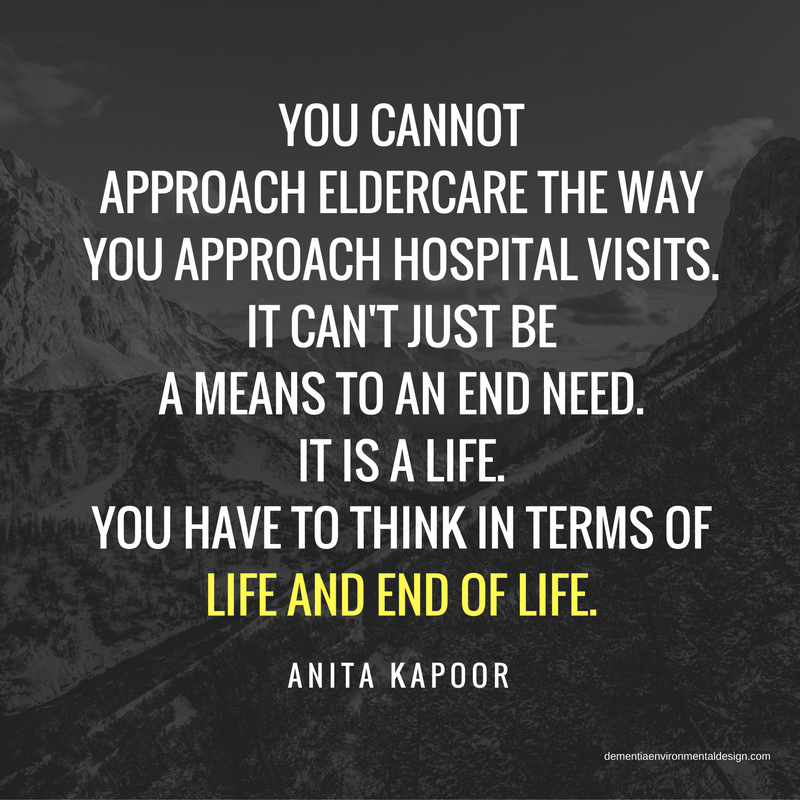
The loss of freedom, dignity and respect in places with 11 to 25 bedded wards, lacking in privacy, with staff being paid SGD$350 a month without food and accommodation were reported in a Channel NewsAsia program known as Talking Point. In addition, it was also mentioned by author and research Ms Radha Basu one staff member can be observed responsible for 20 to 32 residents in the night, and residents live with bare necessities such as a toothbrush, bed and a cabinet. The lifestyle was found to be highly regimented with the journalist sharing that there are were only 2 options for times for showers at 6 am or 7 am.  “it was like a hospital for the rest of your life” stated television host Anita Kapoor. She also states that “it’s not a criticism of the facilities themselves, it’s a criticism of the system. You cannot approach eldercare the way you approach hospital visits. It can’t just be a means to an end need. It is a life. You have to think in terms of life and end of life.”

I was really exhausted by the environment  

– television host, Anita Kapoor, 45 years of age.

I applaud Ms Kapoor for taking a stand and putting herself in the resident’s place, experiencing the environment literally for a fortnight first hand, living as residents lived.

Like my previous article about Singapore nursing homes, our story of the wooden bowl? I questioned how we want to care for our older adults, our parents, our grandparents, given the state of the nursing homes in Singapore. How do we care for our loved ones in Singapore with dementia without dementia enabling built environments?

My thoughts have constantly been being echoed in this programme. Pushing for better environments for people with dementia. I dare to say that I can dream for a day when Singapore will be able to have facilities that advocate for independence, dignity and respect for residents. Seeing an assisted living facility in the heart of Bukit Timah, it’s heartwarming and inspiring to see the St Bernadette Lifestyle village, assisted living facility that is just like a home.

It is with a flicker of hope that one day we can have facilities like intergenerational nursing homes inspired from our HDB designs (Taking a leaf from HDB flats for Pocket Gardens & Intergenerational Nursing Homes) which we call home.

In the meantime, I will keep working on a dementia enabling environmental audit tool for Singapore in the hope that we will be able to create dementia enabling long-term care facilities that Singaporeans can call home.

Watch the full episode here http://video.toggle.sg/en/series/talking-point-2016/ep24/458260

Posted in Caregiving, International Campaigns

Probiotics and Alzheimer’s Disease

Good news for a lot of us in Asia whose probiotics drinking habits may be a daily run of the mill affair. From a young age, my parents would bottle me up with a small bottle of Yakult or Vitagen. These days if you walk into any 7-Eleven in Singapore, Korea, Japan or Taiwan you should be able to find a yoghurt drink rich with probiotics or just a probiotic supplement. Most of us in Asia would at least have heard of Lactobacillus acidophilus from our Yakult ads on television growing up.

New research published in the renown journal, Frontiers in Aging Neuroscience have shown that our daily dose of probiotics may have a positive impact on cognition. More research has to be carried out of course given this study is relatively new. The research, a randomised, double-blind controlled study conducted with 60 people living with dementia within a 12 week period. According to the study the participants consumed 200ml of probiotic milk daily containing Lactobacillus acidophilus, Lactobacillus casei, Bifidobacterium bifidum, and Lactobacillus fermentum.

Below is an infographic from the Internation Association for Probiotics and Prebiotics.

Looks like our recommended daily dose of probiotics may be doing us more good after all.

Reference:

Elmira Akbari, Zatollah Asemi, Reza Daneshvar Kakhaki, Fereshteh Bahmani, Ebrahim Kouchaki, Omid Reza Tamtaji, Gholam Ali Hamidi, Mahmoud Salami. Effect of Probiotic Supplementation on Cognitive Function and Metabolic Status in Alzheimer’s Disease: A Randomized, Double-Blind and Controlled Trial. Frontiers in Aging Neuroscience, 2016; 8 DOI: 10.3389/fnagi.2016.00256

http://journal.frontiersin.org/article/10.3389/fnagi.2016.00256/pdf

Posted in Ageing & Culture, Caregiving, Therapeutic Activities

An Amazing Music and Memory Program for Dementia

If you have 5 mins today, you’ve got to watch this video on music, memory and dementia that is being carried out in the Redleaf manor aged care home in New South Wales, Australia. The video (ABC iview-catalyst) shares with viewers insight into this new programme on personlised playlist that can greatly improve the quality of life and well-being of the individual.

The programme helps people to
– reconnect with family
– brings people out of their shell
– brings out positive emotions

Music should be accessible in all care facilities, and prescribed music can help to elevate agitation and reduce the use of antipsychotics (medications)in a study by Standford University.

Music is the only stimulus that activates a range of centres in the brain, aside from memories (temporal lobe and amygdala), music also touches on the movement centres and emotional. This gives answers to the reactions that occur when a person with dementia listens to music despite the progressive deterioration of the brain.

Looking back at our infants, how many of us have played music or sang our babies to sleep? In prelinguistic stages, the environment consists of music and sounds of happiness or sadness or fear. Babies react to the powerful effect of music.

Music is a powerful medium that it is pivotal to our brain’s health.

You can watch the 30min episode here but it’s only available for people living in Australia
http://iview.abc.net.au/programs/catalyst/SC1502H006S00, for those living outside of Australia you can try this link http://www.abc.net.au/catalyst/stories/4421003.htm .

Posted in Caregiving, Dementia, Therapeutic Activities

Care staff gets a taste of living with dementia

Oxford Brookes University has devised a training programme to help staff working with people with dementia to come close to understanding the experience of living with dementia. This programme is carried out by a facilitator and participants have to wear a stimulation suit as part of the process. This aids the experiential learning process and creates some awareness of the needs of the individual with dementia.

The programme has proved to be successful and has helped care workers to better understand the experience of living with dementia; and in turn influence and improve the quality of care that they provide to the people they care for.

You can read more about the programme here here http://www.chc.brookes.ac.uk/training/dementia-simulation


Posted in Ageing & Culture, Caregiving

Illegal Money Lenders, Domestic Helpers, Family Caregivers & Dementia

Recent news reports from Hong Kong have highlighted the plight of four domestic helpers that committed suicide as a result of being victims of debt and association with illegal money lenders.

In countries such as Singapore, Hong Kong, Malaysia, Thailand, domestic helpers are needed in the community. They provide support and care for many older adults living in the community allowing them to age in place in their homes (Yeo 2014); this includes people with or without dementia. Many of helpers are live in caregivers for older adults; providing round the clock care, be it toileting at three in the morning or escorting them to an activity at three in the afternoon, they will be there. Live in helpers provide a much-needed service and care for many of us who strive to keep our loved homes at home instead of institutionalisation, think nursing home.

clean-house-vector


For those who are not familiar with foreign domestic help in Asia, you may wish to read the two article below.

Read about Mylene and Yu Heng’s story here

Read about Ms Mersi Fransina Missa story here

Live-in domestic helpers consist of mostly women from Philipines, Myanmar, Indonesia or even Thailand. The job of a domestic helper covers a range of responsibilities;

  • Cooking nutritious culturally specific meals
  • Ensuring clean and sanitary environment
  • Carrying out personal hygiene
  • Household maintenance
  • Provide activities as specified by the employers or therapist
  • Escorts and transport
  • Nursing care. (Nursing care may cover anything from medication administration, basic wound dressings to cleaning out a colostomy bag.)

Our loved ones with dementia who are being cared for by these dedicated helpers, may not be able to recognise the signs of stress that helpers may be experiencing when faced with debt. It is important that guardians, employers and policy makers provide the support and education to ensure that the helpers caring for our older adults do not fall prey to these manipulative schemes. Migrating to a foreign country to care for an older adult is not an easy task, leaving family and friends to provide 24-hour care to a stranger. Yes, there is an acknowledgement of choice and payment, but that is not to say that it is a difficult task none the less.Open communication, education about finances and an outlet to seek help to helpers is needed. This will help to prevent them from becoming a target for loan sharks/illegal money lenders who show up at the door and harassing the helper.

In a news article from Philstar global, Emily Lau, a Legislative Councillor from Hong Kong was quoted as saying “The main reason these women are in debt is because governments allow agents to collect so much money from them.” On top of that, the South China Morning Post had reported that agencies were found working with creditors, imposing loans on helpers at rates so high that they are deemed illegal. Caught in a distant land, with family at home to support, harassed by money lenders and debt appears to have no end in sight. It is sad that lives are lost because of these vile schemes.

robber-vector-set

For the hardworking and dedicated helpers who are protecting our loved ones with dementia from institutionalisation and helping them to maintain a good quality of life. We need to in turn assist them and ensure they do not fall prey to scheming smooth talking illegal moneylenders. These illegal money lenders or loan sharks promise fast and easy solution; on the pretence of providing helpers with a hand with loans. Only to trap them in a mountain of debt, bound with harassment and threats that have resulted in a lost of lives due to these tragic circumstances.