Director Katsumi Sakaguchi’s newest film “Walking with My Mother”
Official selection of Tokyo International Film Festival 2014
Director Katsumi Sakaguchi captures the life of his mother, Suchi, 78 through film, as she lives with dementia and depression, coping with the loss of her daughter and then her beloved husband. In the film Katsumi documents a life of distress, frustration and grief as his mother tries to remain resilient against all the trials and tribulations that life has hurl against her. He captures his own feelings and emotions as he tries to understand the needs of his mother and his own, and to cope with the changes that life has brought for both of them. The film also showcases their travel back to Suchi’s hometown and the positive improvements that such a change brings.
A beautiful video on WaiJiang music and the use of music to honor and remember the ones you love.
This video provides an insight into the passionate Teochew musicians in Singapore. I’m still reeling from the fact that they don’t have a score and everything is memorised. It’s amazing, the commitment of the musicians. One of the older adults appeared to have difficulties going up the stairs, but he still made it up to go for their jamming session. People talk about how we need to find more appropriate music that reflects the era of the person with dementia, and songs that are culturally appropriate. We still have a team in Singapore that continues to carry this tradition on with fierce dedication, as they preserve and cherish our heritage and culture in Singapore.
If you are looking for traditional Teochew music, these musicians are the real deal.
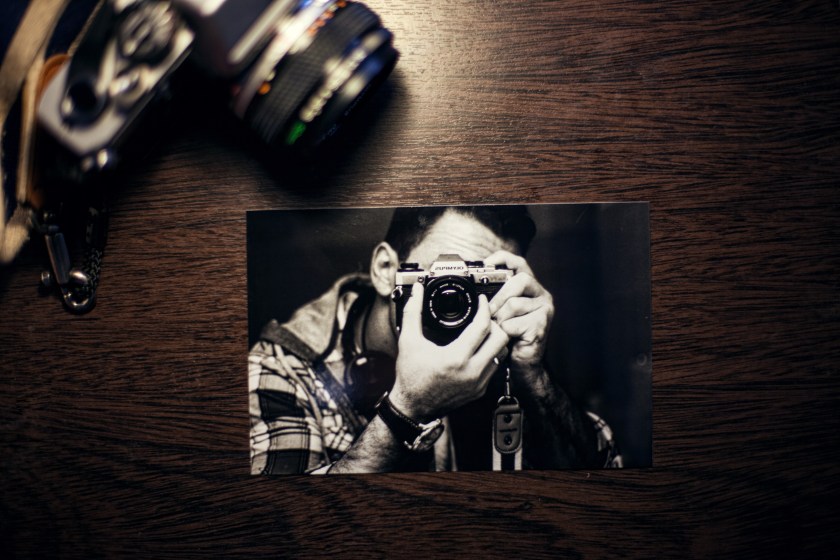
I was talking to a friend about dementia, and I forget that there are people who have not come in contact with people with dementia. They have little awareness about dementia despite the information through the media and multiple health promotions campaigns. They tell me it’s just people being old and forgetful. That doesn’t even come close. We talked about dementia, but I get the feeling that the words were just empty nothingness sailing pass like the boats down the river on a hot summer’s day. I turned to Jake Hearth’s series of photos for help and that hit home hard. Giving the person a realistic glimpse of what dementia can be without the glitz and glamour of the media. After that experience, I thought perhaps it might be useful for others who may require photography as a medium to raise awareness about dementia.
Below are 3 sites that contain photographic life stories of love, courage and strength in the face of dementia.
1. This is what Early Onset Dementia looks like.
If you haven’t seen Jake’s photos, the link is at the bottom. Jake’s photos took the net by storm and his photos on Reddit went viral and before I knew it, I saw articles about his photos in the Huffington post, the mirror and even in the daily mail. His photos document the progress of his mum and his family in the last decade as they work to care for his mother, Jacquie, 58 who is living with Pick’s Disease. His photos have certainly touched my heart and many other and I am thankful for him to be sharing his photos of his family’s experience to help raise awareness of dementia.
From http://imgur.com/a/Wlyko with the caption: This was taken in 2005 or so. At this point, Jacquie had Pick’s Disease, but it had been misdiagnosed as menopause. She would be about 48 here.
This beautiful 2014 photo blog by Yeo Kai Wen shares with the world, the story of Mylene, who is a domestic worker from the Philippines and Yu Heng, an elderly lady with dementia. In Singapore, some families may hire foreign domestic workers to help care for their family members with dementia. Mylene has been living with Yu Heng for 7 years now, and provides care for her 24 hours a day.
This is a project by a photographer only going by the name of J.R. who created a photo essay to share and document his family’s experience with his father’s living with frontotemporal dementia. It’s a very touching photo essay as J.R. chronicles photos of his father’s progress.
He touches on the beginning of dementia and the signs and symptoms that his father exhibits. He talks about his father’s progress with dementia and details incidents which marks each milestone and the achievements that his dad had done throughout his lifetime. This photo essay shares with people the challenges that family caregivers face and the sacrifices that they make to keep the family together.
I hope these sites would prove useful and a big thank you to the caregivers and photographers who have shared these stories using photography to raise awareness about dementia.
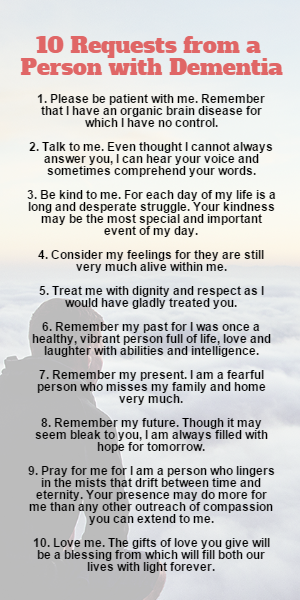
I found this online and made it into a bookmark. I found it to be very meaningful and wanted to share it with everyone. I couldn’t find the author, and the posts all listed it as anonymous. I hope that people may find this useful and share it with their friends.
I was very much one of the many individuals in the public that thought it was the deterioration in memory that had robbed people of their identity in the case of dementia. When I read this study, I felt like I was hit on the head by a bolt from the blue.
The study published in June 2015, in the Journal of the Association for Psychological Science on neurodegeneration and identity. In this study, researchers, Nina Strohminger from Yale University and Shaun Nichols from the University of Arizona made a breathtaking discovery.
Nina and Shaun had measured perceived identity changes in 248 patients with Frontotemporal Dementia, Alzheimer’s Disease (AD) and Amyotrophic Lateral Sclerosis (ALS).
They found that moral behavior, not memory loss, causes loved ones to say that the patient wasn’t “the same person” anymore. That people with Frontotemporal Dementia was observed to have the greatest change in perceived change in the identity of the person with dementia by the caregiver. Next in line was AD and lastly ALS.

 From
From 



 Designing for Aged Care