Reading up on all the news, reports and discussions on the aged care royal commission, it makes me wonder if personhood is forgotten in dementia care. Recognition, respect and trust is not rocket science and that’s just common sense. What’s happened to aged care? Why is it that people living with dementia are now being objectified, disrespected and feared in aged care. How did we go so wrong?
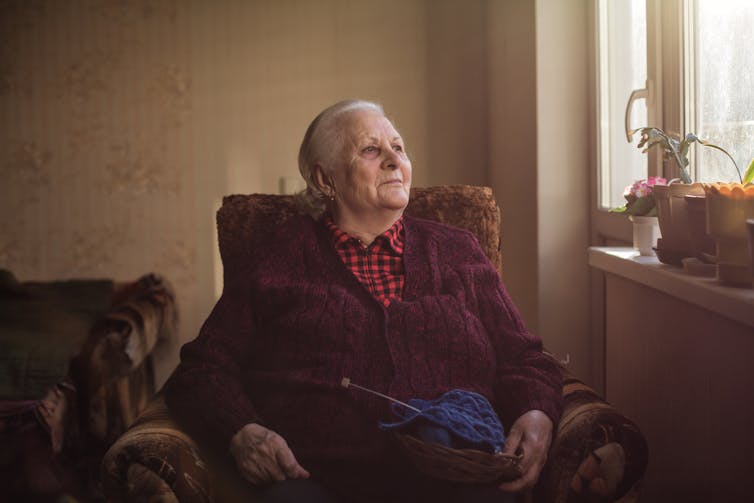
Many older Australians prefer to stay at home than enter residential aged care – but the process of securing home care is riddled with complexities. From shutterstock.com
The Royal Commission into Aged Care has unleashed a spate of claims of system failure within the residential aged care sector.
Now, as the commission shifts its focus to care in the community, we’re also seeing claims of failure within the home care packages program.
This scheme aims to support older people with complex support needs to stay at home. But what we’ve got is a market-based system where the processes involved in accessing support and managing services are making it difficult for vulnerable older Australians to receive the care they want.
If this system is to be workable, older people need better information and more personalised supports to enable choice and control – especially those with complex needs.
A growing number of older Australians are receiving home care subsidised by the government. During the 2017-18 financial year, 116,843 people accessed home care packages.
This means that, theoretically, home care providers must work with consumers to design and deliver services that meet their goals and care needs, as determined by an Aged Care Assessment Team.
However, in reviewing the active steps outlined in the government pathway to access a package, we must consider the person who is navigating this path.
They are frail older people with complex support needs, often seeking help at times of crisis. These include the growing number of older Australians living with multiple medical conditions and complex age-related syndromes such as dementia.
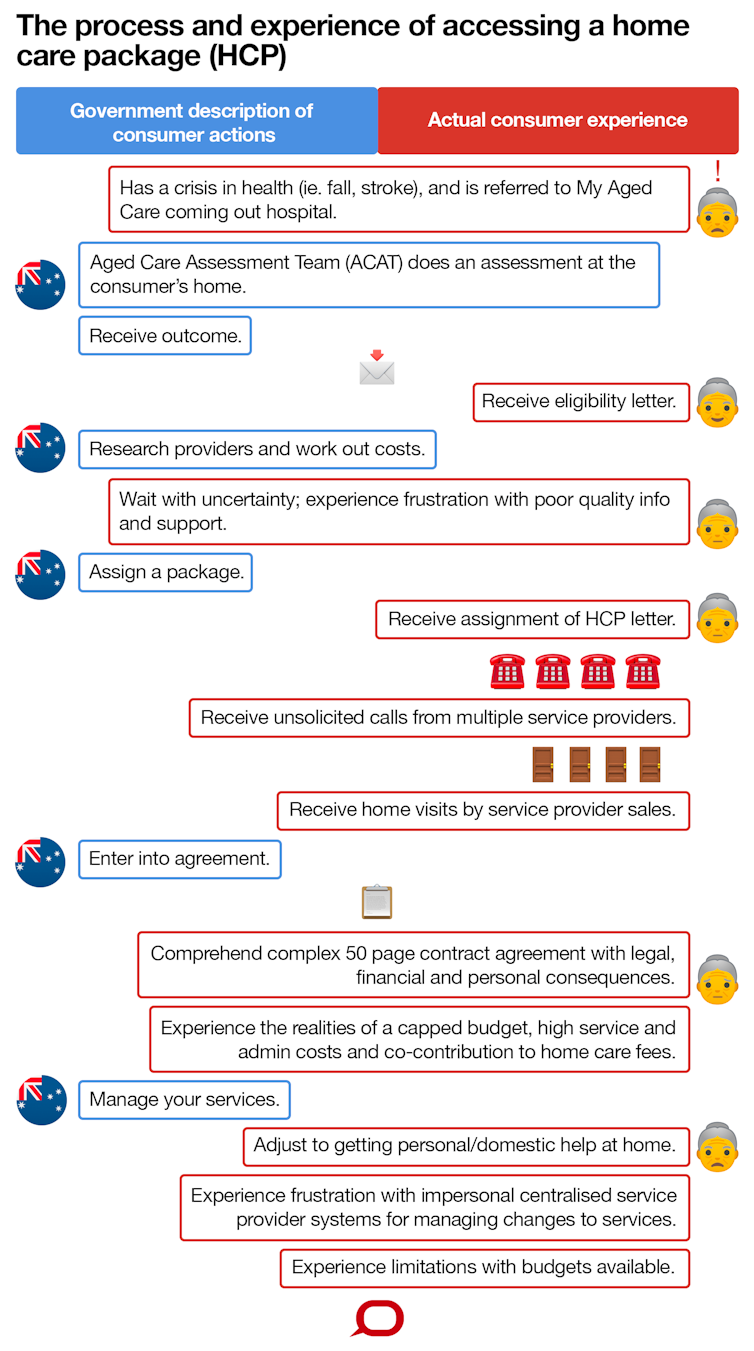
After a person has been assessed, they will receive a letter informing them they are eligible. However, due to long waiting lists, this does not provide them with immediate access to care; most wait many months before they are actually assigned a package by My Aged Care.
When they eventually receive a letter confirming their package, the consumer will be approached by various service providers. They will need to sign a complex contract with their chosen provider.
If the consumer is feeling frustrated and confused during these early stages, this is only the beginning. The recent marketisation of home care means managing their own care requires going through impersonal, centralised provider systems.
People need clear information to choose a provider
The first thing people assigned a home care package need to do is choose a care provider.
There are now close to 900 different providers offering home care packages. This includes not-for-profits, as well as a growing number of for-profit providers competing for new business.
In reality, however, few older people research different providers. Once they’re assigned a home care package, their name is placed on a centralised database accessible by all registered service providers.
The person then receives unsolicited phone calls from the sales teams of different providers, offering their services and trying to make appointments to come and visit. For consumers, this represents a shift from a familiar government model of care provision to a market model.
Research shows consumers often don’t understand consumer directed care, and this can leave them vulnerable to the forceful marketing tactics employed by some providers. It can also make negotiating a complex contract with legal, financial and personal implications very difficult.
Older people granted a home care package will be approached by different providers wanting their business. From shutterstock.com
To make informed choices between providers, people need accessible information. There is currently insufficient information for older people and their families to compare services on indicators of quality (such as the number of complaints agencies receive, the training of staff, the types of specialist services they offer, and so on).
To address this gap, the government must commit to collecting and publishing data on home care quality. This would drive service improvement and increase people’s ability to make informed choices between different providers.
Service and administrative fees
To make informed choices, people also need to be able to compare services on the basis of price.
The average profit per client for home care package providers was A$2,832 in 2016-17, but there’s significant variability between providers’ fees.
For example, the use of people’s individual care budgets to cover administration or case management fees ranges between 10-45% of their total package.
High fees and administrative costs may reveal the profit-driven motives of a few unscrupulous providers.
Because of administrative fees, many people are spending a high portion of their individual budgets on case management to support their care.
While there’s evidence case management can provide clinical benefits for older people, in the context of the current home care funding model, it may also leave people with less money for direct care services than they need.
People need support to manage their packages
We’re currently looking at the experiences of people with dementia using home care packages. Unsurprisingly, we’re finding that while they are grateful for the services they’re receiving, they are having a difficult time managing their care. For some this may be due to their limited decision-making capacity, but for many, their choice and control is being limited as much by the service model.
For example, to enable providers to compete in the open market, many have adopted central 1800 numbers to support people to manage their services. This means if consumers want to change something, they are funnelled through this system.
Think about your own experience of service helplines, such as with telephone or energy companies. Now consider a woman with dementia who needs to call a 1800 number to change the time of her shower so she can see her doctor.
Rather than communicating with a local and known case manager, she now needs to speak to someone she doesn’t know and who is not familiar with her care needs.
Instead of facilitating choice and control, this demand on the consumer to constantly articulate their needs to unfamiliar people means many are frustrated, and some are even opting out of services.
How can we improve things?
The three words the government associates with consumer directed home care are choice, control and markets.
But the system doesn’t foster control. Although consumers technically have choices, the marketised and bureaucratic approaches of service providers make it difficult for consumers to articulate and receive support for their personal choices.
The processes, information and supports available to assist older people and their families are inadequate to facilitate the type of choices and control one might associate with “consumer directed” care.
There’s an urgent need to improve the processes for accessing timely home care packages, particularly for those with complex support needs. This includes the quality and accessibility of information, resources and decision-making tools.
There’s also a significant need for training, advocacy and impartial support for choice, particularly for people with limited decision-making capacity, such as those living with dementia.
Research and practice in aged care and disability in other settings provide extensive resources for person-centred planning and decision making which could be adapted for use in our home care system.
As the royal commission begins investigating the failures of the residential aged care sector, it is important such a review also considers the broader socio-political factors that have contributed to this crisis.
The commission needs to go beyond the institutional problems at individual aged care facilities, as these are a symptom of a much broader rejection of ageing in society and marginalisation of older people.
Negative stereotyping of older people is reinforced in the media, and this both informs and reflects societal attitudes. In Western society especially, we fear dependency, invisibility and dying. Aged care is a silo of these fears. And until it affects us personally, we ignore it.
How older people are marginalised in society
We have an expiry date in our society. This is not the date we die, but a time when our skills and knowledge are no longer considered to be valid or useful. Our value is largely determined by our economic contributions to society. But for many older people, this is difficult to demonstrate because they’re no longer in the workforce.
The economic impact of societal rejection of ageing is significant. Modelling by Price Waterhouse Cooper indicates that Australia’s gross domestic product would increase by almost 5% if people were supported to work longer. And data from the Australian Bureau of Statistics reveal that many Australians would like to retire later if they could.
Yet, there is evidence that older people are routinely denied work. In 2016, Age Discrimination Commissioner Susan Ryan said there was an urgent need to “tackle the discrimination that forces people out of work years before they want to leave”.
While older people should be supported to work longer if they wish, over half of Australians between the ages of 65 and 80 report a moderate or severe disability, resulting in greater dependency. A 2017 study of late-life dependency published in The Lancet found that, on average, older people will require 24-hour care for 1.3 to 1.9 years of their lives.
However, it is important that older people are not considered redundant in their societal role when dependency increases.
Aged care workers are also undervalued
Residential aged care facilities fulfil an essential role in our society. Yet, our recent ethnographic study in two residential aged care facilities in Victoria shows how this role has been compromised by an under-skilled, under-valued and overworked aged care workforce.
Older people were exposed to a revolving door of anonymous workers, significantly reducing opportunities for teamwork and fostering relationships between staff and residents. In one of the not-for-profit facilities, a single registered nurse was responsible for the care of 73 residents. This contributed to the delegation of an increasing range of tasks to unregistered personal care assistants with minimal training and delays in recognising signs of health deterioration among residents.
A reliance on general practitioners also increased the likelihood of hospital transfer. And hospital transfers can sometimes prove harmful, with previous studies showing that the noisy, fast-paced environment, bright lights and anonymous faces can have a negative impact on residents, particularly those with dementia.
Within the healthcare sector, aged care has the lowest status of all specialty areas amongst nurses and doctors. Recruiting appropriately qualified and skilled people to work in aged care is thus a constant challenge. Australia is expected to increasingly rely on imported labour to staff its aged care sector in the near future.
Ways to fix the system
Encouraging more healthcare professionals to enter the aged care sector will require a multi-pronged approach, starting with finding ways to engender more professional respect for those working in the field.
Greater emphasis also needs to be placed on improving the gerontological expertise of aged care workers. This can be strengthened by prioritising aged care in medical school education and recognising “nursing home” care as a specialist medical area. It is also imperative that personal care assistants receive greater recognition of the roles and duties they perform.
Registration of personal care assistants as third-tier health care professionals is well overdue to ensure better oversight of their training and scope of their practice.
We also need to recognise the importance of human connection in residential aged care facilities. This requires strategies to build better relationships between residents and staff, and developing a formula for more accurate staffing allocations that reflect the real time commitments involved in aged care.
Who bears the ultimate responsibility?
It’s not enough to be shocked by the aged care scandals uncovered by the media and the decision to appoint a royal commission to investigate. We must also make older people, their contributions and end-of-life needs more visible. Increased funding and oversight will only come when we collectively say it’s important.
It is incumbent on us to ensure that residential aged care facilities do not operate as holding bays for the silenced, or wastelands for the discarded, where the occupants are expected to demand nothing and be as little cost to society as possible.
We have an opportunity to reconstruct the delivery of residential aged care. Let’s begin with the end in mind: a society that not only values older people, but values the resources required to provide the care they need and deserve.
Last month the aged care minister Ken Wyatt announced he would introduce regulations to address the use of “chemical restraint” in residential aged care – a practice where residents are given psychotropic drugs which affect their mental state in order to “control” their behaviour.
Psychotropic medications used as “chemical restraints” are antipsychotics, antidepressants, anti-epileptics and benzodiazepines (tranquilisers).
Wyatt followed this announcement this month with a A$4.2 million funding pledge to better monitor care in nursing homes through mandatory “quality indicators”, and including one covering medication management.
Of course, you would be hard pressed to find a staff member admitting to controlling a resident by giving them a tablet. Instead, most staff would stress that medication was given to calm or comfort them.
But our research shows psychotropic use is rife in Australia’s aged care system.
Reforms are desperately needed, but we need to develop the right approach and learn from countries that have tried to regulate this area – most notably the United States and Canada.
What’s the problem with antipsychotic drugs?
Antipsychotic drugs such as risperidone and quetiapine are often used to manage behavioural symptoms of dementia.
But large reviews conclude they don’t work very well. They decrease agitated behaviour in only one in five people with dementia. And there is no evidence they work for other symptoms such as calling out and wandering.
Due to their limited effect – and side effects, including death, stroke and pneumonia – guidelines stress that antipsychotics should only be given to people with dementia when there is severe agitation or aggression associated with a risk of harm, delusions, hallucinations, or pre-existing mental illness.
The guidelines also state antipsychotics should only be given when non-drug strategies such as personalised activities have failed, at the lowest effective dose, and for the shortest period required.
The high rates of antipsychotic use in Australian aged care homes indicates the guidelines aren’t being followed.
In our study of more than 12,000 residents across 150 homes, we found 22% were taking antipsychotics every day. More than one in ten were were charted for these drugs on an “as required” basis.
We also found large variations in use between nursing homes, ranging from 7% to 44% of residents. How can some homes operate with such low rates, whereas others have almost half their residents taking antipsychotic medications?
Regulations to reduce chemical restraint
Of all countries, the US has made the most effort to address high rates of antipsychotic use.
After reports in the 1980s highlighting poor nursing home care, Congress passed the Omnibus Budget Reconciliation Act which sets national minimum standards of care, guidelines to assist homes to follow the law, and surveyors to enforce it.
For residents with dementia and behavioural symptoms, the regulations require documentation of the behaviour, a trial of non-drug strategies such as activity programs, and dose reductions after six months.
Prescribing practices vary widely between institutions. From shutterstock.com
Homes that don’t meet these regulations are subject to a series of sanctions, ranging from financial penalties to closure.
The regulations were initially associated with substantial declines in antipsychotic use. By 1995 only 16% of residents were taking them.
But average rates of use rose to 26% by 2010. And in 2011, a Senate hearing found 83% of claims for antipsychotics in nursing homes were prescribed for unlicensed use.
This led advocates to conclude the regulations and surveyor guidance were ineffective.
Quality indicators to reduce chemical restraint
Another way to reduce antipsychotic use in aged care homes is by mandatory quality indicators, along with public reporting. The US introduced this in 2012. A similar system was instituted in Ontario, Canada, in 2015.
Measures are essential for quality improvement. But they can also lead to unintended consequences and cheating.
In the US, antipsychotic rates for people with dementia has allegedly reduced by 27% since the start of their quality indicator program.
But those diagnosed with schizophrenia were exempt from reporting. Then the percentage of residents listed as having schizophrenia doubled from 5% to nearly 10% of residents within the first few years of the initiative. So 20% of the reduction was probably due to intentional mis-diagnosis rather than an actual decrease in antipsychotic use.
A recent US study has also shown that the use of alternative sedating medications not subject to reporting, specifically anti-epileptic drugs, has risen substantially as antipsychotic use declined, indicating widespread substitution.
In Ontario, the use of trazadone, a sedating antidepressant, has also markedly increased since its antipsychotic reporting program began.
Reporting issues
In the US, nursing homes self-report indicators. A recent study compared nursing home data with actual prescribing claims, concluding that homes under-reported their antipsychotic prescribing, on average, by 1 percentage point.
Public reporting is often also time-consuming, with some researchers arguing that time spent managing quality indicators may be better spent providing care for residents.
Where to now?
Awareness of a problem is the first step to addressing it, and chemical restraint is a key issue coming to light in the aged care royal commission.
The proposed regulations and new quality indicator will allow homes and regulators to monitor the use of chemical restraint, but more importantly, should be used to assess the impact of training and other strategies to ensure appropriate use of psychotropic medications.
But to meet their full potential, these programs need to be carefully designed and evaluated to ensure that cheating, under-reporting and substitution does not occur like it did in North America.
It’s an uncomfortable image to consider: an elderly person – perhaps somebody you know – physically restrained. Maybe an aged care resident deemed likely to fall has been bound to his chair using wrist restraints; or someone with dementia acting aggressively has been confined to her bed by straps and rails. These scenarios remain a reality in Australia.
The Australian government has recently moved to regulate the use of physical and chemical restraints in aged care facilities. This comes ahead of the Royal Commission into Aged Care Quality and Safety.
Certainly this is a step in the right direction – but banning physical restraint is unlikely to remove it from practice. If we want to achieve a restraint free approach we need to educate the sector about viable alternatives, which aren’t always pharmacological.
The rate of physical restraint in Australia is difficult to ascertain. One study across five countries examining the care of residents over one week reported between 6% (Switzerland) and 31% (Canada) of residents had been physically restrained.
These figures suggest a substantial, ingrained issue with multiple contributing factors. Issues might include inadequate staff knowledge and skills, insufficient resources, and difficulty accessing specialist services.
While injuries caused directly by physical restraint could include falls and nerve injury, the impacts go beyond this. A significant consequence of restraint is its immobilising effects which can lead to incontinence, cognitive decline and a general deterioration in a person’s physical condition.
In physically restraining residents, staff are failing to employ other evidence‐based interventions. Behavioural and psychological symptoms of dementia can be managed by strategies such as improving sleep, controlling pain, music therapy, orientation therapy, and, if required, one-to-one care.
Preventing falls requires a multi-pronged approach including strengthening, balance training, medication review and co-ordination of care between doctors, nurses and therapists.
Physical restraint breaches a person’s human rights and dehumanises older members of our community.
Restraints don’t work
Our recent review of studies into the practice identified 174 deaths of nursing home residents due to physical restraint. The eight studies reviewed came from the US and Europe between 1986 and 2010.
This research reaffirmed the view that restrained individuals still experience falls, which the restraints often seek to prevent. But perhaps most compelling were the findings that physically restraining patients with dementia increases agitation, worsens behavioural and psychological symptoms, and hastens their cognitive decline.
Care staff need to be better equipped to look after patients without resorting to physical restraint. From shutterstock.com
We’ve also undertaken a detailed analysis of resident deaths in Australian nursing homes reported to the coroner between 2000 and 2013. This uncovered only five deaths due to physical restraint. All residents had impaired mobility and the physical restraints had been applied to prevent falls. The residents died from neck compression and entrapment caused by the restraints.
Current processes
Most would expect the use of physical restraints would be closely monitored, with any harm reported to a regulatory or professional body. This is not necessarily the case in Australia.
Reporting often lags due to an unclear understanding about what constitutes physical restraint, and perhaps because little is forthcoming in the way of alternatives to address these residents’ care needs.
The only systematic voluntary scrutiny that could apply exists in principle, though not largely in practice, via the National Aged Care Quality Indicator Program. Fewer than 10% of aged care providers around the country participate in the quality indicator program, and the results of these audits are yet to be released publicly.
It’s only when a death occurs that a report to an independent authority – the Coroner’s Court – is made.
Similar laws introduced in other countries to ban physical restraint haven’t worked. In the US, there was an initial decrease in use of restraint and then a gradual return to previous levels.
Abolishing the use of physical restraints on nursing home residents remains challenging because of the widespread but incorrect perception that physical restraints improve resident safety. Nursing staff report using physical restraints to guarantee residents’ safety; to control resident behaviour while fulfilling other tasks; or to protect themselves and others from perceived harm or risk of liability.
Changing laws does not change attitudes. Education and training is required to dispel the myths and inform that better options than physical restraint already exist. Otherwise staff, family and the general public will continue with a mistaken belief it is safer to restrain a person than allow them to move freely, or that restraint is necessary to protect other residents or staff.
Our team convened an expert panel to develop recommendations for addressing the issue. We considered three of our 15 recommendations to prevent the use of physical restraint among nursing home residents the most important.
The first is establishing and mandating a single, standard, nationwide definition for describing “physical restraint”. A universal definition of what constitutes physical restraint enables consistent reporting and comparability in nursing homes.
Secondly, when there are no viable alternatives to physical restraint, any use should trigger mandatory referral to a specialist aged care team. This team should review the resident’s care plan and identify strategies that eliminate the use of physical restraint. This requires improved access to health professionals with expertise in dementia and mental health when a nursing home calls for help.
Thirdly, nursing home staff competencies should be appropriate to meet the complex needs of residents, particularly those with dementia. This is the long term solution to eradicate the need to apply physical restraint and is achievable with national education and training programs.
The harm from physical restraint is well documented, as are the potential solutions. Changing the legislation is a necessary step, but will not change practice on its own. Addressing as many of the underlying contributing factors as possible should commence alongside the government’s call for tougher regulations.
Many caregivers in Asia can agree, it’s super hard to find resources and in some countries, it’s hard even to know where to start. When we go online there are so many websites and resources, it’s hard to even know where to start. It’s hard especially when a lot of information tends to be advertisements for private organisations promoting their services. When this post from Monica Cations post popped up on twitter, it was like, wow, what a great idea!
Let’s have one for countries in Asia. The list is below is one for Asia, and if you wish to view the full list of organisations, you can visit https://www.alz.co.uk/associations














 Designing for Aged Care