Posted in Ageing & Culture, Caregiving, Research & Best Practice

Older Adults Are Still Likely Underestimating Cognitive Impairment in Their Families

grandma-515530_960_720

News release

 Study Finds Racial Differences in Reporting and Overall Trend of Underreporting Cognitive Impairment

An increasing number of older adults are reporting cognitive impairment in their families over the past two decades, according to a new study led by researchers at NYU Rory Meyers College of Nursing and East Carolina University’s Brody School of Medicine.

The study, which also finds ethnic and racial differences in reporting cognitive impairment, is published in Preventing Chronic Disease, a journal of the Centers for Disease Control and Prevention.

The aging population in the U.S. is growing rapidly, with the number of people age 65 and over in 2010 (40.2 million) projected to more than double by 2050. With the rapid increase in the aging population, the size of the population with cognitive impairment and dementia will continue to accelerate, highlighting the importance of identifying cognitive changes.

“Cognitive impairment may serve as a precursor to future dementia. Early detection of cognitive impairment can facilitate timely medical treatments, appropriate care planning, and prevention efforts,” said Bei Wu, PhD, Dean’s Professor in Global Health and director of Global Health & Aging Research at NYU Meyers, co-director of NYU Aging Incubator, and the study’s senior author.

The study sought to examine the trends of self-reported cognitive impairment among five major racial/ethnic groups from 1997 to 2015 in the United States. The researchers used data from the National Health Interview Survey, including 155,682 individuals age 60 and above in their sample. The large sample included people of a variety of races and ethnicities, including Asian Americans,  Blacks, Hispanics, Native Americans, non-Hispanic Blacks, and non-Hispanic Whites.

Rather than using a screening test or clinical examination to evaluate cognitive impairment, respondents were asked to report if any family member was “limited in anyway because of difficulty remembering or because of experiencing periods of confusion.”

The researchers found an increasing trend in self-reported cognitive impairment: the overall rate increased from 5.7 percent in 1997 to 6.7 percent in 2015 among older adults in the U.S. This finding may suggest that awareness of cognitive impairment, perhaps from heightened public attention to and interest in Alzheimer’s disease, has improved to some extent.

grandma-748254_960_720

When looking at each racial/ethnic group, however, the increasing trend was significant only among White respondents. In Whites, the rate of self-reported cognitive impairment increased from 5.2 percent in 1997 to 6.1 percent in 2015. Asian American, Black, Hispanic, and Native American respondents had higher rates of self-reported cognitive impairment than Whites, but these rates did not significantly increase from 1997 to 2015.

Regardless of the overall increasing trend, the rates of self-reported cognitive impairment were still low, which may suggest underreporting. The researchers note that the rates of self-reported cognitive impairment are much lower than the estimated prevalence of cognitive impairment. For adults 65 years and older, the rate of self-reported cognitive impairment was 6.3 percent in 2000 and 7.5 percent in 2012, while the estimated prevalence of cognitive impairment in the same age group was 21.2 percent in 2000 and 18.8 percent in 2012.

These findings underscore the need to further promote awareness of cognitive impairment, especially in minority populations. Different cultures hold different beliefs and perceptions of disease and aging. For instance, research has found that compared to Whites, minorities are less likely to seek treatment for psychiatric symptoms because of lack of access to care or due to stigma.

“Culturally specific health education is needed in individuals, family members, and healthcare providers to improve awareness and knowledge of signs and early symptoms of Alzheimer’s and other dementia,” said Huabin Luo, PhD, of East Carolina University.

In addition to Wu and Luo, Gary Yu of NYU Meyers coauthored the study.

Posted in Caregiving

The language of dementia is slowly changing

Kate Swaffer (she/her) Kaurna Country's avatar

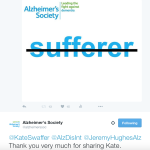
There has been, for many years, discussions, requests, even what could be seen as begging from may of us diagnosed with dementia to use respectful language. That means, respectful from our point of view, not those who are not diagnosed with dementia.

Of course, people with dementia do suffer some of the time, but we did before dementia too, but were not then termed as sufferers all the time. Some individuals with dementia may wish to refer to themselves as sufferers, and of course, that is totally their right, but I believe it is not ok to do so publicly, as it infers that we are all ok with that negative label.

The following is my guest blog published by Dementia Australia after attending the Alzheimer’s Disease International (ADI) Conference in Puerto Rico in 2014

I repeat: “Please don’t call us sufferers”

During the recent ADI2014 conference, it was apparent…

View original post 745 more words

Posted in Caregiving, International Policies, Research & Best Practice

Why a drug treatment for dementia has eluded us


File 20180109 83553 1tp4671.jpg?ixlib=rb 1.1

Have our hopes of a drug treatment for dementia been dashed by drug company Pfizer giving up on research efforts?
from http://www.shutterstock.com

Jürgen Götz, The University of Queensland

Finding a cure for neurodegenerative diseases such as Alzheimer’s is challenging. They’re difficult to diagnose, and drugs struggle to get into the brain as the brain’s blood supply is largely separate to the rest of the body. Not surprisingly, several companies have left this territory in recent years. This week, pharmaceutical giant Pfizer announced it will stop research into developing drugs to treat Alzheimer’s disease, after costly failed attempts over the past decade.

In recent years some clinical trials involving potential dementia drugs have had disappointing setbacks. In 2012, Pfizer and Johnson & Johnson halted development of the antibody drug bapineuzumab, after it failed in late-stage trials to treat patients with mild to moderate Alzheimer’s.

Despite this week’s announcement, Pfizer’s support of the UK’s Dementia Discovery Fund, an initiative involving the government, major pharmaceutical companies, and Alzheimer’s Research UK, may be where their money can make the most impact in this space. The fund aims to boost dementia research investment by financing early-stage drug development projects. And other pharma companies, such as Eli Lilly, Biogen and Novartis have continued to pursue dementia drug development with modest but promising success to date.

So what makes dementia such a difficult condition to treat with drugs, and is progress being made towards a treatment?


Read more: Alzheimer’s breakthrough? Have we nearly cured dementia? Not just yet…


Why dementia is so hard to treat

Despite the vast number of people affected globally, with an estimated 46.8 million people currently living with dementia, there is currently no cure. While current treatments manage symptoms (the latest drug to gain FDA approval was memantine, in 2003) they offer no prospect of recovery.

Part of the difficulty in finding treatments for dementia stems from the fact it’s not a single disease, but a complex health problem with more than 50 underlying causes. Dementia can be better thought of as an umbrella term describing a range of conditions that cause parts of the brain to deteriorate progressively.


Read more: What causes Alzheimer’s disease? What we know, don’t know and suspect


Most drug treatments currently in development have targeted the pathology of Alzheimer’s disease, the most common form of dementia, which accounts for about 60 to 70% of all cases.

Finding a successful treatment for Alzheimer’s faces two major hurdles: the first being we still don’t know enough about the disease’s underlying biology. For example, we don’t know what exactly regulates the toxic build-up of amyloid-β plaques and tau tangles in the brain that are found in Alzheimer’s patients, which specific types of these are toxic, or why the disease progresses at different rates in different people.

It doesn’t help that symptoms of Alzheimer’s develop gradually and slowly and a diagnosis might only be made years after the brain has started to undergo neurodegenerative changes. To boot, it’s not uncommon for Alzheimer’s to be present as well as other forms of dementia.

The second major hurdle to finding a treatment is that drugs need to first cross the blood-brain barrier. The blood–brain barrier provides a defence against disease-causing pathogens and toxins that may be present in our blood, and by design exists to keep out foreign substances from the brain. The downside is that it also keeps the vast majority of potential drug treatments from reaching the brain.


Read more – Explainer: what is the blood-brain barrier and how can we overcome it?


The brain has a blood barrier that protects it from pathogens that invade the rest of our body, which also means drugs can’t get in there.
from http://www.shutterstock.com

Promising steps in the right direction

Currently available medications such as those which block the actions of an enzyme that destroys an important chemical messenger in the brain for memory (acetylcholinesterase inhibitors) or blocks the toxic effects of another messenger, glutamate (memantine) temporarily manage symptoms. But new treatments are focused on slowing or reversing the disease process itself, by targeting the underlying biology.

One approach, called immunotherapy, involves creating antibodies that bind to abnormal developments in the brain (such as amyloid-β or tau), and mark them for destruction by a range of mechanisms. Immunotherapy is experiencing a surge of interest and a number of clinical trials – targeting both amyloid-β and tau – are currently underway.

Aducanumab, an antibody targeting amyloid-β, has shown promise in clinical trials and phase 3 trials are currently ongoing, as are several tau-based strategies. If any are successful, we would have a vaccine for Alzheimer’s.


Read more – How Australians Die: cause #3 – dementia (Alzheimer’s)


It’s estimated only 0.1% of antibodies circulating in the bloodstream enter the brain – this also includes the therapeutic antibodies currently used in clinical trials. An approach my team is taking is to use ultrasound to temporarily open the blood-brain barrier, which increases the uptake of Alzheimer’s drugs or antibody fragments.

We’ve had success in mice, finding ultrasound can clear toxic tau protein clumps, and that combining ultrasound with an antibody fragment treatment is more effective than either treatment alone in removing tau and reducing Alzheimer’s symptoms. The next challenge will be translating this success into human clinical trials.

The task of dementia drug development is no easy feat, and requires collaboration across government, industry and academia. In Australia, the National Dementia Network serves this purpose well. It’s only through perseverance and continued investment in research that we’ll one day have a treatment for dementia.


The ConversationWith thanks to Queensland Brain Institute Science Writer Donna Lu.

Jürgen Götz, Director, Clem Jones Centre for Ageing Dementia Research, The University of Queensland

This article was originally published on The Conversation. Read the original article.

Posted in Caregiving, Research & Best Practice, The Built Environment

How the brain selectively remembers new places

pexels-photo-210552.jpeg

Neuroscientists identify a circuit that helps the brain record memories of new locations.

MIT News release – Source: How the brain selectively remembers new places

When you enter a room, your brain is bombarded with sensory information. If the room is a place you know well, most of this information is already stored in long-term memory. However, if the room is unfamiliar to you, your brain creates a new memory of it almost immediately.

MIT neuroscientists have now discovered how this occurs. A small region of the brainstem, known as the locus coeruleus, is activated in response to novel sensory stimuli, and this activity triggers the release of a flood of dopamine into a certain region of the hippocampus to store a memory of the new location.

“We have the remarkable ability to memorize some specific features of an experience in an entirely new environment, and such ability is crucial for our adaptation to the constantly changing world,” says Susumu Tonegawa, the Picower Professor of Biology and Neuroscience and director of the RIKEN-MIT Center for Neural Circuit Genetics at the Picower Institute for Learning and Memory.

“This study opens an exciting avenue of research into the circuit mechanism by which behaviorally relevant stimuli are specifically encoded into long-term memory, ensuring that important stimuli are stored preferentially over incidental ones,” adds Tonegawa, the senior author of the study.

Akiko Wagatsuma, a former MIT research scientist, is the lead author of the study, which appears in the Proceedings of the National Academy of Sciences the week of Dec. 25.

New places

In a study published about 15 years ago, Tonegawa’s lab found that a part of the hippocampus called the CA3 is responsible for forming memories of novel environments. They hypothesized that the CA3 receives a signal from another part of the brain when a novel place is encountered, stimulating memory formation.

They believed this signal to be carried by chemicals known as neuromodulators, which influence neuronal activity. The CA3 receives neuromodulators from both the locus coeruleus (LC) and a region called the ventral tegmental area (VTA), which is a key part of the brain’s reward circuitry. The researchers decided to focus on the LC because it has been shown to project to the CA3 extensively and to respond to novelty, among many other functions.

The LC responds to an array of sensory input, including visual information as well as sound and odor, then sends information on to other brain areas, including the CA3. To uncover the role of LC-CA3 communication, the researchers genetically engineered mice so that they could block the neuronal activity between those regions by shining light on neurons that form the connection.

To test the mice’s ability to form new memories, the researchers placed the mice in a large open space that they had never seen before. The next day, they placed them in the same space again. Mice whose LC-CA3 connections were not disrupted spent much less time exploring the space on the second day, because the environment was already familiar to them. However, when the researchers interfered with the LC-CA3 connection during the first exposure to the space, the mice explored the area on the second day just as much as they had on the first. This suggests that they were unable to form a memory of the new environment.

The LC appears to exert this effect by releasing the neuromodulator dopamine into the CA3 region, which was surprising because the LC is known to be a major source of norepinephrine to the hippocampus. The researchers believe that this influx of dopamine helps to boost CA3’s ability to strengthen synapses and form a memory of the new location.

They found that this mechanism was not required for other types of memory, such as memories of fearful events, but appears to be specific to memory of new environments. The connections between the LC and CA3 are necessary for long-term spatial memories to form in CA3.

“The selectivity of successful memory formation has long been a puzzle,” says Richard Morris, a professor of neuroscience at the University of Edinburgh, who was not involved in the research. “This study goes a long way toward identifying the brain mechanisms of this process. Activity in the pathway between the locus coeruleus and CA3 occurs most strongly during novelty, and it seems that activity fixes the representations of everyday experience, helping to register and retain what’s been happening and where we’ve been.”

Choosing to remember

This mechanism likely evolved as a way to help animals survive, allowing them to remember new environments without wasting brainpower on recording places that are already familiar, the researchers say.

“When we are exposed to sensory information, we unconsciously choose what to memorize. For an animal’s survival, certain things are necessary to be remembered, and other things, familiar things, probably can be forgotten,” Wagatsuma says.

Still unknown is how the LC recognizes that an environment is new. The researchers hypothesize that some part of the brain is able to compare new environments with stored memories or with expectations of the environment, but more studies are needed to explore how this might happen.

“That’s the next big question,” Tonegawa says. “Hopefully new technology will help to resolve that.”

The research was funded by the RIKEN Brain Science Institute, the Howard Hughes Medical Institute, and the JPB Foundation.

Posted in Caregiving, International Campaigns, International Policies

Dementia: number of people affected to triple in next 30 years

WHO News release – Source: Dementia: number of people affected to triple in next 30 years 

News release

 As the global population ages, the number of people living with dementia is expected to triple from 50 million to 152 million by 2050.

“Nearly 10 million people develop dementia each year, 6 million of them in low- and middle-income countries,” says Dr Tedros Adhanom Ghebreyesus, Director-General of WHO. “The suffering that results is enormous. This is an alarm call: we must pay greater attention to this growing challenge and ensure that all people living with dementia, wherever they live, get the care that they need.”

The estimated annual global cost of dementia is US$ 818 billion, equivalent to more than 1% of global gross domestic product. The total cost includes direct medical costs, social care and informal care (loss of income of carers). By 2030, the cost is expected to have more than doubled, to US$ 2 trillion, a cost that could undermine social and economic development and overwhelm health and social services, including long-term care systems.

First global monitoring system launched

The Global Dementia Observatory, a web-based platform launched by WHO today, will track progress on the provision of services for people with dementia and for those who care for them, both within countries and globally. It will monitor the presence of national policy and plans, risk reduction measures and infrastructure for providing care and treatment. Information on surveillance systems and disease burden data is also included.

“This is the first global monitoring system for dementia that includes such a comprehensive range of data,” said Dr Tarun Dua, of WHO’s Department of Mental Health and Substance Abuse. “The system will not only enable us to track progress, but just as importantly, to identify areas where future efforts are most needed.”

Encouraging results in planning for dementia and support for carers

To date, WHO has collected data from 21 countries (1) of all income levels. By the end of 2018, it is expected that 50 countries will be contributing data.

Initial results indicate that a high proportion of countries submitting data are already taking action in areas such as planning, dementia awareness and dementia-friendliness (such as facilitating participation in community activities and tackling the stigmatization of people living with dementia) and provision of support and training for carers, who are very often family members.

Of the countries reporting data so far:

  • 81% have carried out a dementia awareness or risk reduction campaign
  • 71% have a plan for dementia
  • 71% provide support and training for carers
  • 66% have a dementia-friendly initiative.

All of these activities are recommended by WHO in the Global action plan on the public health response to dementia 2017-2025. The Plan provides a comprehensive blueprint for action, in areas including: dementia awareness and dementia-friendliness; reducing the risk of dementia; diagnosis, treatment and care; research and innovation; and support for dementia carers. It suggests concrete actions that can be taken by policy-makers, health- and social-care providers, civil society organizations and people with dementia and their careers. The Plan has been developed with attention to the importance of respecting the human rights of people with dementia and engaging them in planning for their care. Targets against which progress can be measured are included.

Diagnosis and research require significant effort

Just 14% of countries reporting data could indicate the number of people being diagnosed with dementia. Previous studies suggest that as many as 90% of people with dementia in low- and middle-income countries are unaware of their status.

The data also highlight the need for rapid scale-up of research. There have been some encouraging signs in funding available for investment in research for a cure for dementia in recent years, but much more needs to be done. The number of articles in peer-reviewed journals on dementia in 2016 was close to 7000. This compares with more than 15 000 for diabetes, and more than 99 000 for cancer during the same year. Research is needed not only to find a cure for dementia, but also in the areas of prevention, risk reduction, diagnosis, treatment and care.

The Observatory will provide a knowledge bank where health and social care authorities, medical professionals, researchers and civil society organizations will be able to find country and regional dementia profiles, global reports, policy guidance, guidelines and toolkits on dementia prevention and care.

Dementia

Dementia is an umbrella term for several diseases that are mostly progressive, affecting memory, other cognitive abilities and behaviour and interfering significantly with a person’s ability to maintain the activities of daily living. Women are more often affected than men. Alzheimer’s disease is the most common type of dementia and accounts for 60–70% of cases. The other common types are vascular dementia and mixed forms.

Editor’s note

WHO’s work on the Global Dementia Observatory is supported by the governments of Canada, Germany, Japan, the Netherlands, Switzerland and the United Kingdom of Great Britain and Northern Ireland and the European Commission.

For more information, please contact:

Alison Brunier
Communications Officer
World Health Organization
Tel: +41 22 791 4468
Mobile: +41 79 701 9480
E-mail: bruniera@who.int

Fadela Chaib
Communications Officer
World Health Organization
Tel: +41 22 791 3228
Mobile: +41 79 475 5556
E-mail: chaibf@who.int


(1) Australia, Bangladesh, Chile, Costa Rica, Dominican Republic, Fiji, France, Hungary, Italy, Japan, Jordan, Maldives, Mauritius, Myanmar, Netherlands, Qatar, Swaziland, Sweden, Switzerland, Togo, Tunisia


Posted in Caregiving

Does colour really affect our mind and body? A professor of colour science explains

File 20170921 17987 2fd7ve.jpg?ixlib=rb 1.1
Bathing in pure colour can have effects on the body and mind.
Author provided

Stephen Westland, University of Leeds

Red makes the heart beat faster. You will frequently find this and other claims made for the effects of different colours on the human mind and body. But is there any scientific evidence and data to support such claims? The physiological mechanisms that underpin human colour vision have been understood for the best part of a century, but it is only in the last couple of decades that we have discovered and begun to understand a separate pathway for the non-visual effects of colour.

Like the ear, which also provides us with our sense of balance, we now know that the eye performs two functions. Light sensitive cells known as cones in the retina at the back of the eye send electrochemical signals primarily to an area of the brain known as the visual cortex, where the visual images we see are formed. However, we now know that some retinal ganglion cells respond to light by sending signals mainly to a central brain region called the hypothalamus which plays no part in forming visual images.

Light but not vision

The hypothalamus is a key part of the brain responsible for the secretion of a number of hormones which control many aspects of the body’s self-regulation, including temperature, sleep, hunger and circadian rhythms. Exposure to light in the morning, and blue/green light in particular, prompts the release of the hormone cortisol which stimulates and wakes us, and inhibits the release of melatonin. In the late evening as the amount of blue light in sunlight is reduced, melatonin is released into the bloodstream and we become drowsy.

The retinal cells that form the non-image-forming visual pathway between eye and hypothalamus are selectively sensitive to the short wavelengths (blue and green) of the visible spectrum. What this means is that there is clearly an established physiological mechanism through which colour and light can affect mood, heart rate, alertness, and impulsivity, to name but a few.

For example, this non-image-forming visual pathway to the hypothalmus is believed to be involved in seasonal affective disorder, a mood disorder that affects some people during the darker winter months that can be successfully treated by exposure to light in the morning.

Similarly, there is published data that show that exposure to bright, short-wavelength light a couple of hours prior to normal bedtime can increase alertness and subsequently affect sleep quality. Poor quality sleep is becoming increasingly prevalent in modern society and is linked with increased risk factors for obesity, diabetes and heart disease. There is some concern that the excessive use of smartphones and tablets in the late evening can affect sleep quality, because they emit substantial amounts of blue/green light at the wavelengths that inhibit the release of melatonin, and so prevent us from becoming drowsy.

That’s one effect of blue/green light, but there is much more research to be done in order to back the many claims made for other colours.

Experiencing colour

I lead the Experience Design research group at the University of Leeds where we have a lighting laboratory especially designed to evaluate the effect of light on human behaviour and psychology. The lighting system is unique in the UK in that it can flood a room with coloured light of any specific wavelengths (other coloured lighting usually uses a crude mixture of red, green and blue light).

Recent research by the group has found a small effect of coloured light on heart rate and blood pressure: red light does seem to raise heart rate, while blue light lowers it. The effect is small but has been corroborated in a 2015 paper by a group in Australia.

Blue light has been claimed to reduce suicides on train stations.
FsHH

In 2009 blue lights were installed at the end of platforms on Tokyo’s Yamanote railway line to reduce the incidence of suicide. As a result of the success of these lights (suicides fell by 74% at stations where the blue lights were installed), similar coloured lighting has been installed at Gatwick Airport train platforms. These steps were taken based on the claim that blue light could make people less impulsive and more calm, but there is little scientific evidence yet to support these claims: a three-year study (forthcoming) by Nicholas Ciccone, a PhD researcher in our group, found inconclusive evidence for the effect of coloured lighting on impulsivity. Similar studies are underway in our laboratories to explore the effect of colour on creativity, student learning in the classroom, and sleep quality.

The ConversationIt is clear that light, and colour specifically, can affect us in ways that go far beyond regular colour vision. The discovery of the non-image-forming visual pathway has given a new impetus to research that explores how we respond, both physiologically and psychologically, to colour around us. The increasing availability and use of coloured lighting that has resulted from advances in LED technology has added to the need to carry out rigorous research in this field, but it is becoming increasingly difficult to separate claims for the effects of colour that are supported by data, from those that are based on intuition or tradition.

Stephen Westland, Professor, Chair of Colour Science and Technology, University of Leeds

This article was originally published on The Conversation. Read the original article.