This care home has opened a ‘magical memory garden’, designed to rekindle the memories of those with dementia (SBS Australia).
Category: Caregiving

“Pop Drop” Study finds more ER visits & higher costs for older disabled patients with stressed caregivers

News release
AUGUST 24, 2017 | MICHIGAN – “Pop Drop” Study finds more ER visits & higher costs for older disabled patients with stressed caregivers
Fatigue, sadness and poor health among the spouses who take care of disabled elders can mean higher Medicare bills for the patients.
Emergency room staff call it a “pop drop” – when a disabled older person comes in for medical attention, but it seems like the person who takes care of them at home is also seeking a break from the demands of caregiving.
It’s been hard to actually study the phenomenon. A new University of Michigan study suggests that tired family caregivers are associated with greater ER visits and higher overall health care costs for the person they care for.
In a paper in the new issue of the Journal of the American Geriatrics Society, the team reports their findings from a study of 3,101 couples over the age of 65, each with one spouse acting as caregiver for their disabled partner.
The researchers looked at the Medicare payments and emergency department visits for the disabled spouses in the six months after the caregiver spouses took standard tests to measure their fatigue, mood, sleep habits, health and happiness.
Even after they took into account many factors, the researchers found that in just those six months, emergency department visits were 23 percent higher among patients whose caregivers had scored high for fatigue or low on their own health status.
Patients with fatigued or sad caregivers also had higher Medicare costs in that same time period: $1,900 more if the caregiver scored high for fatigue, and $1,300 more if the caregiver scored high for sadness, even after all other factors were taken into account.
The cost of unpaid help
“Many of us who work in clinical settings feel that patients with high home caregiving needs, such as dementia, often rely on the medical system as a source of respite for their spouses or other caregivers, because other respite isn’t paid for,” says lead author Claire Ankuda, M.D., M.P.H. “But there hasn’t been a lot of data about it, and only recently has our society been talking about caregivers and potential ways to incentivize and support them as a way of keeping patients living at home.”
“Informal caregivers, including spouses, enable older adults with functional disability to stay out of the nursing home and live at home where they’d prefer to be,” says senior author Deborah Levine, M.D., M.P.H., an assistant professor of internal medicine and neurology at U-M. “Our findings suggest that we need to do a better job of identifying and supporting caregivers experiencing distress, in order to help caregivers feel better and hopefully improve outcomes in older adults with disability.”
Long-term data gives key insights
The couples in the study were all taking part in the long-term Health and Retirement Study, conducted by the U-M Institute for Social Research on behalf of the National Institutes of Health. Ankuda, Levine and their colleagues probed HRS data because it allowed them to correct for factors that other, short-term studies can’t – such as the baseline level of Medicare costs, demographic differences including income and education, and even whether the couples have adult children living nearby.
The findings add hard new data about the link between caregivers’ own experiences and the amount the Medicare system pays to take care of those the caregivers take care of at home.
Nearly 15 million older adults get help with everyday activities from spouses and other family or friend caregivers. In the new study, the researchers included couples where one spouse got help from the other with activities such as bathing, dressing, walking, getting into or out of bed, shopping, cooking, and taking medications.
Helping with these tasks on a daily basis, without pay or respite, can take a toll on the caregiver’s own health, wellness and mental state – which can lead to burnout. Medicare does not offer payment or formal respite coverage for family or friends who take regular care of older adults – and only covers home care by certified agencies under certain circumstances.
More research & services needed
Ankuda notes that studies on the impact of supporting family caregivers more formally are just beginning to produce results.
Meanwhile, health policy researchers are beginning to suggest that it may make fiscal sense to incentivize home caregiving, to keep seniors from needing more expensive nursing home care.
“I definitely think there are specific services that could help caregivers, if we can identify those people who are highest risk and provide a basic level of support such as an around-the-clock geriatric care call line that could help caregivers feel less isolated and talk to a nurse about whether, for example, to go to the emergency department,” Ankuda says. “This is a high-cost, vulnerable population.”
Formal respite care, peer support groups and other options could also help stave off fatigue and sadness – and the hospital staff who notice “pop drop” practices could help steer caregivers to such options. So could the primary care clinicians who take care of both the disabled spouse and the caregiver.
Because the new study takes into account the level of Medicare spending for the disabled spouse in the six months before their caregiver was interviewed, it may actually underestimate the impact of caregiver fatigue, she notes.
Indeed, before the authors corrected for the full range of factors, they documented that Medicare costs were lower for patients whose spouse-caregivers who reported being happy or rested. They also saw higher costs among patients whose caregivers had higher depression scores on a standard mood questionnaire.
One factor that wasn’t associated with higher costs in the new study was the caregiver’s score on a standard measure of sleep habits. Sleep disruption is harder to quantify in older people, Ankuda notes. But the measurement of fatigue, which can result from both the strain of caregiving and poor sleep, was clearly associated with both higher rates of emergency department visits and higher overall costs.
Oversedation in Nursing Homes
Source: Human Rights Watch
Published: 5th Feb 2018
The human rights watch has produced a report on the use of sedation in nursing homes. The report titled “they want docile” highlights the plight of people with dementia being chemically restraint through overmedication of antipsychotic drugs.
Read the full report here https://www.hrw.org/report/2018/02/05/they-want-docile/how-nursing-homes-united-states-overmedicate-people-dementia
Too many times I’m given too many pills…. [Until they wear off], I can’t even talk. I have a thick tongue when they do that. I ask them not to [give me the antipsychotic drugs]. When I say that, they threaten to remove me from the [nursing] home. They get me so I can’t think. I don’t want anything to make me change the person I am.
—Walter L., an 81-year-old man given antipsychotic drugs in a Texas nursing facility, December 2016.
It used to be like a death prison here. We cut our antipsychotics in half in six months. Half our residents were on antipsychotics. Only 10 percent of our residents have a mental illness.
—A director of nursing at a facility in Kansas that succeeded in reducing its rate of antipsychotic drug use, January 2017.

Building a better world: can architecture shape behaviour?

Via Tsuji
Jan Golembiewski, University of Sydney
In 1966, a British planner called Maurice Broady came up with a new term for the architectural lexicon: architectural determinism.
This was to describe the practice of groundlessly asserting that design solutions would change behaviour in a predictable and positive way.
It was a new phrase but the belief system behind it – that buildings shape behaviour – had allowed the heroes of architecture to make all kinds of outlandish claims.
A hopeful history
Leon Battista Alberti, an Italian Renaissance-era architect, claimed in the 1400s that balanced classical forms would compel aggressive invaders to put down their arms and become civilians.
Frank Lloyd Wright, the US architect who designed one of the most famous buildings in America, Fallingwater, similarly believed appropriate architecture would save the US from corruption and turn people back to wholesome endeavours.
British author and thinker Ebenezer Howard believed companies would be more efficient if their employees lived in village-like garden communities.
Swiss-born French architect Le Corbusier made claims about how his Villa Savoye building in France would heal the sick – and when it did just the opposite, he only avoided court because of the commencement of the second world war.
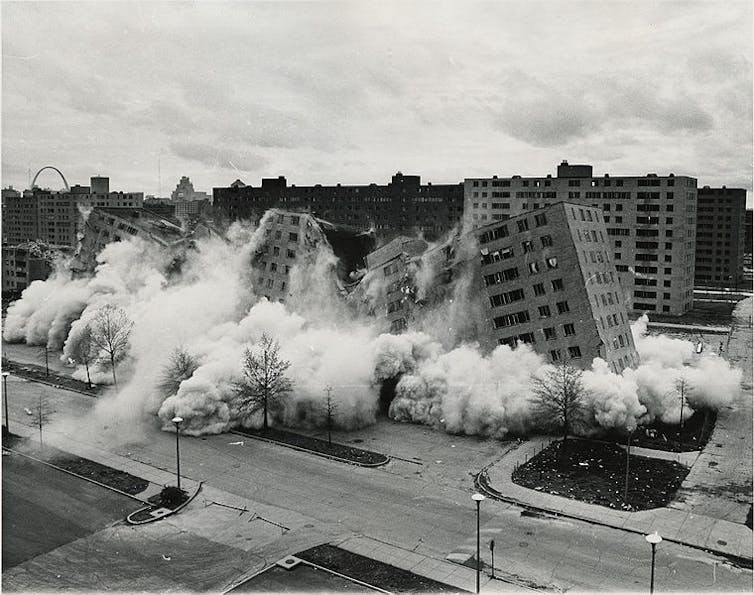
It took a long list of failures over the millennia before postmodern theorists took to critiquing architectural fantasy with malevolent vengeance. The high-point of this trend was the delight shared over the demolition of the famously dangerous and dysfunctional Pruitt-Igoe urban housing complex in St Louis in the US.
It was designed by architects George Hellmuth, Minoru Yamasaki and Joseph Leinweber to provide “community gathering spaces and safe, enclosed play yards.” By the 1960s, however, it was seen as a hotspot for crime and poverty and demolished in the 1970s.
Wikimedia
The loss of faith in architecture’s power has been regrettable. Architects’ well-meant fantasies once routinely provided clients with hope and sometimes even with results.
Without this promise, the profession was left inept before the better structural knowledge of engineers, the cumulative restrictions imposed by generations of planners, the calculations of project-managers and the expediency of a draughtsman’s CAD (computer-aided design) skills in turning a client’s every whim into reality.
Without fiction, architecture has become a soulless thing. But was determinism dismissed too soon? Is there a role for imagined futures without rationalist restrictions?
Restoring the faith
Just think of some of the ways architecture can manipulate your own experience. In his book, Happy City: Transforming Our Lives Through Urban Design, US author Charles Montgomery points out that some environments predictably affect our moods.
The fact is that environments do affect us, regardless of whether by design or by accident. In 2008, researchers in the UK found that a ten-minute walk down a South London main street increased psychotic symptoms significantly.
In my own research, I find that the healthier a person is, the more a good environment will affect them positively and the less a bad one will affect them negatively. Mentally ill patients show about 65 times more negative reactivity to bad environments than controls and all these reactions translate directly into symptoms.
The same patients have about half the positive responsiveness. That’s fewer smiles, less laughter and a reported drop in feeling the “fun of life”.
But that’s not all. The potential for architecture is richer still. The ease with which architecture can embrace sublime aesthetics makes it great for generating awe.
Psychiatrists have found that awe reduces the prevalence and severity of mood disorders. Could sublime architecture even potentially save lives?
The psychological effects of architecture are difficult to prove, but difficulty doesn’t dilute the value of a building that hits the right notes and creates a sense of awe. Each building type has different functions, and for each there’s an imperative to use the building to help create an optimal mood, desire or sense of coherence, security or meaning.

Wikimedia
Fortunately, there’s a resurgence of belief that buildings can change behaviour, led by a few architectural journals: World Health Design, Environment Behavior and HERD.
Most of these focus on health care design, because that’s where behavioural changes have life and death consequences.
But nobody dares make any promises. As such, research rarely opens the black box of environmental psychology, leaving findings unexplained and prone to failure.
To give architecture back its mojo, a new interest in how architecture changes us must be fostered. Clients have to learn to trust architects again and research funding bodies have to re-gear to encourage research into how buildings affect our mood, health and behaviours.
Finally, architecture schools have to teach students how they might predict psychological, emotional, healing and functional effects.
 All innovation, ultimately, is led by the imagination – even if that means taking risks and sometimes getting it wrong.
Jan Golembiewski, Researcher in Environmental Determinants of Mental Health, University of Sydney
This article was originally published on The Conversation. Read the original article.
MIND Diet May Slow Cognitive Decline in Stroke Survivors
Study results presented at the American Stroke Association International Conference
News Releases – Rush University Medical Center
January 25, 2018

A diet created by researchers at Rush University Medical Center may help substantially slow cognitive decline in stroke survivors, according to preliminary research presented on Jan. 25 at the American Stroke Association’s International Stroke Conference 2018 in Los Angeles. The findings are significant because stroke survivors are twice as likely to develop dementia compared to the general population.
The diet, known as the MIND diet, is short for Mediterranean-DASH Diet Intervention for Neurodegenerative Delay. The diet is a hybrid of the Mediterranean and DASH (Dietary Approaches to Stop Hypertension) diets. Both have been found to reduce the risk of cardiovascular conditions such as hypertension, heart attack and stroke.
“The foods that promote brain health, including vegetables, berries, fish and olive oil, are included in the MIND diet,” said Dr. Laurel J. Cherian, a vascular neurologist and assistant professor in Rush’s Department of Neurological Sciences. “We found that it has the potential to help slow cognitive decline in stroke survivors.”
Cherian is the lead author of the study, which was funded by the National Institute of Aging (grant numbers R01AG054476 and R01AG17917).
Study assessed survivors’ cognitive function, monitored their diets
Study co-author Martha Clare Morris, ScD, a Rush nutritional epidemiologist, and her colleagues developed the MIND diet based on information from years of research about what foods and nutrients have good, and bad, effects on the functioning of the brain. The diet has been associated with reduced Alzheimer’s risk in seniors who adhered to its recommendations. Even people who moderately adhered had reduced risk of AD and cognitive decline.
Rush is currently seeking volunteers to participate in the study, which aims to show whether a specific diet can prevent cognitive decline and brain changes with age. Those interested in participating in the study can call (708) 660-MIND (6463) or email mindstudychicago@rush.edu.
The MIND diet has 15 dietary components, including 10 “brain-healthy food groups” and five unhealthy groups — red meat, butter, cheese, pastries and sweets, and fried or fast food.
To adhere to and benefit from the MIND diet, a person would need to eat at least three servings of whole grains, a green leafy vegetable and one other vegetable every day — along with a glass of wine — snack most days on nuts, have beans every other day or so, eat poultry and berries at least twice a week and fish at least once a week. The diet also specifies limiting intake of the designated unhealthy foods, limiting butter to less than 1 1/2 teaspoons a day and eating less than five servings a week of sweets and pastries, and less than one serving per week of whole fat cheese, and fried or fast food.
“I was really intrigued by the results of a previous MIND study, which showed that the people who were most highly adherent to the MIND diet cognitively functioned as if they were 7.5 years younger than the least adherent group,” Cherian said. “It made me wonder if those findings would hold true for stroke survivors, who are twice as likely to develop dementia compared to the general population.”
From 2004 to 2017, Cherian and colleagues studied 106 participants of the Rush Memory and Aging Project who had a history of stroke for cognitive decline, including decline in one’s ability to think, reason and remember. They assessed people in the study every year until their deaths or the study’s conclusion, for an average of 5.9 years, and monitored patients’ eating habits using food journals.
The researchers grouped participants into those who were highly adherent to the MIND diet, moderately adherent and least adherent. They also looked at additional factors that are known to affect cognitive performance, including age, gender, education level, participation in cognitively stimulating activities, physical activity, smoking and genetics.
Related diets not associated with slower cognitive decline
The study participants whose diets scored highest on the MIND diet score had substantially slower rate of cognitive decline than those who scored lowest. The estimated effect of the diet remained strong even after taking into account participants’ level of education and participation in cognitive and physical activities. In contrast to the results of slower decline with higher MIND diet score, stroke survivors who scored high on the Mediterranean and DASH diets, did not have significant slowing in their cognitive abilities.
“The Mediterranean and DASH diets have been shown to be protective against coronary artery disease and stroke, but it seems the nutrients emphasized in the MIND diet may be better suited to overall brain health and preserving cognition,” Cherian said.
According to Cherian, studies have found that folate, vitamin E, omega-3 fatty acids, carotenoids and flavonoids are associated with slower rates of cognitive decline, while substances such as saturated and hydrogenated fats have been associated with dementia.
The right foods may protect stroke survivors’ cognition
“I like to think of the MIND diet as a way to supercharge the nutritional content of what we eat. The goal is to emphasize foods that will not only lower our risk of heart attacks and stroke, but make our brains as resilient as possible to cognitive decline,” she said.
“Our study suggests that if we choose the right foods, we may be able to protect stroke survivors from cognitive decline.” Cherian cautions, however, that the study was observational, with a relatively small number of participants, and its findings cannot be interpreted in a cause-and-effect relationship.
“This is a preliminary study that will hopefully be confirmed by other studies, including a randomized diet intervention study instroke survivors,” she says. “For now, I think there is enough information to encourage stroke patients to view food as an important tool to optimize their brain health.”
If you develop Alzheimer’s, will your children get it too?
Rebecca Sims, Cardiff University
The most common question I get asked is “Will my child get Alzheimer’s disease?” In my experience, this concern is one of the biggest worries for sufferers, and given the devastating effects of the disease, it is not hard to see why it is a difficult thought to contemplate.
For those people with a familial form of Alzheimer’s disease, the answer is quite straightforward. This type of disease is caused by one or more mutation(s) in one of three genes: the amyloid precursor protein (APP), Presenilin 1 (PSEN1) and Presenilin 2 (PSEN2). All of these genes are involved in the production of the amyloid protein. This protein accumulates to form sticky buildups known as plaques, which are found between the cells of the Alzheimer brain and are characteristic of disease.
Those of us who are concerned that they may be at risk from familial Alzheimer’s disease can get a definitive answer through one of the many genetic tests available. A single copy of the mutated gene inherited from an affected parent will ultimately cause disease, with symptoms likely to be noticed before the age of 65 and typically between 30 and 60 years of age. Anyone concerned that they may suffer from this form of Alzheimer’s should seek a referral to a genetic counsellor.
Fortunately, families with a familial form of disease represent less than 1% of all families afflicted by this debilitating disease. For the remaining Alzheimer’s disease families, the answer as to the inheritance of disease is much less clear, and disease onset is certainly not inevitable.
Influencing disease
A combination of both genetic and environmental factors, such as age and gender, contribute to non-familial (also known as sporadic) disease risk, but how these risk factors interact and how many risk factors are required to cause disease is still unknown.
The genetics of non-familial Alzheimer’s is complex: we know that nearly thirty genes, common in the general population, influence disease risk, with potentially hundreds more involved. Additionally, two genes of low frequency have consistently been identified, with an imminent publication by the International Genomics of Alzheimer’s Project, showing another two rare genes have a relatively large effect on disease risk.
Perhaps most excitingly for researchers, genetics scientists have shown that four biological processes in Alzheimer’s disease – that were not previously thought to play a casual role in disease onset – are actually involved. The first process is the immune response, in particular the actions of immune cells and how these potentially dysfunction, attacking the brain, which results in brain cell death.
The second is the transport of molecules into the cell, suggesting that there is a mechanism for the movement of damaging proteins into the brain. The third process that has a role in the onset of Alzheimer’s is the synthesis and breakdown of fatty molecules. And the fourth is the processing of proteins that alters protein breakdown, movement, activity and interactions – all of which are essential for normal protein function.

Lifestyle risk
Age is the greatest risk factor for disease, with the likelihood of developing Alzheimer’s roughly doubling every five years over the age of 65. Women also have more chance of developing the disease than men, potentially due to a reduction in female hormones after menopause.
Medical conditions that increase risk for dementia include cardiovascular factors (type 2 diabetes, high blood pressure, cholesterol levels, and obesity), and depression. While lifestyle factors such as physical inactivity, a diet that increases cholesterol, smoking and excessive alcohol intake, have all been shown to influence disease risk.
Even for those with a high number of genetic, environmental and lifestyle risk factors, Alzheimer’s disease is not inevitable. Likewise, individuals with a low number of risk factors for disease are not precluded from developing Alzheimer’s.
Given this lack of certainty and the lack of effective treatments for Alzheimer’s, most experts don’t recommend genetic testing for non-familial disease. This thinking may well evolve in the future, however, when research identifies new risk genes and improves our understanding of the dysfunctional processes in Alzheimer’s disease.

Answering the burning question, whether you will pass Alzheimer’s disease on to your children, is therefore still a near impossibility. But, as early diagnostic techniques improve, and with the prospect of a number of vaccines and therapeutics currently in clinical trials, risk prediction for Alzheimer’s disease may become mainstream and part of a developing precision medicine culture.
Rebecca Sims, Research Fellow, Division of Psychological Medicine and Clinical Neurosciences, Cardiff University
This article was originally published on The Conversation. Read the original article.
 Designing for Aged Care