Posted in Caregiving, The Built Environment

Broken bones & osteoporosis might be a thing of the past!

How many times have we heard Falls and broken bones are one of the scariest things in aged care, the pain and impacted quality of life and not to mention the mortality rate that goes with it.

I saw this cool video on Youtube on Bone-foam, an Injectable bone-filling glue that sets pretty quickly and revolutionising the painful and cumbersome healing process of broken bones for everyone. I hope this will help make the long painful process of broken bones and osteoporosis history!

Posted in Ageing & Culture, Caregiving, International Policies, The Built Environment

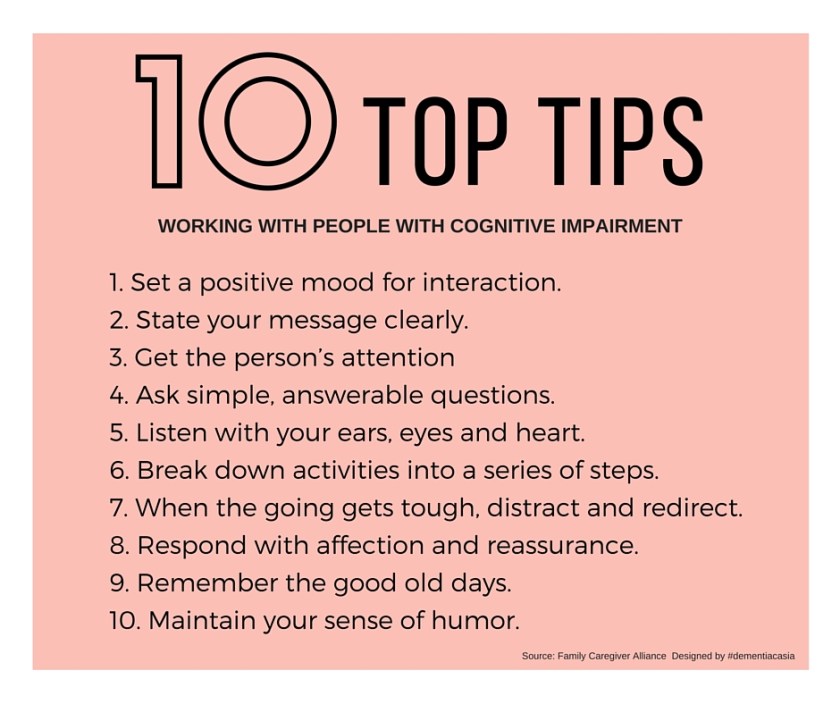
10 Tips for Communicating with a Person with Dementia 

A really practical and simple article with tips from the Family Caregiver Alliance for staff and caregivers working with people with dementia. The article provides advice on communication and understanding changes in behaviours. With additional information on supporting a person with dementia to manage nutrition, hygiene, and incontinence.

I found the top 10 tips for communication very helpful and made a little facebook post sized image to help share these very practical caregiver tips with friends and colleagues. You can also print it out and pin it on the pinboards at the nurses station.

20

These tips are just straightforward and realistic, and transcend the boundaries of culture and language.  I made some changes and replaced the word dementia with cognitive impairment because I thought the nurses on the neuro wards, or even care managers working with people with traumatic brain injuries may also find these tips very handy.

Source: Caregiver’s Guide to Understanding Dementia Behaviors | Family Caregiver Alliance

Posted in Ageing & Culture, International Campaigns, Research & Best Practice, The Built Environment

Australia Online Dementia Support Website

Alzheimer’s Australia Victoria launched an online dementia support website (http://www.helpwithdementia.org.au/) that brings together health services such as counselling, public health education and social programmes for people living with dementia, their families and carers through the web.

Given that 85% of general internet users in Australia utilise the net for communication activities, research and networking, it is only logical that health services for people with dementia and their significant others should extend to the web (Australian Communications and Media Authority 2015).

The great thing about online technology is that everything is literally at your fingertips. Especially for the tech saver person with dementia or caregiver. I know some of the readers are thinking; people who are older adults are not tech savvy. That is not true. 46 percent of older adults in Australia are already internet users (Australian Bureau of Statistics 2014). This platform (http://www.helpwithdementia.org.au/) is a life saver. Face to face services are no doubt great for people who can make the time and effort to travel for a session.

The ease of having services in the comfort of your own home is great. Going for services is really stressful and sometimes people or service providers forget that. There’s the stress of making time to travel, arranging transport, the stress of leaving your loved one alone, the anxiety experienced during the process of travelling, worrying about the cost of travel, taking time off from work or from an important social responsibility (Looking after your grandkids), the list goes on.

There are 50 million and one things to worry about. With an online site, I could be reading or watching about information on dementia sitting on the couch with my loved one or even just in my pyjamas in bed. There’s apparently 16 expert videos available on the site to help people understand about dementia.

There’s counselling that can be done through e-mail or there’s the option of a video conference. Or if you like to keep it casual there’s always the forum where you can hook up with a social network and exchange thoughts and read about people’s experiences on specific topics.

An online support platform is a great idea, and I hope to see more platforms that can cater to the needs of the online community. Youths and children these days are much more connected than I am and perhaps this medium might also be a way to connect to the younger generation to spread the news about having a healthier happier brain. Health prevention campaigns really need to take their heads out of the sand in tech-savvy countries, save the trees and really understand the people. Traditional means of health promotion is important but we also have to embrace the new wave of social media and technology and extend our care into the digital realm.

Source: Home – Alzheimer’s Australia Vic

Posted in Caregiving, The Built Environment

If I could only buy 1 book in 2016, this is it.

If I could buy one book this year, this would be it. Kate Swaffer is certainly an inspiration, her courage, strength and perserverence has broken the stigma of dementia. Starting out with a strong and meaningful dialogue, she shares with the world her diagnosis of dementia, her advantures, inspirationals and philosophioes in life; this is just a start. She has gone back to university and completing a Masters in Dementia Care from the university of Wollongong. She educates students on young onset dementia in the Wicking Dementia Centre Understanding Dementia Massive Open Online Course (MOOC), which has had more than 40,000 students worldwide. She’s also a key member of the Dementia Alliance International and I can’t even begin to list the number of awards she has attained and the number of communities and people that she has inspired.

If I could only get 1 book in 2016. This will be it.

Source: Updated book release date: January 21st, 2016

Posted in Ageing & Culture, Caregiving, International Policies, The Built Environment

Chair Zumba for a sharper mind and body

Found this heartwarming piece of news about a group of women in their 90s living in America, Seattle who come together for Chair Zumba weekly to keep their mind and body active. You can read more about the article below, there’s a video about the ladies and their Chair Zumba classes here http://komonews.com/news/healthworks/music-and-movement-exercise-may-stave-off-dementia.

chair zumba

I’ve also linked a small clip about a Chair Zumba session below.

Do we have a Zumba instructor in Singapore, Taiwan, Hong Kong, Korea, japan or China willing to organise classes? Victoria Lum’s chair Zumba classes certainly looks pretty cool.

Posted in Ageing & Culture, Caregiving, International Policies, The Built Environment

Experience how a person with dementia grapple with complex flooring patterns

This has been going around the web for the last couple of weeks and everyone has been all over it trying to find the panda among the snowman or the cat among the owls. It has been a fun experience for most of us and for some it may be quite frustrating. Some people who are able to find the cat or the panda have posted bragged about how quickly they may have found it on facebook.

We know this happens and we talk about how confusing complex flooring patterns can be for people with dementia. They may not be able to distinguish the area and may have difficulties walking around. Imagine if you had dropped your keys on the floor or a purse on a carpet

carpet-100089_640.jpg

It would be like looking for the animals in these pictures. See if you can find the panda in the first picture and the cat in the second. .

1. Find the Panda above in the midst of the snowman.

2. Find the cat in the sea of owls.

Images created by Gergely “Dudolf” Dudás and more images can be found on Dudolph’s Facebook page.

Researchers are still trying to work out how the brain tries to categorise objects. The latest breakthrough came from Monash University where researchers are trying to utilise a new imaging technique known as the semantic wavelet-induced frequency-tagging (SWIFT) to help us find the answers (Koenig-Robert et al. 2015).

If you are caring for someone with dementia or working with people with dementia, please stop and have a think about the type of flooring and perhaps these principles from  Prof. Richard Fleming and Kirsty Bennett, University of Wollongong might come in really handy in the decision making process.

  • Reduces unhelpful stimulation
  • Optimise helpful stimulation
  • Support movement and engagement

Just trying to find the panda and the cat may be somewhat easy or really quite frustrating for some. It will take a couple of seconds at least and that is the situation that that people experiecing cognitive impairment have to grapple with when they come up against environments of complex designs. We have to take our current experience with hunting for the panda or cat and multiply that by ten or even a hundred folds. So before you choose that intricately design carpet for your flooring, please stop and think if the choice you are making is an inclusive one for people with dementia.

References:

Fleming R, Bowles J. Units for the confused and disturbed elderly: Development, Design, Programmimg and Evaluation. Australian Journal on Ageing. 1987 November;6(4):25-8.

Fleming R, Forbes I, Bennett K. Adapting the ward for people with dementia. Sydney: NSW Department of Health; 2003.

Koenig-Robert R, VanRullen R, Tsuchiya N (2015) Semantic Wavelet-Induced Frequency-Tagging (SWIFT) Periodically Activates Category Selective Areas While Steadily Activating Early Visual Areas. PLoS ONE 10(12): e0144858.