A documentary on dementia by @Justinbratton6 featuring Alzheimers Disease Association in Singapore, touching on dementia environmental design.
The information provided by Justin Bratton is very informative especially on how Japan is coping with providing care for living with dementia and the programs that they have formulated such as dementia friendly caravan, dementia friendly malls, banks etc.
I love the intergenerational program with the older adults with dementia and the pre-school kids. It’s so lovely to see that sense of connection and a program that breaks the boundaries and stigma of dementia.
1 in 10 Singaporeans over 60 have dementia. This number is set to rise quickly. Are we prepared for the onslaught? Justin Bratton experiences what life is like when warped by dementia. He heads to Japan to find out how the entire country is being mobilized to create a dementia friendly nation.
A great video by the BBC providing a historical perspective on dementia and Alzheimer’s Disease. The video touches on the world’s first Alzheimer’s patient. A good resource for students or anyone who wishes to understand the historical background and origins of this disease.
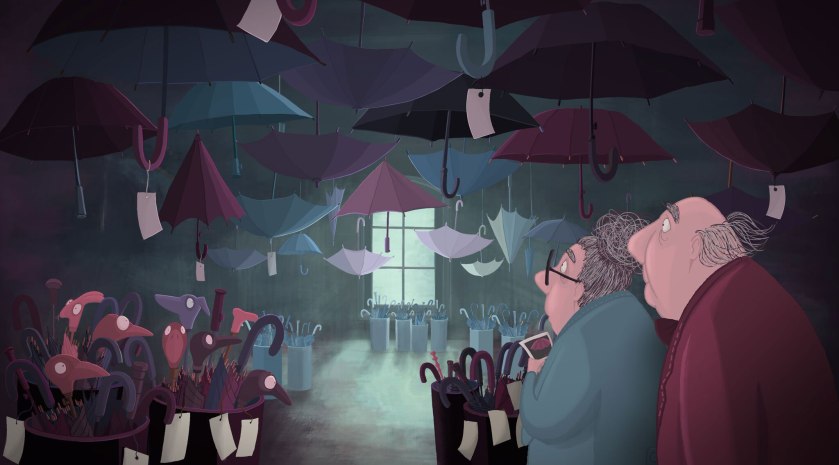
For those who have been involved in remembering together activities such as memory books, photo books or a life story work in dementia care. This short film will move you to tears. It’s enchanting, beautiful and it can’t help but tug at your heart strings. This short film has transformed the lived experience of the everyday memory book activity into a work of art that transcends the screen.
“I think I really wanted to set out to make a film that would touch people, both visually and emotionally. To explore a subject that is tragic but give it hope and tell the story in as beautiful way as possible. I hope I have achieved that, that would be my dream.” – Åsa Lucander
This is a critical piece of news and everyone should know about. There are good resources for brain training and we have misleading resources out there that tarnish the names of good legit programmes.
Lumos Labs, developer of Lumosity “brain training” games, will pay $2 million to settle accusations it misled customers about the cognitive benefits of its apps.
Lumos Labs, the developer of Lumosity “brain training” games, will pay $2 million to settle accusations it misled customers about the cognitive benefits of its online apps and programs. The Federal Trade Commission said on Tuesday that ads deceptively suggested that playing the games a few times a week could increase work and school performance, and even delay conditions like dementia. Lumos Labs must contact customers and offer them an easy way to cancel their subscriptions, which range from $15 to $300. The $2 million will be refunded to customers. Jessica L. Rich, director of the F.T.C.’s Consumer Protection Bureau, said the company “simply did not have the science to back up its ads.” Only products that have been reviewed by the Food and Drug Administration can claim to treat or prevent serious diseases or conditions.
How can we create meaningful and sustainable rooftop gardens. For all the city dwellers reading this, it’s probably no surprise when you see a roottop garden looking tired and dried out after a while, people tend to potter around abit when the garden is first developed but it gets left lonely after a while. People start complaining about the heat in the garden, there is not much to do but wander around in the head. Staff finds that it’s too much of a pain and it get left unattended and left in the wayside. Before you know you the rooftop garden is an empty space with a few giant empty plant pots like hollowed sad eye staring at the sky.
Modern rooftop gardens look great in million dollar condominiums, hospitals and shopping malls. Very flashy and fresh with a multitude of plants, but for a nursing home or an agedcare facility, these are not temporary living spaces, there are people’s homes, where they spend a good number of years in their life. The space is needs to be much more then just therapeutic eye candy. It has to give meaning and purpose, to provide social activities, engagement and movement.
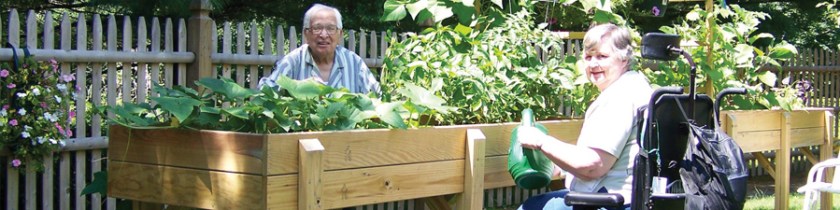
If you lived in an aged care facility don’t you want to be part of a garden that you feel that you can give life to, to contribute to growth, where the people who care for you can benefit from your work despite living with a chronic health condition and requiring much care. You don’t want to stare at people tending to the garden remaining you of restrictions, your loss of function and dignity. You want to be part of the action, to feel life in your hands, and to support growth in another.
Creating the right environment, a rooftop greenhouse or farm in an aged care facility can bring together staff and residents in a healthy and meaningful social activity. To grow sustainable, fresh and delicious produce for their own facility for everyone instead of eating produce that travelled 500kms from an unidentified farm using unknown chemicals and farming methods that you wouldn’t want to know about. Where families can join in and even students from community programmes.
I found this cool local website easigardens that promotes vegetable kits in Singapore and provide a range of vegetables like spinach, kang kong, xiao bai cai etc.
Rooftop greenhouses are a great sustainable idea for everyone. Anyway before I sign off, here are some videos that provide you the who, where, what, why and how regarding the concept, design and application of a rooftop greenhouse in urban residential living.
Let’s create an Inclusive not reclusive environment!
“It was once said that the moral test of government is how that government treats those who are in the dawn of life, the children; those who are in the twilight of life, the elderly; and those who are in the shadows of life, the sick, the needy and the handicapped.”
– Hubert H. Humphrey
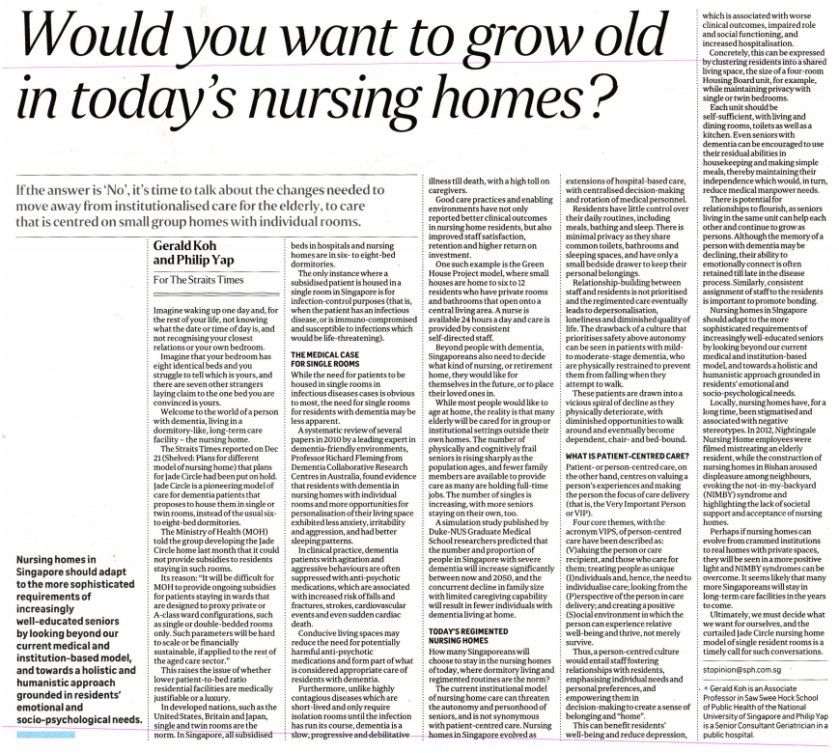
Appears that single bedrooms for people with dementia in nursing homes are considered a luxury in Singapore.
This is a brilliant article by Dr Philip Yap and Dr Gerald Koh, and Singapore needs a serious conversation about how we can respectfully treat our elders with dignity.
How do want to care for our loved ones when they grow older? Singaporeans echo the fact that nursing homes are restrictive, institutionalised and lack personal care (Wee et al. 2015). Do we really want anyone we love to live the last years of their life an acute like facility, watching their neighbours beside them cognitively regress as a result of the tension and depression of the unfamiliar, undignified, and restrictive environment? What sort of morals and values will our children inherit when they are exposed to ideas that privacy, dignity, independence and quality of life is deemed a luxury for our elders living with a terminal condition? Are nursing homes, Singapore’s very own wooden bowl?
We need to do more to become a more inclusive Singapore.
Here’s some additional information about dementia.
“People with dementia are frequently denied the basic rights and freedoms available to others. In many countries, physical and chemical restraints are used extensively in care facilities for elderly people and in acute-care settings, even when regulations are in place to uphold the rights of people to freedom and choice.
An appropriate and supportive legislative environment based on internationally accepted human rights standards is required to ensure the highest quality of service provision to people with dementia and their caregivers.” (Source: WHO 2015)
Reference:
Wee, S.-L. et al., 2015. Singaporeans’ perceptions of and attitudes toward long-term care services. Qualitative health research, 25(2), pp.218–27.

 1 in 10 Singaporeans over 60 have dementia. This number is set to rise quickly. Are we prepared for the onslaught? Justin Bratton experiences what life is like when warped by dementia. He heads to Japan to find out how the entire country is being mobilized to create a dementia friendly nation.



 Designing for Aged Care