

–Vera Nazarian
Reading can bring us happiness, increase empathy and give us the confidence we need. Scientific America published an article suggesting the data from a study conducted by social psychologist Emanuele Castano in New York found that reading literary fiction can improve our levels of empathy and social skills. This way we are able to relate better with others and build stronger, lasting and meaningful relationships and impact how happy we feel.
Reading can also change alter our neuron connectivity in a positive way as seen in the video below. In another study led by neuroscientist Gregory Berns, (Director of Emory University’s Center for Neuropolicy) he found that a novel can transport the reader into the shoes of the protagonist, not just figuratively but from a biological aspect as well. Reading about something that we may want to do might actually make us more confident in the execution of the action.
We keep reading, both in good times and bad; because reading can really help to improve our confidence, cognition, empathy and happiness.
Keep reading!
Life is a constant learning journey; and in this book by Stanford University psychologist Carol Dweck, she has distilled her decades of research into a book to help people to achieve more by thinking about the power of our mindset and how we can improve it. Have a look at the Fixed vs Growth Mindset below and in her book she goes on to talk about how we can rewire our mindets to become better at what we do.
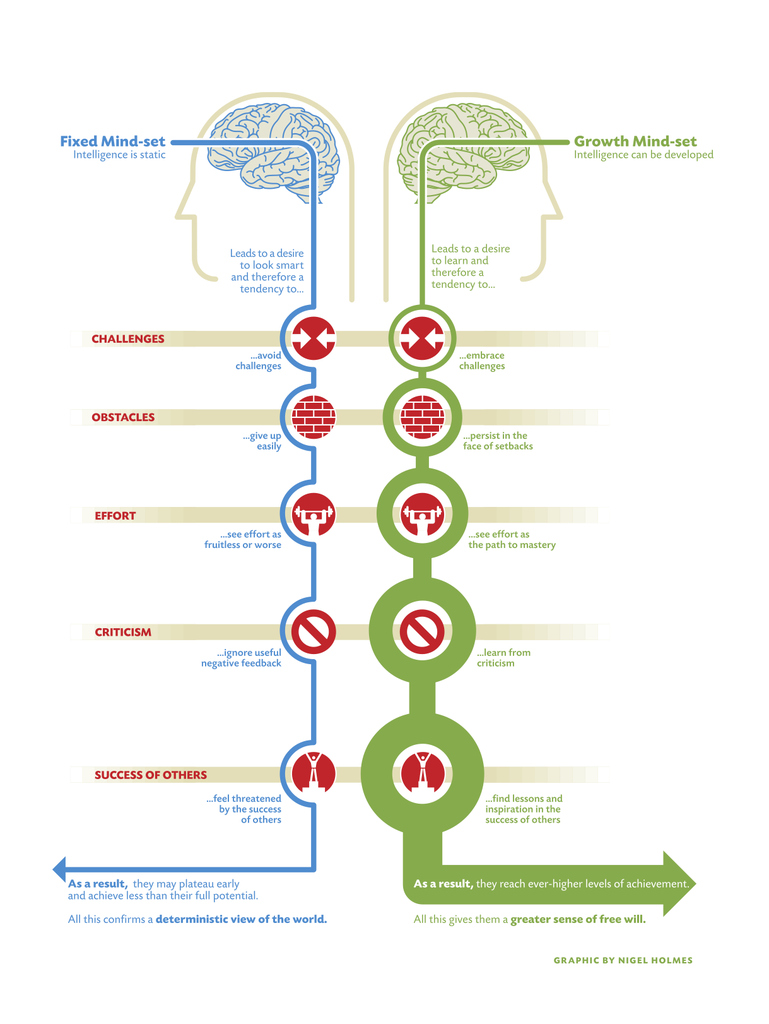
How to fine-tune the internal monologue that scores every aspect of our lives, from leadership to love.
Read more about it here: Fixed vs. Growth: The Two Basic Mindsets That Shape Our Lives – Brain Pickings
A touching story of the lives of Bill and Glad, who soldier on with love in the face of dementia. When the going get tough, they just keeping loving.

Paul and Alice Padilla, at left, during a recent Momentia walk through Woodland Park Zoo in Seattle. Alice, 63, was diagnosed with dementia two years ago.
Credit: Betty Udesen
Alice Padilla’s laugh cut through the air at Seattle’s Woodland Park Zoo. Fresh off an hour-long exhibit tour, she and 16 other friends sat in the zoo cafeteria, snacking on sugar cookies and mocking current bestsellers. The group could appear to be just another cluster of friends visiting the zoo. But they were there for another purpose, too: to provide joy as much as support. Part of a program called Momentia, more than half of the people in the group have dementia.
The day was, in effect, an act of defiance for the 63-year-old Padilla, who was diagnosed with dementia two years ago. By living wholly in the present, Padilla is fighting a disease that threatens to rob her of her memory.
The zoo trip was just one of a series of Seattle-area group activities, from strum and drum bands and rap performances to cafe talks and public policy advocacy, organized for Momentia members. Marigrace Becker, the program manager for the University of Washington Medicine Memory and Brain Wellness Center, co-founded Momentia three years ago to challenge the misconceptions typically associated with dementia.

Alice and Paul Padilla, standing, sing with fellow members of the Momentia Strum & Drum Band during Camp Momentia, an annual gathering in West Seattle for dementia patients and their families. “When you have these kind of people who watch out for each other, you can enjoy your life,” said Alice. YES! Photo by Betty Udesen.
According to the Alzheimer’s Association, by 2050, the number of people age 65 and older with Alzheimer’s disease may nearly triple, from 5.1 million today to a projected 13.8 million. The estimate makes Momentia an imperative for Becker. She spent years volunteering with dementia support groups and, after brainstorming words that rhymed with the condition, came up with “Momentia” to capture the idea of celebrating life in the moment. Becker wanted more than a social service; she wanted empowerment.
“I was envisioning it more like the Occupy movement, [which] galvanizes people and energizes them to have a voice, to build dementia-friendly communities in their own ways,” she said.
While there is no cure for dementia or Alzheimer’s, studies suggest strong social ties can help ward off the diseases’ advance.
That was the goal of another event on a balmy Sunday in September, when more than 100 people with dementia and their families gathered in West Seattle for Camp Momentia. Becker said the annual event recognizes the “staying power” of those touched by the disease.
Padilla was among them. She joined in drumming and square dancing and then capped off the day with a group rendition of “When the Saints Go Marching In.” Her petite frame marched around the large circle of singing campers as they laughed at her impersonation of a Mardi Gras drum major.
“I am not sad or angry,” she said later. “I don’t have any of that because those things are easy to be if you have Alzheimer’s. When you have these kind of people who watch out for each other, you can enjoy your life.”
And with that, her laugh rose through the air once more.
Reblogged from: How Strong Friendships Defy Dementia by Marcus Harrison Green — YES! Magazine
 Designing for Aged Care