Posted in The Built Environment

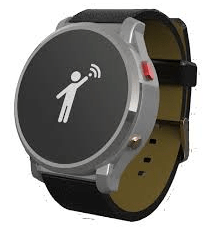
Finally! A decent looking watch that has a GPS tracker, fall detection and medical alert

Finally, a decent looking watch that has a GPS, fall detection and a medical alert or duress alarm. I stumbled on this website surfing for wearable devices. The Find-Me Tunstall Watch actually combines a “mobile phone, panic alert, fall detector and GPS tracker” all into one wearable decent looking device. This is according to their website. It looks really new at the moment and they don’t seem to have a web store or anything for it. I just hope that it will be publicly available soon and for an international market.

watch.png


Source: Find-Me Tunstall Watch

Posted in The Built Environment

Hongkong’s 1st Non-subsidised Apartment for Seniors

Saw this article on Hongkong’s first non-subsidised apartment for seniors and it looks promising. Ranging from $230,000 USD 2 million USD, this Tanner Hill Project provides a range of choices when it comes to the types of apartments, from a studio apartment, to combined units. It promises something for everyone. Read more about it below.

Source: First non-subsidised apartment leases for seniors cost up to HK$20m | Hong Kong Free Press


Posted in Ageing & Culture, Caregiving, Research & Best Practice, The Built Environment

Singapore nursing homes, our story of the wooden bowl?

“It was once said that the moral test of government is how that government treats those who are in the dawn of life, the children; those who are in the twilight of life, the elderly; and those who are in the shadows of life, the sick, the needy and the handicapped.”
– Hubert H. Humphrey

Appears that single bedrooms for people with dementia in nursing homes are considered a luxury in Singapore.

Untitled


This is a brilliant article by Dr Philip Yap and Dr Gerald Koh, and Singapore needs a serious conversation about how we can respectfully treat our elders with dignity.
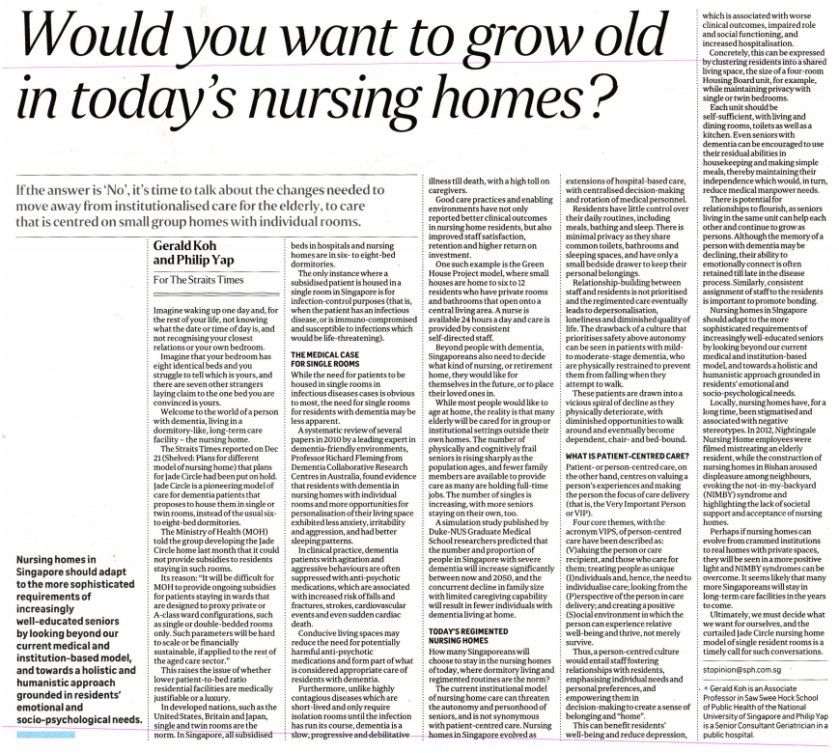
Srtaitstimes

How do want to care for our loved ones when they grow older? Singaporeans echo the fact that nursing homes are restrictive, institutionalised and lack personal care (Wee et al. 2015). Do we really want anyone we love to live the last years of their life an acute like facility, watching their neighbours beside them cognitively regress as a result of the tension and depression of the unfamiliar, undignified, and restrictive environment? What sort of morals and values will our children inherit when they are exposed to ideas that privacy, dignity, independence and quality of life is deemed a luxury for our elders living with a terminal condition? Are nursing homes, Singapore’s very own wooden bowl?

We need to do more to become a more inclusive Singapore.


Here’s some additional information about dementia.

Did you know?

Dementia is a terminal condition with no cure (World Health Organisation 2015).

“People with dementia are frequently denied the basic rights and freedoms available to others. In many countries, physical and chemical restraints are used extensively in care facilities for elderly people and in acute-care settings, even when regulations are in place to uphold the rights of people to freedom and choice.

An appropriate and supportive legislative environment based on internationally accepted human rights standards is required to ensure the highest quality of service provision to people with dementia and their caregivers.” (Source: WHO 2015)

Reference:

Wee, S.-L. et al., 2015. Singaporeans’ perceptions of and attitudes toward long-term care services. Qualitative health research, 25(2), pp.218–27.

Posted in Caregiving, The Built Environment

Broken bones & osteoporosis might be a thing of the past!

How many times have we heard Falls and broken bones are one of the scariest things in aged care, the pain and impacted quality of life and not to mention the mortality rate that goes with it.

I saw this cool video on Youtube on Bone-foam, an Injectable bone-filling glue that sets pretty quickly and revolutionising the painful and cumbersome healing process of broken bones for everyone. I hope this will help make the long painful process of broken bones and osteoporosis history!

Posted in Ageing & Culture, Caregiving, International Policies, The Built Environment

10 Tips for Communicating with a Person with Dementia 

A really practical and simple article with tips from the Family Caregiver Alliance for staff and caregivers working with people with dementia. The article provides advice on communication and understanding changes in behaviours. With additional information on supporting a person with dementia to manage nutrition, hygiene, and incontinence.

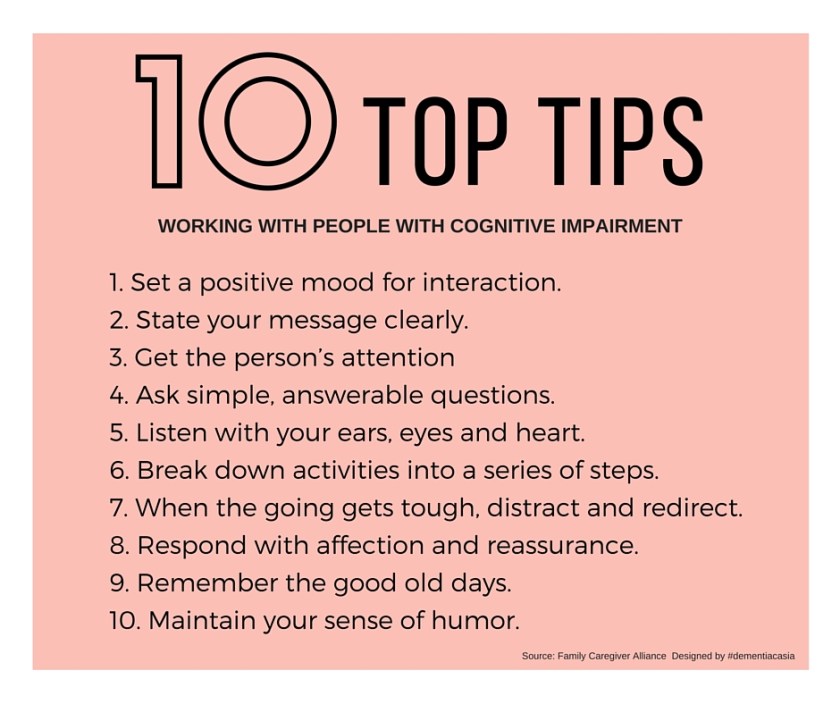
I found the top 10 tips for communication very helpful and made a little facebook post sized image to help share these very practical caregiver tips with friends and colleagues. You can also print it out and pin it on the pinboards at the nurses station.

20

These tips are just straightforward and realistic, and transcend the boundaries of culture and language.  I made some changes and replaced the word dementia with cognitive impairment because I thought the nurses on the neuro wards, or even care managers working with people with traumatic brain injuries may also find these tips very handy.

Source: Caregiver’s Guide to Understanding Dementia Behaviors | Family Caregiver Alliance

Posted in Ageing & Culture, International Campaigns, Research & Best Practice, The Built Environment

Australia Online Dementia Support Website

Alzheimer’s Australia Victoria launched an online dementia support website (http://www.helpwithdementia.org.au/) that brings together health services such as counselling, public health education and social programmes for people living with dementia, their families and carers through the web.

Given that 85% of general internet users in Australia utilise the net for communication activities, research and networking, it is only logical that health services for people with dementia and their significant others should extend to the web (Australian Communications and Media Authority 2015).

The great thing about online technology is that everything is literally at your fingertips. Especially for the tech saver person with dementia or caregiver. I know some of the readers are thinking; people who are older adults are not tech savvy. That is not true. 46 percent of older adults in Australia are already internet users (Australian Bureau of Statistics 2014). This platform (http://www.helpwithdementia.org.au/) is a life saver. Face to face services are no doubt great for people who can make the time and effort to travel for a session.

The ease of having services in the comfort of your own home is great. Going for services is really stressful and sometimes people or service providers forget that. There’s the stress of making time to travel, arranging transport, the stress of leaving your loved one alone, the anxiety experienced during the process of travelling, worrying about the cost of travel, taking time off from work or from an important social responsibility (Looking after your grandkids), the list goes on.

There are 50 million and one things to worry about. With an online site, I could be reading or watching about information on dementia sitting on the couch with my loved one or even just in my pyjamas in bed. There’s apparently 16 expert videos available on the site to help people understand about dementia.

There’s counselling that can be done through e-mail or there’s the option of a video conference. Or if you like to keep it casual there’s always the forum where you can hook up with a social network and exchange thoughts and read about people’s experiences on specific topics.

An online support platform is a great idea, and I hope to see more platforms that can cater to the needs of the online community. Youths and children these days are much more connected than I am and perhaps this medium might also be a way to connect to the younger generation to spread the news about having a healthier happier brain. Health prevention campaigns really need to take their heads out of the sand in tech-savvy countries, save the trees and really understand the people. Traditional means of health promotion is important but we also have to embrace the new wave of social media and technology and extend our care into the digital realm.

Source: Home – Alzheimer’s Australia Vic