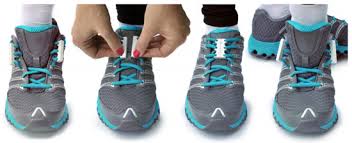
Everyone knows someone who loves their sneakers, unfortunately, sneakers and shoelaces have always been a real hassle, a trip hazard and a perpetual pain in the bottom when they keep coming lose. Saw this on facebook posted by a mate of mine. Looks like a good solution to those annoying shoelaces that keeps coming untied.
How Vitamin D can protect your Brain
For a lot of us Asians, we want fair, smooth porcelain skin, much like our yummy soft tofu or beancurd puddings that we eat as a staple. A student from an article by Martin (2010), when asked about fairer skin was quoted as saying “If my skin is lighter, I will be happier because I think I look good. It makes my emotion better, yes.” Just walking into Changi airport, I was swamped with numerous skin whitening products. Even when I went to Sephora at ION Orchard, the person at the MAC counter recommended a “brighter” foundation for my tan skin colour. When I am out and about on a hot day with my adorable mum, out pops the umbrella to shield her against the rays of the sun preventing her from getting a T-Shirt tan. Walking along Orchard road, it is no surprise to see umbrellas popping out on a hot day, where the streets are drenched with sunlight. 
Sunlight is a good source of Vitamin D and we really shouldn’t be straying away from it. A recent study conducted by Duke-NUS Medical school on Chinese elderly in Singapore; found that Vitamin D can help to maintain a healthy brain. Individuals with low Vitamin D levels are 2-3 times more at risk of cognitive impairment.
So what is Vitamin D and where can we get it?
Vitamin D is synthesised when our skin is exposed to ultraviolet or UV rays from the sun. Vitamin D can also be found as a supplement that is available at the chemist,pharmacies and in some foods. However, before we rush to consume copious amounts of vitamin D tablets or get a sunburn, there are some things that we need to consider.
We need to take everything in moderation and too much Vitamin D has potential adverse effects on our body as seen in Table 1 below from the US Department of Health and Human Services. The table also provides some information on the recommended levels of Vitamin D. Get your Vitamin D levels checked out with your local General Practitioner (GP) to find out what your recommended daily allowance should be before starting on supplements.
| nmol/L** | ng/mL* | Health status |
|---|---|---|
| <30 | <12 | Associated with vitamin D deficiency, leading to rickets in infants and children and osteomalacia in adults |
| 30 to <50 | 12 to <20 | Generally considered inadequate for bone and overall health in healthy individuals |
| ≥50 | ≥20 | Generally considered adequate for bone and overall health in healthy individuals |
| >125 | >50 | Emerging evidence links potential adverse effects to such high levels, particularly >150 nmol/L (>60 ng/mL) |
* Serum concentrations of 25(OH)D are reported in both nanomoles
per liter (nmol/L) and nanograms per milliliter (ng/mL).
** 1 nmol/L = 0.4 ng/mL
Source: Institute of Medicine, Food and Nutrition Board. Dietary Reference Intakes for Calcium and Vitamin D. Washington, DC: National Academy Press, 2010.
What are some foods that contain Vitamin D?
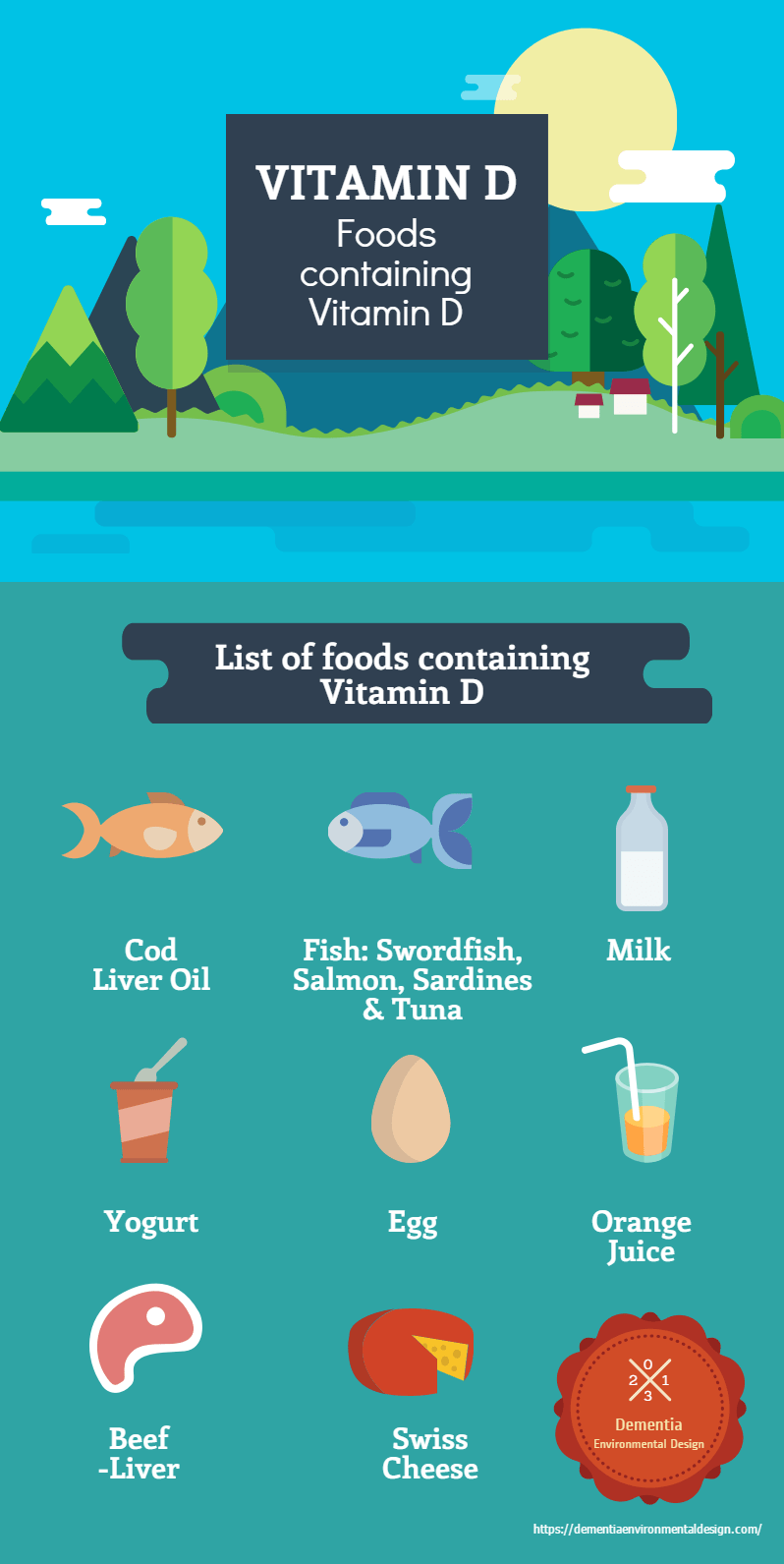
Several food sources of vitamin D are listed in the infographic below.

Source: U.S. Department of Agriculture, Agricultural Research Service. 2011. USDA National Nutrient Database for Standard Reference, Release 24. Nutrient Data Laboratory Home Page,http://www.ars.usda.gov/ba/bhnrc/ndl
.
Please note that Jo does not work or receive any funding from the company or organisation in this article.
Taking a leaf from HDB flats for Pocket Gardens & Intergenerational Nursing Homes
I recently visited a friend living at Dawson and was really surprised at the gardens located on the upper floors of the housing development board (HDB) flat. There was a sky garden right up the top, but there were gardens found in between the floors as well. There isn’t a void deck in the traditional sense like the older flats would have, instead there are familiar seating areas found in these pocket gardens for the residents which are just like a void deck but with a beautiful view of Singapore filled with a range of greenery that stimulate the senses.
There’s safety and security features found in the garden as well, from lighting, to security cameras, handrails, and high vertical railings. For most parts the garden I visited was sheltered from the weather. There were even play area for kids.
I’ve got a few images of the gardens to share with everyone.
Security Cameras, Handrails & Railing

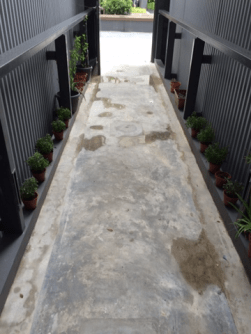
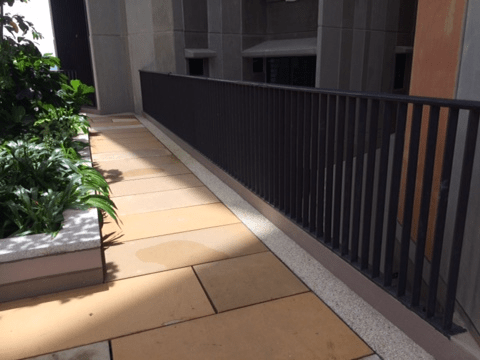
The image below on the left is from a separate HDB block. I added this image in because this was actually a bridge from the HDB flats to the garden. Residents have personalise the bottom of the handrails with little plants of their own on this bridge. The path is open to rain and other environmental conditions, however, the design intrigued me as the gardens are separate from the residents providing me thoughts on how we can link intergenerational services in one facility.
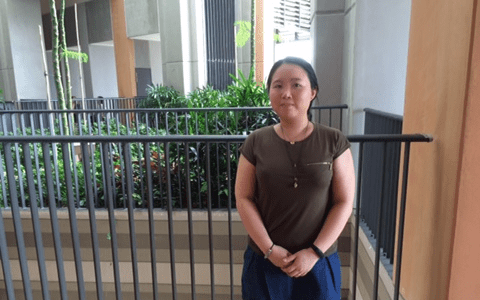
The railing are really high too, approximately 1.3m in height, but enough that doesn’t have a caged in feel. I understand a lot of clinical staff would be concern about safety in nursing homes especially in the gardens. You can see behind me that an array plants have been strategically placed in front of the railing of fence. Below is the front view of the same railing behind me with the plants in the frnt. You can see that the beautiful lush greenery of the plants distract and divert attention away from the railing that appears to be muted, disappearing into the background.

There is a number of wheelchair friendly access to the garden as seen below and handrails of different heights. The handrails were not smooth and provided some grip.

Positive Stimulation (lighting, ceiling, temperature, sound)
The area is flushed with natural light and ventilation.Hanging lights and discreet lighting are placed strategically around the garden and sitting area. High ceiling seen in the garden according to Vartanian et al (2015) are seen to be
- asthetically more beautiful then areas of low ceiling or closed rooms
- activate structures in the brain such as visuospatial exploration and visual motion processing information on objects and space
- Non-enclosed space deactivates the cingulate region and it’s association with the amygdala
We all know that the Amygdala hijacks our rational thoughts and sends us all into a fight or flights behaviour. For designers working on environmental design for people with dementia, this may be something that we may wish to consider in the design of healing or therapeutic gardens and spaces to reduce the activation and evolutionary response to fear and anxiety brough about by the amygdala.
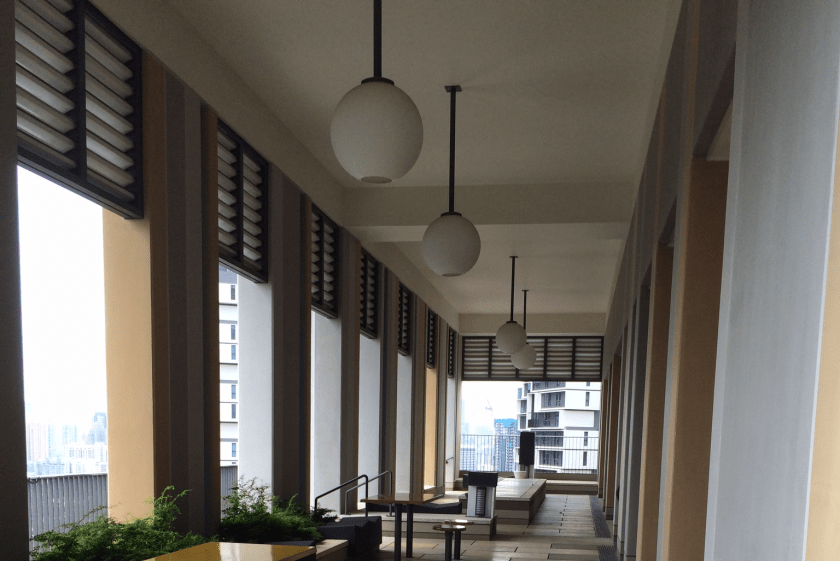
Due to the lack of direct exposure to the sun, the temperature was cool and breezy, which made it quite relaxing even for a 32 degree day in Singapore. The chairs were cool to sit on, and none of the siting area was hot to touch. Despite a few older adults, and teenagers hanging around in the area, chatting in the afternoon, I could not hear their conversations until I am right beside them. The area did not appear noisy despite the moderate number of people hanging about.

Familiar & Inclusive Environments
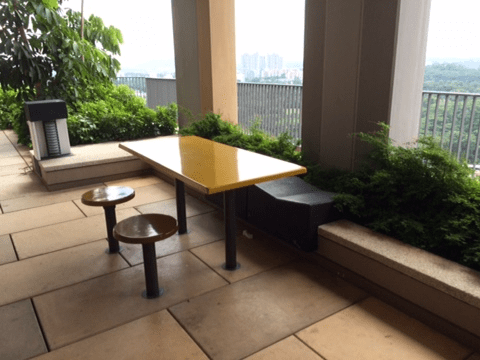
The garden also contained a number of familiar tables and chairs that we see at our local Kopithams (coffeeshops) found in HDB estates and food courts.
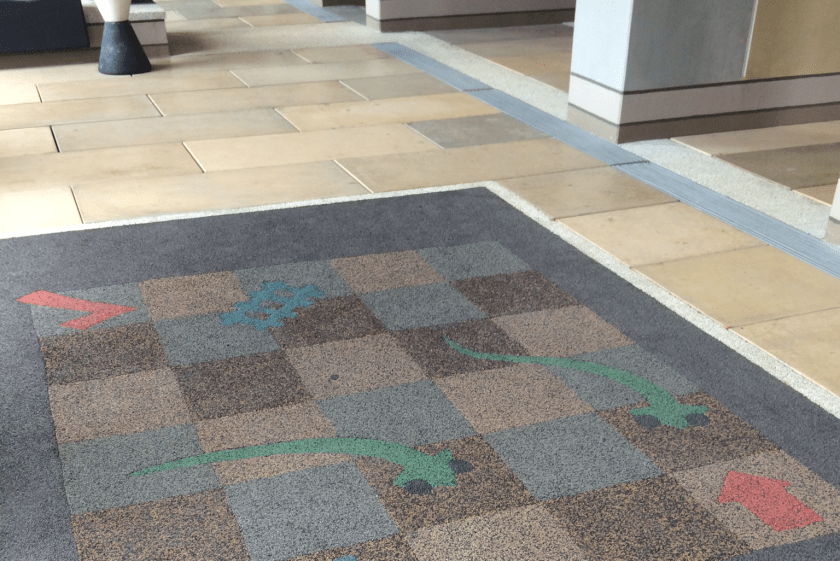
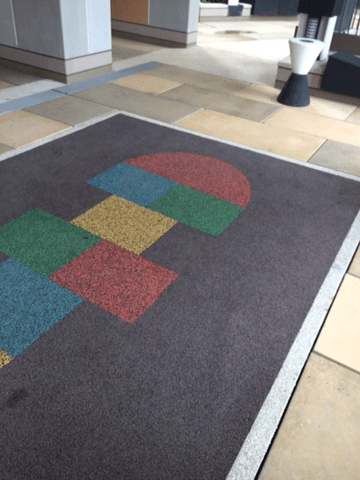
Areas inclusive for children were also found in the garden containing a little area for hop scotch and for a game of snakes and ladders.
Integenerational Facilties
Just looking at the garden, and thinking back on nursing home in Singapore, Nursing Homes can be integrated with other services to serve a multitude of generations and become a truely multigenerational facility such as the design below.The draft below is inspired by this garden and thoughts of an integenerational facility.
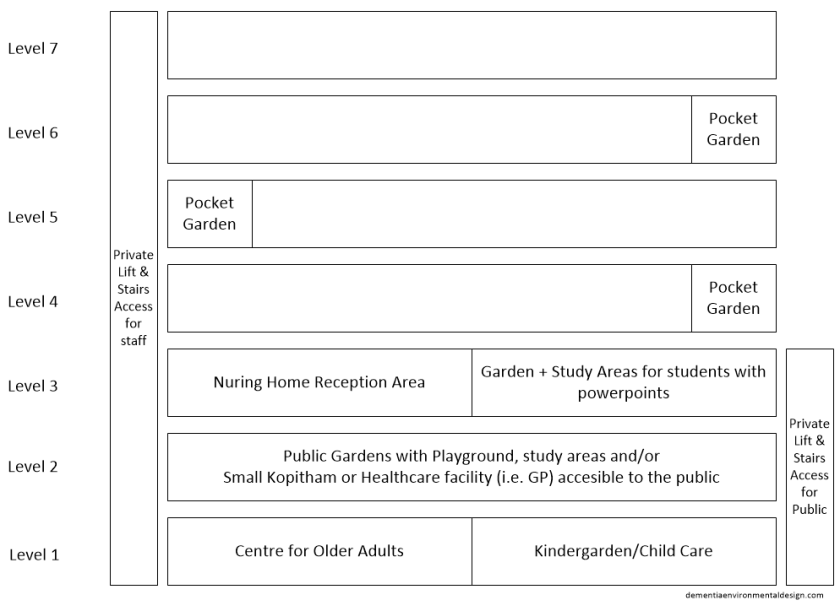
I also notice the tables and chairs were great for students as study area but lack facilties such as powerpoints. Living in a crowded, high density city, finding study areas are getting harder by the minute. For people in the western world, this is our Asian phenomennon. We use to joke that rich kids get to study in Starbucks and fork out a ton for drinks while us poorer kids try and tough it out in the libraries or at the cloest Macdonalds or Mos buger. However, libraries may not be close to home, and if we wanted to study in a group, finding a location gets pretty tough. anyway who has to tough it out in eateries to study have to put up with the noise.
Older adults can participate in activities after they have sent their grandkids to kindergarden, or school and all come together in the mornings and return home in the evenings. Grandparents can also relax with their grandchildren in the public garden, grab a coffee and catch up with friends before meeting up with their kids and going home together. This is a dream for a place where communities and families can come together to build that kampung spirit.
If there is a multi-generation facility such as the ones found above, families can remind tigher and stronger despite hussle and bussle of our urbanised cities and dual income lives. We are already spending much time on transport and work, what we really need is some solutions to help support us with maintaining our relationships with out familiies to build a stronger, tighter, and caring Singapore, and we know it starts with family.
Asian Caregivers: Caring for Parents with Dementia
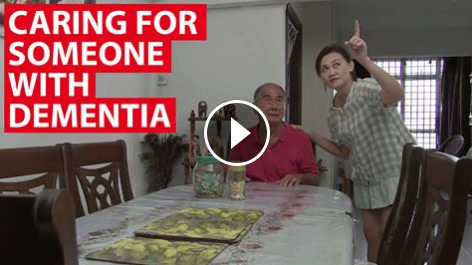
A short clip from Channel News Asia Insider that touches on caring for a person with dementia. The clip talks about how to encourage a person with dementia
- to take a shower
- to reduce frequent intake of food
- how to communicate when caregivers are accused of stealing
A short and useful clip for caregivers.
Why Music & Dementia?
Living Instruments: Music and our brain
I attended an A cappella performance last night by MICappella and they did a rendition of the Iron Maiden Trooper, non-traditional and challenging but the song in itself is really epic and to hear it purely in vocals is mind blowing. Like living instruments in a fireworks display of sound, i imagine the synapsis that must be firing not just within the musicians but within the audience themselves as they watch the performance, lights, vocal, instruments but not instruments, as the mind tries to make sense of the event, following visually one musician to another identifying and piecing together the concert in their minds with sound and sight. During the concert, you can witness the happiness it brings as the crowd jives with the music, smiles lit up the room, think of the rush of dopamine and adrenaline during the song with a fast beat or tempo, all within a span of an hour or two.
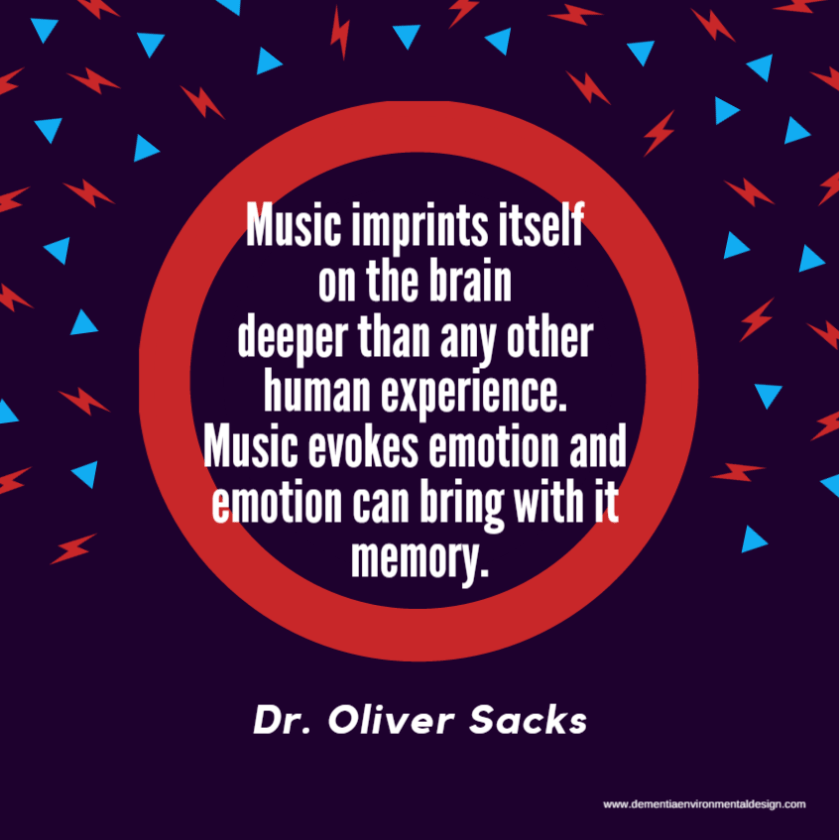
What our human minds can do never cease to amaze me. I think of what a live A Cappella performance or a session could do for people with dementia. We talk about how music brings out our inner self and I believe many are familiar with the documentary Alive inside. Oliver Sacks in the video below is quoted as saying that “music can do things that language cannot”.
Music brings us alive, invoking memories, emotions, even actions; a gentle tap of the foot, drumming of fingers, a secret smile or a giggle when we associate a memory with the music. More needs to be done to bring arts and health together. We know the benefits of music when it comes to health, and even in the positive benefits in the reduction of behavioural and psychological symptoms of dementia. Yet the streams of music and health continue to work in silos. How can we bring arts and health together to support the people, not just for entertainment but for physiological and cognitive benefits as well?
We certainly need to look into more ways in which we can utilise the beauty of music to support and provide culturally meaningful therapeutic interventions to the people with dementia. Understandably for many health care centres, the issues of cost, storage and even space for the provisions of instruments are always an issueIf. With the numerous A cappella groups around the world, perhaps there should be an alignment with artist and healthcare professionals as a form of social responsibility to help the wider community. Music is the medicine that pills cannot provide. So how about A cappella, anyone?