News Release
July 2018 | United Kingdom – Just ten minutes of social interaction a day improves wellbeing in dementia care
An e-learning programme that trains care home staff to engage in meaningful social interaction with people who have dementia improves wellbeing and has sustained benefits.
The average person with dementia in a care home experiences just two minutes of social interaction each day, researchers found. They also showed that out of 170 available training programmes for nursing home staff, only three are evidence-based – none of which improve quality of life.
The Wellbeing and Health for people with Dementia (WHELD) programme trained care home staff to increase social interaction from two minutes a day to ten, combined with a programme of personalised care. It involves simple measures such as talking to residents about their interests and involving them in decisions around their care.
Carers took part in an e-learning programme based on the WHELD training, with or without Skype supervision. They compared outcomes to usual care. Both treatment arms improved resident wellbeing and staff attitudes to person-centred care. The Skype supported arm continued to deliver improved resident wellbeing four months after the trial was completed.
Joanne McDermid, of King’s College London, who presented the research, said: “Care home staff are under a lot of pressure – it’s a really tough job. It’s a challenging environment for both residents living with dementia and staff. Our programme moved care staff to see dementia through the eyes of those who are living it. We found a simple approach, delivered as e-learning, improves staff attitudes to care and residents’ wellbeing, ultimately improving lives for people with dementia.
“In a traditionally task -focussed work environment, our programme reminds us of the human side; of the full life experience of those living with dementia in care.”
Professor Clive Ballard, of the University of Exeter Medical School, who led the research, said: “Just take a moment to imagine life with just two minutes of social interaction each day. To accept this is discrimination against people with dementia. We urgently need to do better. Most care home training programmes are not evidence-based. We know our programme works over the long term, and we now know it can be delivered remotely. We now need to roll this out to care homes.”
A new short film has been released for the Hindi-speaking community, designed to encourage acceptance of dementia as a medical condition, and not a normal part of ageing.
This is the latest in an award-winning series of films aimed at a number of non-English speaking communities in Australia to help de-stigmatise and promote awareness of the condition. The film was developed to help dispel myths and educate the community about the condition.
The film provides up-to-date information on dementia through interviews with Hindi-Australian doctors, carers, counsellors and the stories of the friends, families and carers of people diagnosed with dementia.
Dementia Australia counsellor Vandita Nijhawan said in the Indian community there can be shame when talking about things that happen within the house to outsiders, particularly when it affects the brain.
“Dementia is nothing to be ashamed of. I encourage people to use the free services available through Dementia Australia, which include translations of information about dementia,” Ms Nijhawan said.
The video reassures friends and families of those diagnosed with dementia that feelings of shame or embarrassment can be alleviated by understanding that dementia is a common disease, such as heart disease or high blood-pressure.
The ‘It’s Not a Disgrace It’s Dementia’ series of films are short and family-friendly, running at around 15 minutes in length. They are available in Spanish, Italian, Portuguese, Mandarin, Arabic, Serbian, Cambodian, Vietnamese, Assyrian, Croatian and Ukrainian, each with English subtitles.
This latest film has been produced by Dementia Australia in partnership with Why Documentaries and the Multicultural Communities Council of the Illawarra. Dementia Australia would also like to thank Sri Om Care and the Australian-Indian Aged Care Support Holistic Association (AASHA) for their participation in the filming.
For more dementia resources in Hindi visit dementia.org.au/resources/hindi
Meet Desert Rose, a state-of-the-art home of the future, for the future.
Designed by students from the University of Wollongong (UOW) and TAFE Illawarra, Desert Rose boasts a mix of dementia-friendly features and building design elements, many of which are not currently available on the market and won’t be for another five or 10 years.
Not something out of a sci-fi movie Professor Tim McCarthy, Faculty Advisor for Team UOW Australia-Dubai, hopes Desert Rose will become a new standard in age-friendly design and win Team UOW their second Solar Decathlon when they take their design to Dubai in 2018.
“Desert Rose is a house for life, catering for a couple who are currently active and considering their future, say in their mid-fifties,” Professor McCarthy said.
“They are downsizing to a comfortable, beautiful and bill-free home. The house has features that enable it to adapt to possible future needs resulting from age-related disabilities. It encourages wellness.”
Desert Rose is also dementia-friendly and largely inspired by the work of Dementia Training Study Centre director Professor Richard Fleming and Research Fellow at the Centre for Health Initiatives Dr Lyn Phillipson, both also from UOW.
Professor McCarthy said consultation with members of the Kiama Dementia Alliance and Advisory Group initially influenced the design and evaluation of the prototypes as they arise would include the group and other consumer networks.
Dementia-friendly design elements featured in Desert Rose include:
Line of sight to key facilities – a person with dementia is eight times more likely to use the toilet (especially at night) if they can see the toilet bowl, the occupant of Desert Rose can see the bowl from their position in bed and from the lounge.
Accessibility for people with limited mobility – doors and furniture allow easy navigation with a walking frame, which typically requires a greater turning circle than a wheelchair.
No steps – you can drive a mobility scooter into the kitchen to unload shopping.
Strong points – located in the wall frames allowing railings to fix to the bathroom wall and other places as needed. The ceiling in the bedroom has a built in strongpoint for connecting a hoist to get the person in and out of bed should the need arise.
Sensors – activity monitoring using ubiquitous, but not intrusive technologies such as, low-resolution special infrared sensors that can recognise if someone is standing or lying down, or has fallen. Sensors in the bed can detect is the occupant has woken in the night which can trigger the bathroom light to turn on, followed by the vanity and then back to bed. “Ushering” like this can assist a person with dementia to function without the intervention of a carer. The house can learn the normal patterns of activity and trigger alarms for anomalies.
Professor McCarthy said UOW research into user-acceptance informed the technologies and sensors, which could not be used as a fix-all. He acknowledged some people, may react badly to some forms of monitoring.
Thermal comfort, contrasting colours (especially in the bathroom), brightness, mood and colour controlled LED lighting and retro looking devices are also important features of Desert Rose.
“Research at the Sustainable Buildings Research Centre, co-supervised by Professor Fleming, has shown that thermal comfort is very important for the care of people living with dementia,” Professor McCarthy said.
“If the person becomes too hot, sweaty or cold, it can cause anxiety and agitation which may lead to changes in behaviour, sedative use and so on. Our work by Federico Tartarini has shown that by controlling the temperature and humidity, people with dementia are happier.”
The Solar Decathlon is an international competition that requires teams to design and build an affordable and architecturally beautiful, net-zero energy house.
The full-sized house must then be transported to the competition site in Dubai to compete against the top universities and vocational education and training providers from around the world.
Twenty-two teams from 16 different countries will come together for the Solar Decathlon Middle East 2018 finals held in Dubai in November – including Team UOW and Desert Rose.
Professor McCarthy said the thermal comfort aspects of Desert Rose fit well with the Solar Decathlon competition, as the house must remain between 22 and 25 degrees Celsius with humidity below 65% at all times.
“Excellent insulation and air tightness help us to maintain these settings while using very little energy for heating and cooling,” Professor McCarthy said.
Professor McCarthy said while it was not common for Australian homes (even new ones build to current code) to display such air tightness and energy efficiency, it is common in countries such as Germany where they have developed the Passivhaus standard.
The features of Desert Rose are built-in from day one and allow for easy adaptation later.
“They can be difficult to retrofit to an existing house if they have not been pre-planned while other aspects are easier to retrofit,” he said.
While ultra-modern in terms of technology and design, the home uses retro looking devices with modern abilities.
“We will avoid many new-fangled devices, which would be unfamiliar to a person living with dementia,” Professor McCarthy said.
“Many people revert to what they experienced in their twenties or a particular period of their lives. Simple tap fixtures, lighting controls and communications devices are often better than the ultra-modern or automatic devices.
“How often have you been in a public bathroom and not known how to turn on the water – or if it will turn off automatically? The taps in Desert Rose can look familiar but have built-in safety and water saving features, heat limits to prevent scalding, a reminder to turn off (might be a voice prompt) and an automatic shut-off if a tap is left running too long.”
Professor McCarthy said this was just a snapshot of Desert Rose and that Team UOW were keeping a few tricks up their sleeve ahead of the competition.
“Of the 22 teams who are designing and building net-zero energy homes, Team UOW are the only team targeting this most important social issue,” he said.
Professor McCarthy said even in United Arab Emirates where the population is relatively young, the demographics showed that by 2050 this will have changed with over 20% of their population being over 65.
“So we believe that our house which has been named Desert Rose, after Sturt’s Desert Rose (a flower that blooms in the most difficult circumstances) is a vital part of preparing not just Australia, but also the Middle East for the need of our ageing populations,” he said.
“What is so great about this is that every aspect of the concept has come from our students. They are demonstrating real leadership in tackling our current and future housing needs.”
With a lot of interest from developers of retirement living units and age care providers Professor McCarthy hopes the dementia-friendly features of Desert Rose may be available on the market and part of the Australian Building Code more quickly.
Keep up-to-date with the latest news from Team UOW’s Desert Rose(link is external) and the Solar Decathlon Middle East 2018.
A new study out today has found residents with dementia in aged-care facilities that provide a home-like model of care have a better quality of life and fewer hospitalisations than those living in more standard facilities. We also found the benefits of a home-like model were provided without an increase in running costs.
Our study compared home-like models (which have up to 15 residents per unit and free access to outdoor areas) to more standard residential care, where a large number of people are housed in one building. In 2011, around half of all facilities in Australia had places for more than 60 residents, and the average size is growing.
The World Health Organisation has stated smaller home-like residential care settings “hold promise for older people, family members and volunteers who provide care and support”. But Australia is lagging behind other countries in offering alternative models of residential aged care.
Most older people with dementia want to stay at home as long as they can. When this is no longer possible, they move into residential aged-care facilities, which become their homes.
These residential facilities, or nursing homes, frequently adopt a model of care that emphasises individuality. This is known as person-centred care. But delivering this model may require more staff or a different mix of staff, which may be difficult to deliver with current funding.
So standard aged-care facilities in Australia often have some similarities to health facilities, with designated staff areas and centralised kitchens. Access to outdoor areas, particularly for people with dementia, may depend on the availability of staff. Despite adhering to philosophies such as person-centred care, the scheduling of this care and of meals often lacks flexibility.
The problems are compounded when residential care is used for multiple purposes ranging from palliative care to providing care for people with dementia. The needs of these two groups are quite different and the lack of focus makes delivering quality care a challenge.
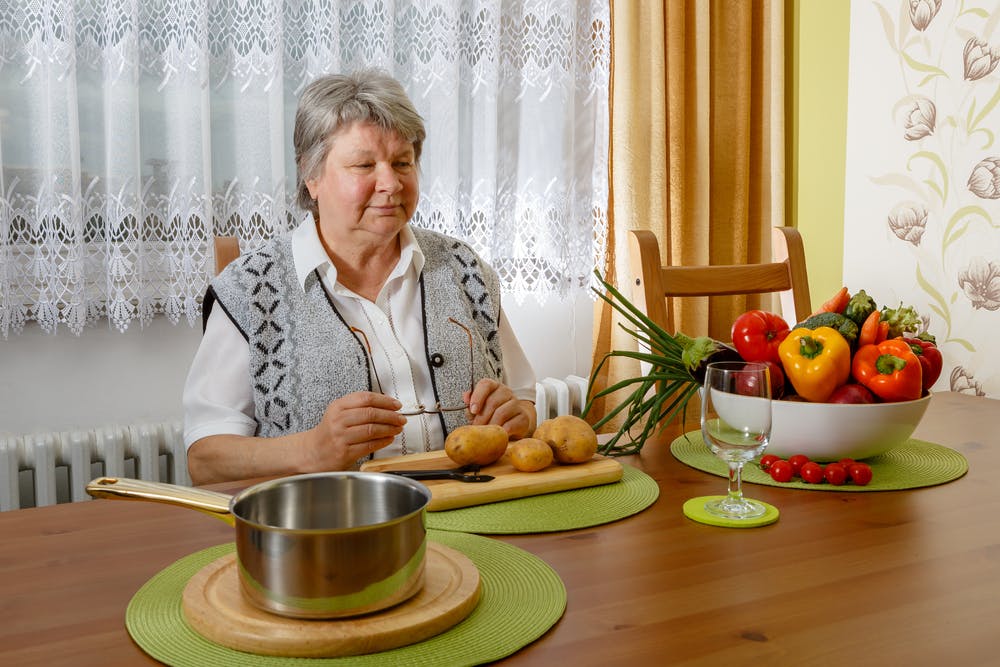
Being involved in simple tasks such as food preparation can improve quality of life. from http://www.shutterstock.com
What we found
Our study was specifically designed to include people with dementia and their family members. People with dementia are not often included in research studies.
It included 541 participants from 17 not-for-profit residential aged-care facilities in four different states in Australia. They had been residents for a year or longer.
These facilities were all considered high quality. This means they had lower hospitalisation rates for potentially avoidable conditions than the national performance target. And more than 80% of residents in the standard care facilities indicated they felt as safe as they wanted and that their environment was as clean and comfortable as they wanted.
Around one-quarter of people in the study lived in a facility with a home-like model of care. All of them were living with dementia.
The study found residents in home-like models of care had a better quality of life, as rated by the residents themselves or their family members. They also had a 68% lower rate of being admitted to hospital and 73% lower rate of having an emergency department presentation.
We have previously shown residents who lived in a home-like model were 52% less likely to be exposed to potentially inappropriate medications. These are medications where the potential harms may outweigh the benefit, such as antipsychotics or relaxants, but are still often prescribed to older people in residential care.
The benefits for residents were provided with similar running costs for the home-like and the standard models of care. However, the costs excluded differences in the build of the facilities. Initial establishment costs are likely to be higher, due to the requirement for more space per resident.
Funding arrangements don’t incentivise Australian aged-care providers to offer variety in terms of models of care. Government funding is provided based on the assessed care needs of the residents, rather than the preferred model of care or resident outcomes.
Funding supplements are available to care providers for reasons such as residents’ financial hardship or risk of homelessness and to small, rural aged-care service providers, but none are available for offering an alternative model of care.
The Australian government plans to improve the aged-care system to offer “choice and flexibility”. This is crucial, but we also need to improve choice and variety in residential aged-care models.
Alzheimer’s disease (AD) is a progressive, neurodegenerative condition that often begins with mild cognitive impairment or MCI, making early and repeated assessments of cognitive change crucial to diagnosis and treatment.
But in a paper published online in the journal Alzheimer’s & Dementia: Diagnosis, Assessment & Disease Monitoring, a team of researchers led by scientists at the University of California San Diego School of Medicine found that repeated testing of middle-age men produced a “practice effect” which obscured true cognitive decline and delayed detection of MCI.
“When persons take the same or similar tests repeatedly over time, they simply get better at taking the tests,” said first author Jeremy A. Elman, PhD, a postdoctoral fellow in the lab of senior author William S. Kremen, PhD, professor of psychiatry and co-director with Carol E. Franz, PhD, of the Center for Behavior Genetics of Aging at UC San Diego School of Medicine. “The consequence is that their results may not accurately reflect the reality of their condition.”
Researchers re-tested 995 middle- to late-middle-aged men in a six-year follow-up of the Vietnam Era Twin Study of Aging (a longitudinal study of male-male twins who had all served in the military sometime between 1965 and 1975, though almost 80 percent reported no combat exposure). A second group of 170 age-matched males were tested for the first time. Group differences were used to calculate practice effects.
The scientists found that there were significant practice effects in most cognitive domains, and diagnoses of MCI doubled from 4.5 to 9 percent after correcting for practice effects. “In other words,” said Kremen, “some men would have declined to levels indicating impairment on follow-up testing had they not been exposed to the tests before.”
The authors said the disparity has significant clinical consequences. Consider, for example, two people with similar characteristics who have identical cognitive test scores just above the threshold for an MCI diagnosis. The only difference: One individual is being tested for the first time while the other has taken such tests before.
“We can infer that the second individual may actually have more impairment, but the effects of practice are artificially increasing their scores,” wrote the authors. “This scenario would suggest that the individual may have dipped below the norm-based threshold and would have been diagnosed as having MCI had the test been taken for the first time.”
The clinical significance, they said, is that treatment for AD is shifting increasingly toward prevention strategies that rely on early identification. The researchers say their findings strongly suggest the importance of correcting for practice effects in longitudinal studies of older adults, such as using similar replacement persons taking the test for the first time.
Co-authors of the study include: Amy J. Jak, UC San Diego and Veterans Affairs San Diego Healthcare System; Matthew S. Panizzon, Daniel E. Gustavson, Xin M. Tu, Carol E. Franz and Sean N. Hatton, UC San Diego; Tian Chen, University of Toledo; Chandra A. Reynolds, UC Riverside; Kristen C. Jacobson, University of Chicago; Rosemary Toomey, Ruth McKenzie and Michael J. Lyons, Boston University; and Hong Xian, St. Louis University and VA St. Louis Healthcare System.
Funding for this research came, in part, from the National Institutes of Health (R01s AG018386, AG022381, AG022982, AG050595, AG018384; R03 AG046413, K08 AG047903).
Elman, Jeremy & J. Jak, Amy & Panizzon, Matthew & M. Tu, Xin & Chen, Tian & Reynolds, Chandra & Gustavson, Daniel & Franz, Carol & Hatton, Sean & C. Jacobson, Kristen & Toomey, Rosemary & McKenzie, Ruth & Xian, Hong & Lyons, Michael & Kremen, William. (2018). Underdiagnosis of mild cognitive impairment: A consequence of ignoring practice effects. Alzheimer’s & Dementia: Diagnosis, Assessment & Disease Monitoring. 10.1016/j.dadm.2018.04.003.
This is the first time the international conference will be held in Chicago. It is co-sponsored by Northwestern University’s Center for Bioethics and Medical Humanities, the Hippocrates Initiative for Poetry and Medicine, the Poetry Foundation and Harvard Medical School.
“Poetry can have a powerful influence on how we experience and understand illness,” said symposium organizer Dr. Kelly Michelson, director of the Center for Bioethics and Medical Humanities at Northwestern University Feinberg School of Medicine. “Very creative people are integrating poetry into clinical care, but we need a broader conversation to understand what that looks like and what its impact could be for patients, families and health care providers.”
The symposium will kick off at 7 p.m. Thursday, May 10, with a reading by poet Mark Doty at the Poetry Foundation, 61 W. Superior St., Chicago.
The conference’s academic program begins at 8:15 a.m. Friday morning, May 11, at the Feinberg School of Medicine at the Robert H. Lurie Research Center in the Baldwin auditorium, 303 E. Superior St., on the Chicago campus.
Panels of the day will explore how poetry can influence the illness experience; how a body’s physiology and a poem’s language speak to each other; how poetry frames the witnessing of cultural differences and disparities; and how lyric form can disrupt and reconstitute our understanding and teaching of illness and health care. The day will also feature a keynote conversation between poet Mark Doty and physician-poet Rafael Campo and a lunchtime poster session.
At 4 p.m., the award ceremony and reading of winning entries of the Hippocrates Prize for Poetry and Medicine will be held at the Poetry Foundation.



 The Australian government plans to improve the aged-care system to offer “

 Designing for Aged Care