Posted in Ageing & Culture, Caregiving, International Policies, The Built Environment

Experience how a person with dementia grapple with complex flooring patterns

This has been going around the web for the last couple of weeks and everyone has been all over it trying to find the panda among the snowman or the cat among the owls. It has been a fun experience for most of us and for some it may be quite frustrating. Some people who are able to find the cat or the panda have posted bragged about how quickly they may have found it on facebook.

We know this happens and we talk about how confusing complex flooring patterns can be for people with dementia. They may not be able to distinguish the area and may have difficulties walking around. Imagine if you had dropped your keys on the floor or a purse on a carpet

carpet-100089_640.jpg

It would be like looking for the animals in these pictures. See if you can find the panda in the first picture and the cat in the second. .
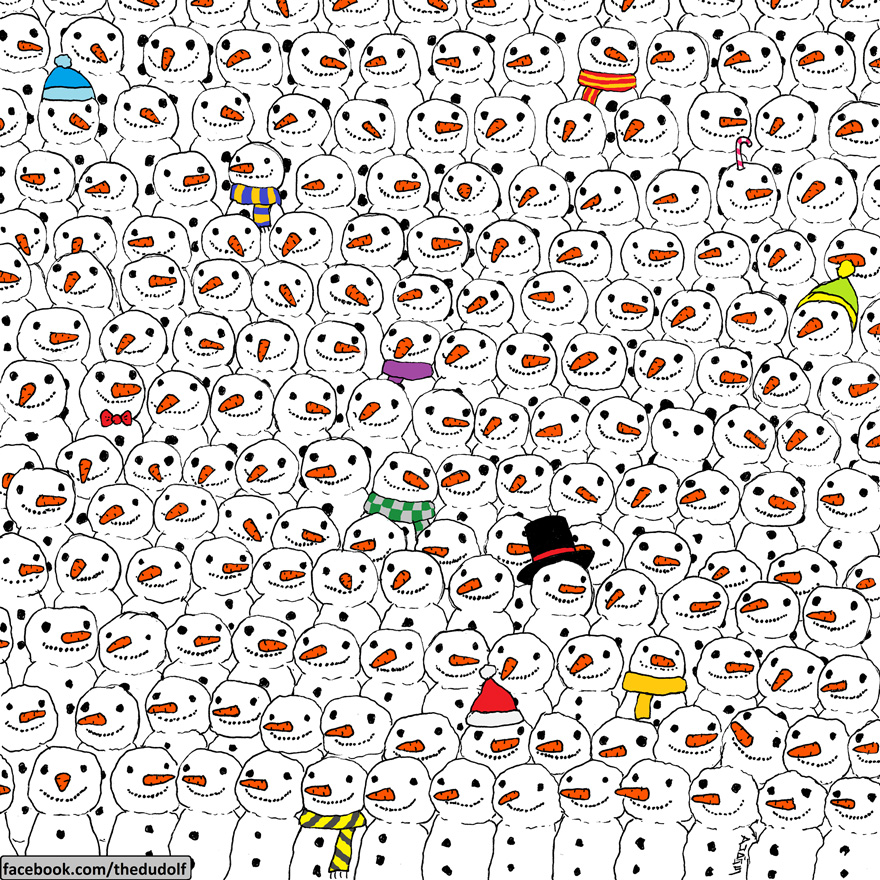
1. Find the Panda above in the midst of the snowman.

2. Find the cat in the sea of owls.

Images created by Gergely “Dudolf” Dudás and more images can be found on Dudolph’s Facebook page.

Researchers are still trying to work out how the brain tries to categorise objects. The latest breakthrough came from Monash University where researchers are trying to utilise a new imaging technique known as the semantic wavelet-induced frequency-tagging (SWIFT) to help us find the answers (Koenig-Robert et al. 2015).

If you are caring for someone with dementia or working with people with dementia, please stop and have a think about the type of flooring and perhaps these principles from  Prof. Richard Fleming and Kirsty Bennett, University of Wollongong might come in really handy in the decision making process.

  • Reduces unhelpful stimulation
  • Optimise helpful stimulation
  • Support movement and engagement

Just trying to find the panda and the cat may be somewhat easy or really quite frustrating for some. It will take a couple of seconds at least and that is the situation that that people experiecing cognitive impairment have to grapple with when they come up against environments of complex designs. We have to take our current experience with hunting for the panda or cat and multiply that by ten or even a hundred folds. So before you choose that intricately design carpet for your flooring, please stop and think if the choice you are making is an inclusive one for people with dementia.

References:

Fleming R, Bowles J. Units for the confused and disturbed elderly: Development, Design, Programmimg and Evaluation. Australian Journal on Ageing. 1987 November;6(4):25-8.

Fleming R, Forbes I, Bennett K. Adapting the ward for people with dementia. Sydney: NSW Department of Health; 2003.

Koenig-Robert R, VanRullen R, Tsuchiya N (2015) Semantic Wavelet-Induced Frequency-Tagging (SWIFT) Periodically Activates Category Selective Areas While Steadily Activating Early Visual Areas. PLoS ONE 10(12): e0144858.


 

Posted in The Built Environment

Best 2015 Science & Tech Summary Videos

Just had to share these 3 awesome videos, the first one is from Science Magazine and is a bit more then 4 minutes, the second is a 55 sec video from Nowthis summarising all the best science and technology innovations in 2015. The last one is a 26-minute video from BBC summarising all the science and tech of 2015. Enjoy!

Science Magazine

Nowthis

http://news.yahoo.com/video/2015-amazing-science-technology-234842844.html?format=embed 

BBC News

Posted in Ageing & Culture, Caregiving, International Policies, Research & Best Practice, The Built Environment, Therapeutic Activities

Food Nostalgia Workshops, a deliciously fresh idea to support Dementia

One of my fondest memories working in aged care in Australia was the talking about Christmas recipes with all the residents during this holiday season. For many of us who have slaved over the stovetop during the festive seasons, you know what I am talking about. To get that perfect Christmas fruitcake was a project months in the making. I usually worked the Christmas shifts and we would always get together and you could see all the ladies eyes lit up like the fairy lights on the Christmas tree as we chatted away about our favourite Christmas dishes, the delectable treats and without a doubt, everyone, literally all the ladies had some cooking tips and advice to share. Sometimes, even their families would join in the conversation and I had to pry myself out of the room haha. From Pavlovas, Dundee cakes, Christmas cakes, brandy butter to Medisterkaker. Everyone had something lovely to share. You can tell I love the Christmas season.

dinner-meal-table-wine-medium

Anyway I found out that in the UK, Magna Vitae is working on a new health initiative to support people with dementia and their caregivers. Guess what? It’s all about food! In January 2016, they will be running a string of dementia friendly workshops known as ‘Feeding Memories’ for people with dementia and their caregivers in the UK.

This workshop certainly breathes innovation, food is such an important component in our daily lives. The workshop is a food reminiscence therapy programme, helping to ‘revive the senses’ through utilising food packaging from the past and it seems like there might be some cooking involved as well. It doesn’t stop there, the workshop has an inclusive and community aspect, sharing the importance of nutrition, diet and getting people socially engaged in their common love for food.

I’m really excited about the workshop and I hope that there will be more of these workshops to go around, especially in the Memory Cafes.

Anyway here’s wishing everyone Happy Holidays.

xoxo

Jo

Source: http://www.magnavitae.org/mvitae/about