Posted in Caregiving, International Campaigns, International Policies, Research & Best Practice

How to reduce your risks of dementia

File 20190122 100279 kp4r7i.jpg?ixlib=rb 1.1

If you engage in cognitively stimulating activities in midlife, such as reading and playing games, you can reduce dementia risk by about 26 per cent, according to research.
(Unsplash/Rawpixel), CC BY-SA

Nicole Anderson, University of Toronto

Many people do not want to think about dementia, especially if their lives have not yet been touched by it. But a total of 9.9 million people worldwide are diagnosed with dementia each year. That is one person every 3.2 seconds.

This number is growing: around 50 million people live with dementia today, and this number will rise to over 130 million worldwide by 2030.

You do not have to wait until you are 65 to take action. In the absence of treatment, we must think of ways to protect our brain health earlier. This month is Alzheimer’s Awareness month — what better time to learn how to reduce your risk of dementia, whatever your age?

In my work at Baycrest’s Rotman Research Institute, I address cognitive, health and lifestyle factors in aging. I investigate how we can maintain our brain health, while reducing the risk of dementia as we age. Currently, I’m recruiting for two clinical trials that explore the benefits of different types of cognitive training and lifestyle interventions to prevent dementia.

There are three dementia risk factors that you can’t do anything about: age, sex and genetics. But a growing body of evidence is discovering early-life, mid-life and late-life contributors to dementia risk that we can do something about — either for our own or our children’s future brain health.


Read more:
Is that ‘midlife crisis’ really Alzheimer’s disease?


Before going any further, let’s clear up some common confusion between Alzheimer’s disease and dementia. Dementia is a term to describe the declines in cognitive abilities like memory, attention, language and problem-solving that are severe enough to affect a person’s everyday functioning. Dementia can be caused by a large range of diseases, but the most common is Alzheimer’s.

Risk factors in early life

Children born at a low birth weight for their gestational age are roughly twice as likely to experience cognitive dysfunction in later life.

Many studies have also identified a link between childhood socioeconomic position or educational attainment and dementia risk. For example, low socioeconomic status in early childhood is related to late life memory decline, and one meta-analysis identified a seven per cent reduction in dementia risk for every additional year of education.

A diet high in unrefined grains, fruit, vegetables, legumes, olive oil and fish has been linked to lower dementia rates.
(Unsplash/Ja ma), CC BY

Poorer nutritional opportunities that often accompany low socioeconomic position can result in cardiovascular and metabolic conditions such as hypertension, high cholesterol and diabetes that are additional risk factors for dementia.

And low education reduces the opportunities to engage in a lifetime of intellectually stimulating occupations and leisure activities throughout life that build richer, more resilient neural networks.

Work and play hard in middle age

There is substantial evidence that people who engage in paid work that is more socially or cognitively complex have better cognitive functioning in late life and lower dementia risk. Likewise, engagement in cognitively stimulating activities in midlife, such as reading and playing games, can reduce dementia risk by about 26 per cent.

We all know that exercise is good for our physical health, and engaging in moderate to vigorous physical activity in midlife can also reduce dementia risk.

Aerobic activity not only helps us to maintain a healthy weight and keep our blood pressure down, it also promotes the growth of new neurons, particularly in the hippocampus, the area of the brain most responsible for forming new memories.

(Unsplash/Bruce Mars)

Stay social and eat well in later years

While the influences of socioeconomic position and engagement in cognitive and physical activity remain important dementia risk factors in late life, loneliness and a lack of social support emerge as late life dementia risk factors.

Seniors who are at genetic risk for developing Alzheimer’s disease are less likely to experience cognitive decline if they live with others, are less lonely and feel that they have social support.


Read more:
Will you be old and ‘unbefriended?’


You have heard that you are what you eat, right? It turns out that what we eat is important as a dementia risk factor too. Eating unrefined grains, fruit, vegetables, legumes, olive oil and fish, with low meat consumption — that is, a Mediterranean-style diet — has been linked to lower dementia rates.

Along with my Baycrest colleagues, we have put together a Brain Health Food Guide based on the available evidence.

What about Ronald Reagan?

Whenever I present this type of information, someone invariably says: “But my mother did all of these things and she still got dementia” or “What about Ronald Reagan?”

Playing games is proven to slow cognitive decline.
(Unsplash/Vlad Sargu), CC BY

My father earned a bachelor’s degree, was the global creative director of a major advertising firm, had a rich social network throughout adulthood and enjoyed 60 years of marriage. He passed away with Alzheimer’s disease. My experience with my dad further motivates my research.

Leading an engaged, healthy lifestyle is thought to increase “cognitive reserve” leading to greater brain resiliency such that people can maintain cognitive functioning in later life, despite the potential accumulation of Alzheimer’s pathology.

Thus, although all of these factors may not stop Alzheimer’s disease, they can allow people to live longer in good cognitive health. In my mind, that alone is worth a resolution to lead a healthier, more engaged lifestyle.The Conversation

Nicole Anderson, Associate Professor of Geriatric Psychiatry, University of Toronto

This article is republished from The Conversation under a Creative Commons license. Read the original article.

Posted in Caregiving, Research & Best Practice

Study shows dementia care program delays nursing home admissions, cuts Medicare costs

Woman in nursing home

Sima Dimitric/Flickr


News Release
December 2018 | UCLA – Study shows dementia care program delays nursing home admissions, cuts Medicare costs


New research shows that a comprehensive, coordinated care program for people with dementia and their caregivers significantly decreased the likelihood that the individuals would enter a nursing home. The study also shows that the program saved Medicare money and was cost-neutral after accounting for program costs.

The research, conducted at the UCLA Alzheimer’s and Dementia Care Program, was designed to evaluate the costs of administering the program, as well as the health care services used by program participants, including hospitalizations, emergency room visits, hospital readmissions and long-term nursing home placement.

“The findings of this study show that a health care system-based comprehensive dementia care program can keep persons with dementia in their homes and in the community without any additional cost to Medicare,” said the study’s senior author, Dr. David Reuben, Archstone Professor of Medicine and chief of the UCLA Division of Geriatrics at the David Geffen School of Medicine at UCLA.

The study was published Dec. 21 in JAMA Internal Medicine.

The research focused on the UCLA Alzheimer’s and Dementia Care Program. In the program, people with dementia and their caregivers meet with a nurse practitioner specializing in dementia care for a 90-minute in-person assessment and then receive a personalized dementia care plan that addresses the medical, mental health and social needs of both people. The nurse practitioners work collaboratively with the patient’s primary care provider and specialist physicians to implement the care plan, including adjustments as needs change over time. A total of 1,083 Medicare beneficiaries with dementia were enrolled in the program and were followed for three years. The study compared them to a similar group of patients living in the same ZIP codes who did not participate in the program.

“The most striking finding was that patients enrolled in the program reduced their risk of entering a nursing home by about 40 percent,” said lead author Dr. Lee Jennings, assistant professor at the University of Oklahoma College of Medicine. Jennings began the project while on faculty at the Geffen School and finished it after arriving at Oklahoma.

There were no differences between the two study groups in hospitalizations, emergency room visits or hospital readmissions. However, cost was another important element of the study. Participants in the program saved Medicare $601 per patient, per quarter, for a total of $2,404 a year. However, after program costs were factored in, the program was cost-neutral and might result in savings in other settings, such as at other health care systems. That was good news to the study’s authors.

“We found the study to be very exciting,” Jennings said, “because it showed that an intensive intervention can delay nursing home entry without adding costs. The intervention isn’t going to reverse dementia, but it allows us to provide high-quality care to help patients cope with the progression of this disease and stay in their homes for longer.”

Jennings added that individuals with dementia typically have not received good-quality care. “Part of the reason,” she said, “is that the care takes a significant amount of time, which primary care physicians don’t have in abundance. In addition, pharmacologic treatments for dementia are limited, which makes community resources all the more important for both patients and caregivers. However, community programs tend to be underutilized.”

The intervention featured in the study addresses those issues directly. The assessment looks not only at what the patient and caregiver need, but also at their strengths, such as financial security, family assistance and proximity to community resources. It is designed to be interdisciplinary and to address the needs of both patients and caregivers.

“This study aligns with similar studies of collaborative care models for other chronic diseases, such as heart failure,” Jennings said. “It underscores that we need to be thinking differently about how we provide care to persons with chronic illnesses, like dementia. This study shows the benefit of a collaborative care model, where nurse practitioners and physicians work together to provide comprehensive dementia care.”

Posted in Caregiving, International Campaigns, Research & Best Practice

My Brain Robbie campaign aims to help your kids keep their brains healthy

News Release
January 2019 | Global Brain Health Institute – My Brain Robbie animation campaign aims to help keep little brains healthy

My Brain Robbie animation campaign aims to help keep little brains healthy

My Brain Robbie, a fantastic new initiative to promote brain health among school going children, has been launched through the Pilot Awards for Global Brain Health Leaders, an initiative of the Global Brain Health Institute (GBHI), Alzheimer’s Association and Alzheimer’s Society UK. The project includes an animated video of a little brain which helps children learn about the eight steps to keeping our brains healthy, along with free educational resources for parents and teachers.

The My Brain Robbie campaign aims to fill an educational gap in the field of dementia prevention by generating a public health educational initiative for children aged 6 to 12 years. It also aims to increase global public awareness of the importance of brain health across the lifespan, rather than it being considered that brain protection strategies are an issue only for the elderly.

The video and materials bring together the latest scientific research in neurology and epidemiology which encourage early prevention and lifelong healthy lifestyles to mitigate the risk of developing chronic brain diseases including Alzheimer’s disease. Recent studies project that up to 30% of dementia may be preventable by targeting modifiable risk factors. The initiative was developed by researcher, doctor/physician and Atlantic Fellow for Equity in Brain Health at GBHI, Dr. Eleonore Bayen.

My Brain Robbie explains in child friendly language, the simple ways to keep our brain healthy using eight neuroprotective habits which connect with known modifiable risk factors for cognitive decline:

  1. ‘Learn’ touches on the role of education, cognitive stimulation and learning new things, in building cognitive reserve.
  2. ‘Be active’ describes the importance of physical activity and preventing sedentary lifestyles. Bad habits can develop as a result of spending too much time in front of electronic screens, a key issue for children, not to mention adults too!
  3. ‘Avoid head injuries’ looks at the prevention of traumatic brain injury.
  4. ‘Have a healthy diet’ refers to the “Mediterranean diet”. Another Atlantic Fellow, Claire McEvoy, among others has demonstrated the benefits of the ‘Mediterranean diet’ for brain health.
  5. ‘Avoid dangerous substances’ educates children in age-appropriate language about the dangers of tobacco and drug intake as well as excessive alcohol use.
  6. ‘Sleep well’ explains the importance of healthy sleep.
  7. ‘Take good care of your health’ looks at the importance of following medical care instructions for chronic diseases that can impact brain health, for example, hypertension.
  8. ‘Spend time with family and friends’ highlights the importance of social interaction for keeping our brains healthy.
robbie and suitcase 2.png

My Brain Robbie, which was funded by GBHI and the Alzheimer’s Association, empowers children to maintain a healthy brain throughout their lives by providing them with simple public health messages. Dr Bayen hopes that, by providing information about brain health as part of early life education, this will create a shift in perceptions, beliefs, attitudes and stigma towards diseases of the brain, particularly dementia, in this generation and beyond.

Dr Bayen said: “This pilot arrives at a perfect time in history when the fight against dementia in high, low and middle income countries has become a top priority with an urgent need for innovative actions and “out of the box” thinking in prevention and care. While education at school offers us an amazing opportunity to fight stigma as well as social and health inequities, it appears that ‘dementia prevention and brain health at school’ is currently not being addressed and this would surely improve public awareness worldwide.”

She continued: “We hope that by teaching these important healthy brain habits to a younger generation that this may, in turn, educate upwards through the generations by motivating their parents and grandparents to learn more about the subject of brain health and dementia prevention. It may also, in turn, help to create a more supportive and inclusive living environment for people with neurocognitive disability and to create a feeling of optimism in a field of neurology where there have been limited therapeutic successes. Children are often wonderful teachers for their peers, parents, grandparents, and society at large.”

Dr Bayen worked in collaboration with a wide variety of experts such as neuroscientists, medical and health professionals, education specialists, teachers, parents, communication and design experts, as well as other Atlantic Fellows and faculty from GBHI.

The videos are currently available in English and French with plans to translate these into many more languages. My Brain Robbie welcomes interest from educators, health groups, parenting communities and others in sharing this initiative with as many children as possible.

She was inspired to develop the initiative during her Atlantic Fellowship with GBHI based at the University of California, San Francisco and Trinity College Dublin. GBHI focuses on protecting the world’s aging populations from threats to brain health. Collectively with partners, GBHI aims to reduce the scale and impact of dementia. The Pilot Awards for Global Brain Health Leaders is an initiative launched by GBHI and partners, the Alzheimer’s Association and the Alzheimer’s Society UK. The awards aim to support emerging leaders in brain health protection by funding small-scale innovative activities to delay, prevent, or mitigate the impact of dementia.

“Dr Bayen’s work is a wonderful example of GBHI’s approach to attaining a global impact on dementia prevention. It engages inter-professional contributions to development on a global scale. It also recognizes that brain protection is a life-long dialogue. Her innovative strategy of teaching children who will then engage in dialogue within households to ‘educate-up’ to parents and grandparents while reducing the stigma of dementia is timely.” said Victor Valcour, Executive Director of GBHI and the Atlantic Fellows for Equity in Brain Health program.

Dr Bayen said: “As a researcher and also a physician, I feel that my duty is not only to advance pure science but also to communicate it with others in creative ways. I hope that the My Brain Robbie campaign inspires children to feel responsible for their own brain health and to become aware of others’ brain health too.”

To watch and download the videos and materials please visit www.mybrainrobbie.org


Further Information

Eleonore and Robbie 1.png

Dr Eleonore Bayen holds a Medical Degree with specialty training in Neurology and a PhD in Health Economics. She specializes in traumatic brain injury (TBI). She has advanced experience in architecting educational intervention programs about brain and disability for patients, family caregivers, and non-medical populations. Dr. Bayen was supported in her Atlantic Fellowship as a Fulbright grantee to the United States and was trained at the University of California, San Francisco site of GBHI in 2016. In this capacity, she was selected to be part of the first international class of the Atlantic Fellows who graduated from the Global Brain Health Institute in 2017. Bayen is currently an assistant professor in neuro-rehabilitation in Paris at Sorbonne University – La Pitié-Salpêtrière hospital.

Posted in Caregiving, Dementia, Research & Best Practice

Most caregivers of people with dementia are family members, and they need help

File 20181126 140510 giujwy.jpg?ixlib=rb 1.1

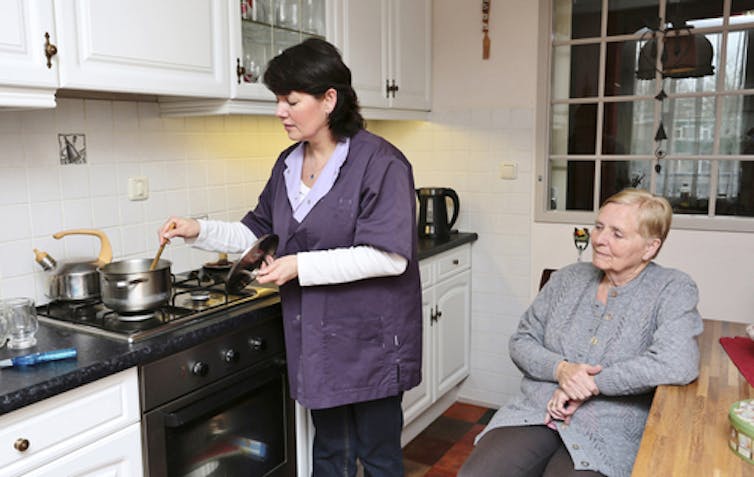
Daily tasks such as cooking and cleaning are out of the reach of many seniors.
Nancy Beijersbergen/Shutterstock.com
Alan Stevens, Texas A&M University ; Carole White, University of Texas at Austin; Marcia G. Ory, Texas A&M University , and Sandhya Sanghi, Texas A&M University

Family care of an older adult has emerged as an essential element of the U.S. health care system, with 83 percent of long-term care provided to older adults coming from family members or other unpaid helpers. As the population of older adults grows, so too does the expectation of family care for persons living with dementia.

We have engaged in decades of research, documenting the impact of dementia caregiving on the health and well-being of the caregiver. We have also conducted research to create evidence-based interventions that can be defined as structured programs with positive results that have been scientifically proved through clinical trials.

We have learned much from family caregivers who report that the amount and type of care expected of them is growing, and have concluded that caregiving demands should be matched by community-based support systems. We have advocated for the adoption of one evidence-based intervention, called REACH II (Resources for Enhancing Alzheimer’s Caregiver Health II), which is designed to help caregivers manage daily care into health care and community-based organizations.

Challenges to family caregiving

The toll of caregiving can be financial as well as physical.
nuiza11/Shutterstock.com

Family caregivers experience multiple challenges daily when caring for a person with dementia, whose care needs steadily increase as cognitive abilities decline. Care burdens can have high physical, emotional and financial costs. An overview, or a meta-analysis, of 84 studies found that caregivers experienced more depression and stress than non-caregivers.

More recently, AARP reported that more than one in three, or 36 percent to be specific, of family caregivers who were not currently in the labor force said they retired early or quit their jobs because of family caregiving concerns.

Despite the critical role that family caregivers play, support programs based on evidence based interventions are not widely available. The National Academies report Families Caring for an Aging America concluded that “few of the nation’s millions of family caregivers of older adults have access to evidence-based interventions.” Moreover, caregivers are often marginalized or ignored by formal health care providers of the person with dementia.

Supporting family caregivers

Interventions that combine education about dementia and advice about specific “do’s and don’t’s” of dementia care with guided training and practice appear to be of greatest value to family caregivers. This approach of providing multiple types of support and training allows the intervention to address the vast spectrum of challenges faced by caregivers and allows support and training activities to be tailored to the unique needs of each family.

While scientific research has demonstrated the value of providing education, skills training and support to family caregivers, we have found in our research that health care and social service providers do not routinely provide support programs based on evidence-based interventions. Thus, for the vast majority of family caregivers, caregiving support services remain extremely fragmented if not elusive. Family caregivers are often left alone to provide care that can be complicated and exhausting 24/7.

From our experience, the lack of caregiving support services that are evidence-based is not solely driven by neglect from health care and social support service providers. Rather, existing evidence-based interventions require dedicated personnel who must be trained to deliver the intervention, yet the delivery of the intervention are not covered by Medicare and other third-party payers.

Additionally, family caregivers are often either unaware of existing services, or they are unable to participate due to emotional stresses, time commitments or scheduling concerns. Finally, there are systemic barriers associated with the failure to translate research into practice, resulting in limited program implementation by community-based agencies that provide care to older adults and assistance to dementia caregivers.

Without care for the caregiver, the system crumbles

Love for a family member is often not enough to meet the tough demands of caregiving.
Robert Kneschke/Shutterstock.com

We believe that forging strong partnerships between health care systems that frequently see patients with dementia and the community-based organizations that provide ongoing supportive services that help caregivers develop skills to deal with negative behaviors associated with memory loss (e.g., agitation or wandering) is necessary to bridge the gap in caregiving services.

Leveraging technology, such as offering online information and support to increase educational opportunities and perhaps even automating some aspects of intervention delivery, will help ensure access to services to the widest possible audience. Working directly with employers to provide proven services to the workforce could mitigate the negative economic impact of premature employment reduction.

While changes in the health care system and workplace are important, we believe that all sectors of our society need to more formally recognize family caregiver services. Such an approach can change attitudes, reduce stigma and foster caring and supportive behavior toward those living with dementia. One example is the Dementia Friendly America initiative, a national effort to support and serve those who are living with dementia, their caregivers and families.

Communities are also taking action by leveraging tailored resources in business, community-based services and supports, faith communities, health care communities, legal and financial services, local government and residential settings.

While improvements are needed in all community sectors recognized by the Dementia Friendly America model, this is especially so in the health care sector. Family caregivers are the source of greatest impact on the health of a person living with dementia, yet are often excluded in conversations with the person’s health care providers. Health care providers should be encouraged to document the role of the family caregiver in the a patient’s electronic health record.

Also, health care providers should make every attempt to involve the family caregiver in all health care interactions, especially in discharge planning after a hospital stay. As a sector, health care systems can also facilitate a dementia friendly approach by directing families to community-based social support services to address common challenges such as getting medications and transportation to health care appointments.

There is a role for higher education as well. Colleges and universities could help prepare a dementia-friendly health care work force to meet the needs of the growing numbers of persons with dementia, estimated to nearly triple by midcentury with an American being diagnosed with dementia every 33 seconds. Attention to dementia-friendly practices such as differentiating dementia from normal aging, early investigation of dementia symptoms by a health care professional and basic training in how to communicate with a person with dementia should be encouraged across the social and health disciplines.

Our care system depends heavily on family caregivers. If their needs are not recognized and addressed, family caregivers risk burnout from the prolonged distress and physical demands of caregiving, and the nation will bear the costs.The Conversation

Alan Stevens, Professor of Medicine; Director, Center for Applied Health Research, Texas A&M University ; Carole White, Professor and Nancy Smith Hurd Chair in Geriatric Nursing and Aging Studies, University of Texas at Austin; Marcia G. Ory, Regents and Distinguished Professor, Associate Vice President for Strategic Partnerships and Initiatives, Texas A&M University , and Sandhya Sanghi, Assistant Investigator, Texas A&M University

This article is republished from The Conversation under a Creative Commons license. Read the original article.