Posted in Caregiving, Dementia, International Campaigns, International Policies, Research & Best Practice

The Link between Hoarders, Brain Damage & the Research

In Asia, you would usually see a case about a hoarder which is a common reference for a person living in severe domestic squalor. In most cases volunteers would have gone in to help clean up the home only to have it return to the same steady state a few months after.

Image from Chinanew.com (Elderly resident in Qing Dao accumulates items that blocks the apartment entrance.)

With our high-rise living 2 recent cases caught my eye, a 78-year-old lady sleeping in a stairwell in Singapore for 3 months as a result of the clutter in her home and an apartment in Shanghai, whose entrance has been completely blocked as a result of a single resident’s collection of items.

np_20150429_jnbug-nbm_848227_0

Image from The New paper (TNP, Singapore)

A lot of the time, these situations leave us confused, especially after a big clean up, they continue to build up and reside in unsanitary and highly dangerous living conditions. It is not uncommon for colleagues or friends to say that the individual was well articulated and seemed well presented. So why do they continue to live in conditions that endanger their lives and others?

In a study by Snowden et al. (2012), one in 700 elderly living alone in the community may be living in these conditions. Research by Lee et al. (2014) in Australia found that people living in squalor were mostly living with brain damage that is impacting their ability to accept that their living condition was highly unacceptable in society. To answer the question about the well-presented individual, their research have also found that most of these individuals score well on the Mini-Mental State Examination (MMSE) indicating a level of capacity resulting in the ability to remain well-spoken and presented individual.

Having helped out in some of these activities, it was and still is in hope; that a lot of the residents who were residing in these living conditions did not have the physical means to clean up their homes. For many of us living in high-rise apartments with our parents and children, a lot of us tend to turn a blind eye and only start to care when it begins to affect our living environments. The usual situation is when we start seeing a rise in the number of cockroaches, a bedbug infestation, or the smell of rotting garbage. By then it is too late.

In addition to the community, Sutherland and Macfarlene (2014), touches the inability of psychiatrists to view this as a psychiatric issue and yet psychiatrist are the key individuals that can assess and prescribe appropriate strategies.

Sutherland and Macfarlane (2014) advise that in these situations practitioners really only have 2 options.  To intervene against the wishes of the person in question or do nothing. People could argue that this is highly paternalistic, some may say prescriptive. However, when the situation may pose a risk of harm to the individual and the community living in these high-rise communities, can you really turn your back on the situation?

Some of us may risk inaction out of respect for the individual. We may not want our neighbours to “lose face”, we may want to be polite, to keep the peace or for some of us, we just haven’t had the time to look, and for a minority of us, we may not care.  to contact our local MP or town council for help; we are in fact abandoning these individuals as a society and putting everyone’s lives in jeopardy, their lives and our own. These environments are a huge fire hazard, in addition to the contributing unsanitary conditions when we allow bedbugs, cockroaches and other insects to spawn when we could have acted early and provided the right care for our neighbours and reduce the risk of harm to everyone.

“Our services should act in the best interests of the person where possible while bearing in mind the interests of others. When capacity is in doubt, decisions about intervention may be debatable. It may be easier to do nothing. Recognising our responsibilities, even if they distress us, is necessary. If we find the job impossible, it is important to refer to people or services who can take on the case (Snowdon, 2014, p682).”

These individuals are who may be found with diminished capacity may be able to be managed by services such as home help/care and other community services (Sutherland and Macfarlane, 2014). The researchers also suggest that in extreme cases, guardianship may e necessary. The person could be cared for in a residential home with clinical care such as an aged care home.

In the event that we may have seen such a situation, we should contact our local MP or town council for help. By remaining inactive, we are in fact abandoning these individuals as a society and putting everyone’s lives in jeopardy, their lives and our own. These environments are a huge fire hazard (Pending Road), in addition to the contributing unsanitary conditions when we allow bed bugs, cockroaches and other insects (Eunos Cockroach Infestation) to spawn when we could have acted early and provided the right care for our neighbours and reduce the risk of harm to everyone.

Video posted by Nur’Ashikin Fazlan Zainol on facebook.

By including the safety and lives of others in our daily lives, we include the safety of our family.


References:

Lee, S., Lewis, M., Leighton, D., Harris, B., Long, B., & Macfarlane, S. (n.d). Neuropsychological characteristics of people living in squalor. International Psychogeriatrics, 26(5), 837-844.

McDermott, S., Linahan, K., & Squires, B. J. (2009). Older People Living in Squalor: Ethical and Practical Dilemmas. Australian Social Work, 62(2), 245-257.

Snowdon, J., & Halliday, G. (2012). A study of severe domestic squalor: 173 cases referred to an old age psychiatry service. International Psychogeriatrics, 23(2), 308-314.

Snowdon, J., & Halliday, G. (2009). How and when to intervene in cases of severe domestic squalor. International Psychogeriatrics, 21(6), 996-1002.

Snowdon, J. (2014). Severe domestic squalor: Time to sort out the mess. Australian & New Zealand Journal Of Psychiatry, 48(7), 682.

Sutherland, A., & Macfarlane, S. (2014). Domestic squalor: Who should take responsibility?. The Australian And New Zealand Journal Of Psychiatry, 48(7), 690.


Posted in Caregiving, Dementia, Research & Best Practice, Therapeutic Activities

Animal-assisted therapy helps reduce BPSD

A successful pilot study that helped to reduced behavioural and psychological symptoms of dementia (BPSD) was conducted on 15 nursing homes residents living with dementia who were exhibiting agitation and aggression. The study was carried out over a period of nine weeks on weekdays (2.30pm – 3.30pm) in two nursing homes that offering recreation programs. The team providing the intervention consisted of therapeutic recreation staff, therapy dogs, and their handlers. Residents in the program could play, pet, feed. chat or just talk about pets that they had in the past or just chat with the handlers. At three weeks, changes in the reduction in behaviour were apparent and after nine weeks, it was found that agitated behaviours were reduced and the residents in the program have become more engaged.

dog-869022_1280

This study was published in the American journal of Alzheimer’s Disease and other Dementias by Nancy Richeson from the College of Nursing and Health Professions in the University of Southern Maine, Portland.

Reference:

Richeson, N. (2003). Effects of animal-assisted therapy on agitated behaviors and social interactions of older adults with dementia.American Journal Of Alzheimer’s Disease & Other Dementias, 18(6), 353-358 6p.

Source: Effects of animal-assisted therapy on agitated behaviors and social interactions of older adults with dementia

Posted in Caregiving, Research & Best Practice, The Built Environment

Lumosity misled customers

This is a critical piece of news and everyone should know about. There are good resources for brain training and we have misleading resources out there that tarnish the names of good legit programmes.

Lumos Labs, developer of Lumosity “brain training” games, will pay $2 million to settle accusations it misled customers about the cognitive benefits of its apps.

Read more about it from NY Times: Lumosity Game Developer Agrees to $2 Million Settlement – The New York Times


Lumos Labs, the developer of Lumosity “brain training” games, will pay $2 million to settle accusations it misled customers about the cognitive benefits of its online apps and programs. The Federal Trade Commission said on Tuesday that ads deceptively suggested that playing the games a few times a week could increase work and school performance, and even delay conditions like dementia. Lumos Labs must contact customers and offer them an easy way to cancel their subscriptions, which range from $15 to $300. The $2 million will be refunded to customers. Jessica L. Rich, director of the F.T.C.’s Consumer Protection Bureau, said the company “simply did not have the science to back up its ads.” Only products that have been reviewed by the Food and Drug Administration can claim to treat or prevent serious diseases or conditions.

Posted in Ageing & Culture, Caregiving, Research & Best Practice, The Built Environment

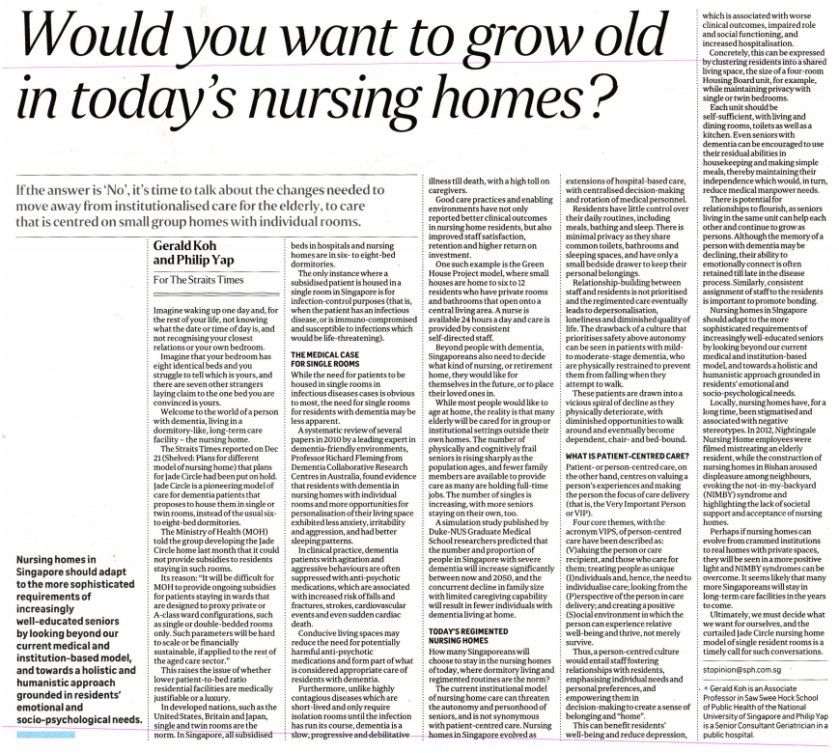
Singapore nursing homes, our story of the wooden bowl?

“It was once said that the moral test of government is how that government treats those who are in the dawn of life, the children; those who are in the twilight of life, the elderly; and those who are in the shadows of life, the sick, the needy and the handicapped.”
– Hubert H. Humphrey

Appears that single bedrooms for people with dementia in nursing homes are considered a luxury in Singapore.

Untitled


This is a brilliant article by Dr Philip Yap and Dr Gerald Koh, and Singapore needs a serious conversation about how we can respectfully treat our elders with dignity.

Srtaitstimes

How do want to care for our loved ones when they grow older? Singaporeans echo the fact that nursing homes are restrictive, institutionalised and lack personal care (Wee et al. 2015). Do we really want anyone we love to live the last years of their life an acute like facility, watching their neighbours beside them cognitively regress as a result of the tension and depression of the unfamiliar, undignified, and restrictive environment? What sort of morals and values will our children inherit when they are exposed to ideas that privacy, dignity, independence and quality of life is deemed a luxury for our elders living with a terminal condition? Are nursing homes, Singapore’s very own wooden bowl?

We need to do more to become a more inclusive Singapore.


Here’s some additional information about dementia.

Did you know?

Dementia is a terminal condition with no cure (World Health Organisation 2015).

“People with dementia are frequently denied the basic rights and freedoms available to others. In many countries, physical and chemical restraints are used extensively in care facilities for elderly people and in acute-care settings, even when regulations are in place to uphold the rights of people to freedom and choice.

An appropriate and supportive legislative environment based on internationally accepted human rights standards is required to ensure the highest quality of service provision to people with dementia and their caregivers.” (Source: WHO 2015)

Reference:

Wee, S.-L. et al., 2015. Singaporeans’ perceptions of and attitudes toward long-term care services. Qualitative health research, 25(2), pp.218–27.

Posted in Ageing & Culture, International Campaigns, Research & Best Practice, The Built Environment

Australia Online Dementia Support Website

Alzheimer’s Australia Victoria launched an online dementia support website (http://www.helpwithdementia.org.au/) that brings together health services such as counselling, public health education and social programmes for people living with dementia, their families and carers through the web.

Given that 85% of general internet users in Australia utilise the net for communication activities, research and networking, it is only logical that health services for people with dementia and their significant others should extend to the web (Australian Communications and Media Authority 2015).

The great thing about online technology is that everything is literally at your fingertips. Especially for the tech saver person with dementia or caregiver. I know some of the readers are thinking; people who are older adults are not tech savvy. That is not true. 46 percent of older adults in Australia are already internet users (Australian Bureau of Statistics 2014). This platform (http://www.helpwithdementia.org.au/) is a life saver. Face to face services are no doubt great for people who can make the time and effort to travel for a session.

The ease of having services in the comfort of your own home is great. Going for services is really stressful and sometimes people or service providers forget that. There’s the stress of making time to travel, arranging transport, the stress of leaving your loved one alone, the anxiety experienced during the process of travelling, worrying about the cost of travel, taking time off from work or from an important social responsibility (Looking after your grandkids), the list goes on.

There are 50 million and one things to worry about. With an online site, I could be reading or watching about information on dementia sitting on the couch with my loved one or even just in my pyjamas in bed. There’s apparently 16 expert videos available on the site to help people understand about dementia.

There’s counselling that can be done through e-mail or there’s the option of a video conference. Or if you like to keep it casual there’s always the forum where you can hook up with a social network and exchange thoughts and read about people’s experiences on specific topics.

An online support platform is a great idea, and I hope to see more platforms that can cater to the needs of the online community. Youths and children these days are much more connected than I am and perhaps this medium might also be a way to connect to the younger generation to spread the news about having a healthier happier brain. Health prevention campaigns really need to take their heads out of the sand in tech-savvy countries, save the trees and really understand the people. Traditional means of health promotion is important but we also have to embrace the new wave of social media and technology and extend our care into the digital realm.

Source: Home – Alzheimer’s Australia Vic

Posted in Research & Best Practice, The Built Environment

Meditation & the impact on your brain

Meditation was a weekly affair for me growing up. Learning Hapkido at the age of 8, we would have meditation sessions at least once a week. Time would stop when I close my eyes and concentrate on serenity and harmony. Attaining a sense of peace within. As a child I took it for granted, it was just something that we had and we did, it was part of our lives. I never really gave it much thought about the impact it had on my mind and body. Now as I look around, more research and evidence have been springing up worldwide on the benefits of meditation. I certainly have my parents to thank for getting me into meditation as a child.

Source of image: http://upw-prod-images.global.ssl.fastly.net/nugget/552e8d42346134001c380100/attachments/Effects-eccbed24a58cdbfd53cb9033e42e13fa.png

This video by scientific America is a great video that focuses on meditation and its impact on the brain. It doesn’t matter if you are 5, 15, 55 or 105, meditation will have positive benefits for your mind, body, and soul. Enjoy the video.

From the youtube page:

Does mindfulness training improve cognitive abilities? A systematic review of neuropsychological findings. [Preview] (Clinical Psychology Review) http://www.ncbi.nlm.nih.gov/pubmed/21…

Long-term meditators self-induce high-amplitude gamma synchrony during mental practice (PNAS) http://www.pnas.org/content/101/46/16…

Evidence builds that meditation strengthens the brain, UCLA researchers say (UCLA)
http://newsroom.ucla.edu/portal/ucla/…

The underlying anatomical correlates of long-term meditation: Larger hippocampal and frontal volumes of gray matter (PMC)http://www.ncbi.nlm.nih.gov/pmc/artic…

Age effects on gray matter volume and attentional performance in Zen meditation (Neurobiology of Aging)http://www.sciencedirect.com/science/…

Age effects on attentional blink performance in meditation [Preview](Conciousness and Cognition) http://www.sciencedirect.com/science/…

Mental Training Affects Distribution of Limited Brain Resources (PLOS Biology)
http://www.plosbiology.org/article/in…

The American Psychological Association on the benefits of mindfulness
http://www.apa.org/monitor/2012/07-08…