Posted in Caregiving, International Campaigns, International Policies

Dementia: number of people affected to triple in next 30 years

WHO News release – Source: Dementia: number of people affected to triple in next 30 years 

News release

 As the global population ages, the number of people living with dementia is expected to triple from 50 million to 152 million by 2050.

“Nearly 10 million people develop dementia each year, 6 million of them in low- and middle-income countries,” says Dr Tedros Adhanom Ghebreyesus, Director-General of WHO. “The suffering that results is enormous. This is an alarm call: we must pay greater attention to this growing challenge and ensure that all people living with dementia, wherever they live, get the care that they need.”

The estimated annual global cost of dementia is US$ 818 billion, equivalent to more than 1% of global gross domestic product. The total cost includes direct medical costs, social care and informal care (loss of income of carers). By 2030, the cost is expected to have more than doubled, to US$ 2 trillion, a cost that could undermine social and economic development and overwhelm health and social services, including long-term care systems.

First global monitoring system launched

The Global Dementia Observatory, a web-based platform launched by WHO today, will track progress on the provision of services for people with dementia and for those who care for them, both within countries and globally. It will monitor the presence of national policy and plans, risk reduction measures and infrastructure for providing care and treatment. Information on surveillance systems and disease burden data is also included.

“This is the first global monitoring system for dementia that includes such a comprehensive range of data,” said Dr Tarun Dua, of WHO’s Department of Mental Health and Substance Abuse. “The system will not only enable us to track progress, but just as importantly, to identify areas where future efforts are most needed.”

Encouraging results in planning for dementia and support for carers

To date, WHO has collected data from 21 countries (1) of all income levels. By the end of 2018, it is expected that 50 countries will be contributing data.

Initial results indicate that a high proportion of countries submitting data are already taking action in areas such as planning, dementia awareness and dementia-friendliness (such as facilitating participation in community activities and tackling the stigmatization of people living with dementia) and provision of support and training for carers, who are very often family members.

Of the countries reporting data so far:

  • 81% have carried out a dementia awareness or risk reduction campaign
  • 71% have a plan for dementia
  • 71% provide support and training for carers
  • 66% have a dementia-friendly initiative.

All of these activities are recommended by WHO in the Global action plan on the public health response to dementia 2017-2025. The Plan provides a comprehensive blueprint for action, in areas including: dementia awareness and dementia-friendliness; reducing the risk of dementia; diagnosis, treatment and care; research and innovation; and support for dementia carers. It suggests concrete actions that can be taken by policy-makers, health- and social-care providers, civil society organizations and people with dementia and their careers. The Plan has been developed with attention to the importance of respecting the human rights of people with dementia and engaging them in planning for their care. Targets against which progress can be measured are included.

Diagnosis and research require significant effort

Just 14% of countries reporting data could indicate the number of people being diagnosed with dementia. Previous studies suggest that as many as 90% of people with dementia in low- and middle-income countries are unaware of their status.

The data also highlight the need for rapid scale-up of research. There have been some encouraging signs in funding available for investment in research for a cure for dementia in recent years, but much more needs to be done. The number of articles in peer-reviewed journals on dementia in 2016 was close to 7000. This compares with more than 15 000 for diabetes, and more than 99 000 for cancer during the same year. Research is needed not only to find a cure for dementia, but also in the areas of prevention, risk reduction, diagnosis, treatment and care.

The Observatory will provide a knowledge bank where health and social care authorities, medical professionals, researchers and civil society organizations will be able to find country and regional dementia profiles, global reports, policy guidance, guidelines and toolkits on dementia prevention and care.

Dementia

Dementia is an umbrella term for several diseases that are mostly progressive, affecting memory, other cognitive abilities and behaviour and interfering significantly with a person’s ability to maintain the activities of daily living. Women are more often affected than men. Alzheimer’s disease is the most common type of dementia and accounts for 60–70% of cases. The other common types are vascular dementia and mixed forms.

Editor’s note

WHO’s work on the Global Dementia Observatory is supported by the governments of Canada, Germany, Japan, the Netherlands, Switzerland and the United Kingdom of Great Britain and Northern Ireland and the European Commission.

For more information, please contact:

Alison Brunier
Communications Officer
World Health Organization
Tel: +41 22 791 4468
Mobile: +41 79 701 9480
E-mail: bruniera@who.int

Fadela Chaib
Communications Officer
World Health Organization
Tel: +41 22 791 3228
Mobile: +41 79 475 5556
E-mail: chaibf@who.int


(1) Australia, Bangladesh, Chile, Costa Rica, Dominican Republic, Fiji, France, Hungary, Italy, Japan, Jordan, Maldives, Mauritius, Myanmar, Netherlands, Qatar, Swaziland, Sweden, Switzerland, Togo, Tunisia


Posted in Caregiving, International Campaigns

High-intensity exercise delays Parkinson’s progression


High-intensity exercise three times a week is safe for individuals with early-stage Parkinson’s disease and decreases worsening of motor symptoms, according to a new phase 2, multi-site trial led by Northwestern Medicine and University of Colorado School of Medicine scientists.

This is the first time scientists have tested the effects of high-intensity exercise on patients with Parkinson’s disease, the second most common neurodegenerative disorder and the most common movement disorder, affecting more than a million people in the United States.

It previously had been thought high-intensity exercise was too physically stressful for individuals with Parkinson’s disease.

The paper will be published in JAMA Neurology Dec. 11, 2017.

Parkinson’s symptoms include progressive loss of muscle control, trembling, stiffness, slowness and impaired balance. As the disease progresses, it may become difficult to walk, talk and complete simple tasks. Most people who develop Parkinson’s are 60 and older.

“If you have Parkinson’s disease and you want to delay the progression of your symptoms, you should exercise three times a week with your heart rate between 80 to 85 percent maximum. It is that simple,” said co-lead author Daniel Corcos, professor of physical therapy and human movement sciences at Northwestern University Feinberg School of Medicine.

Because medications for Parkinson’s have adverse side effects and reduced effectiveness over time, new treatments are needed.

The randomized clinical trial included 128 participants ages 40 to 80 years old from Northwestern University, Rush University Medical Center, the University of Colorado and the University of Pittsburgh.

Participants enrolled in the Study in Parkinson Disease of Exercise (SPARX) were at an early stage of the disease and not taking Parkinson’s medication, ensuring the results of the study were related to the exercise and not affected by medication.

“The earlier in the disease you intervene, the more likely it is you can prevent the progression of the disease,” Corcos said. “We delayed worsening of symptoms for six months; whether we can prevent progression any longer than six months will require further study.”

Scientists examined the safety and effects of exercise three times weekly for six months at high intensity, 80 to 85 percent of maximum heart rate, and moderate intensity, 60 to 65 percent of maximum heart rate. They compared the results to a control group who did not exercise.

After six months, participants were rated by clinicians on a Parkinson’s disease scale ranging from 0 to 108. The higher the number, the more severe the symptoms.

Participants in the study had a score of about 20 before exercise. Those in the high intensity group stayed at 20. The group with moderate exercise got worse by 1.5 points. The group that did not exercise worsened by three points. Three points out of a score of 20 points is a 15 percent change in the primary signs of the disease and considered clinically important to patients. It makes a difference in their quality of life.

“We are stopping people from getting worse, which is significant, particularly if we catch them early in the disease,” Corcos said.

What sets this study apart from others is the high number of participants, and that they exercised for a relatively long period of time. Most exercise studies are 12 weeks, Corcos said.

“We gave them a proper workout,” Corcos said. “This is not mild stretching. This is high intensity. It’s part of the idea that exercise is medicine.”

Corcos and colleagues confirmed it was safe for the participants to do high-intensity exercise by giving them a cardiologist-supervised graded exercise test to evaluate the heart’s response to exercise.

Previous studies in humans suggest high-intensity exercise improves motor symptoms, but the evidence wasn’t sufficient to determine whether exercise intensity modifies symptoms or disease progression. In addition, most studies have not precisely measured or controlled exercise intensity and none have been conducted at 80 to 85 percent maximum heart rate.

“Several lines of evidence point to a beneficial effect of exercise in Parkinson’s disease,” said Dr. Codrin Lungu, program director at the National Institute of Neurological Disorders and Stroke. “Nevertheless, it’s not clear which kind of exercise is most effective. The SPARX trial tries to rigorously address this issue. The results are interesting and warrant further exploration of the optimal exercise regimes for Parkinson’s.”

Published: December 11, 2017

Source: Northwestern Now

高强度运动延迟帕金森氏症的进展

发布日期:2017年12月11日
西北大学发布 

转到移动页面。

芝加哥 – 根据由西北医学院和科罗拉多大学分校领导的新的第二阶段多点试验,每周三次高强度运动对于早期帕金森病患者是安全的,并且减少了运动症状的恶化。医学科学家。

这是科学家第一次测试高强度运动对帕金森病患者的影响,帕金森病是第二种最常见的神经退行性疾病和最常见的运动障碍,影响了美国超过一百万人。

以前曾认为高强度运动对帕金森病患者来说过于紧张。

该论文将于2017年12月11日在JAMA Neurology上发表。

帕金森症状包括肌肉控制进行性减退,发抖,僵硬,缓慢和平衡受损。 随着疾病的进展,走路,谈话和完成简单任务可能变得困难。 大多数帕金森病患者年龄在60岁以上。

“如果你患有帕金森病,而且你想延缓症状的进展,那么你应该每周锻炼三次,心率在80%到85%之间,这是很简单的,”联合主编丹尼尔·科科斯(Daniel Corcos)教授说。西北大学费因伯格医学院的物理治疗和人体运动科学。

由于帕金森药物有不良的副作用,随着时间的推移有效性降低,需要新的治疗方法。

随机临床试验纳入了来自西北大学,拉什大学医学中心,科罗拉多大学和匹兹堡大学的128名40至80岁的参与者。

参加帕金森病运动研究(SPARX)的参与者处于疾病的早期阶段,不服用帕金森药物,确保研究结果与运动有关,并且不受药物影响。

Corcos说:“你介入的疾病越早,你就越可能预防疾病的进展。 “我们推迟了六个月的症状恶化,是否可以阻止进展超过六个月,需要进一步研究。”

科学家每周三次检查运动的安全性和效果,持续六个月,高强度,最高心率的80%到85%,中等强度,最高心率的60%到65%。 他们将结果与没有运动的对照组进行比较。

六个月后,参与者由帕金森病评分范围为0至108的临床医师评价。数目越高,症状越严重。

研究参与者在运动前有20分左右的成绩。 高强度组为20人。中度运动组为1.5分。 没有运动的组恶化了三分。 得分为20分的三分之一是这种疾病的主要体征有15%的变化,并且认为临床上对于患者是重要的。 这对他们的生活质量有所影响。

Corcos说:“我们正在阻止人们变得更糟,这很重要,特别是如果我们在疾病早期发现他们。

这项研究与其他研究不同之处在于参与者人数众多,而且他们行使了相当长的一段时间。 Corcos说,大多数运动研究是12周。

“我们给了他们适当的锻炼,”Corcos说。 “这不是轻度的拉伸,这是高强度的,这是锻炼是药物的一部分。”

Corcos及其同事证实,参与者通过给予心脏科医师监督的分级运动试验来评估心脏对运动的反应,从而进行高强度运动是安全的。

以前对人类的研究表明高强度运动可改善运动症状,但证据不足以确定运动强度是否改变症状或疾病进展。 此外,大多数研究没有精确测量或控制运动强度,没有进行过最高心率的80%到85%。

美国国立神经疾病与卒中研究所(National Institute of Neurological Disorders and Stroke)的项目主任Codrin Lungu博士说:“有几条证据表明,帕金森病的运动是有益的。” “然而,目前还不清楚哪一种运动最有效,SPARX试验试图严格解决这个问题,结果是有趣的,并且需要进一步探索帕金森氏症的最佳运动机制。

Posted in Ageing & Culture, Caregiving, International Policies, The Built Environment

Japan offers us many lessons in embracing longevity

Japan offers us many lessons in embracing longevity

Image 20160105 28994 16fs028
With a quarter of the population aged over 65, Japan has had to be innovative in catering for their wants and needs.
Martyn Jones, Author provided

Marco Amati, RMIT University; Marilena Kavoura, RMIT University; Martyn Jones, RMIT University, and Robin Goodman, RMIT University

Japan is famous for the longevity of its citizens. A quarter of its population is older than 65. That is a proportion that Australia is likely to reach only by 2056. Japan’s experience makes it an interesting example to learn from in the area of aged care.

In 2000, following a decade of stagnant growth, mounting public debt and skyrocketing hospitalisation, Japan introduced the Long-Term Care Insurance Scheme (LTCIS). This universal and compulsory scheme provides support to assess and deliver care through institutional or community-based services for all people over 65. It provides sufficient funds to allow everyone to age in place – even those in public housing and with late-onset dementia.

The scheme represents one of the boldest social democratic experiments in aged care policy in the last 30 years. Yet with bold experiments come surprises.

To the chagrin of the scheme’s designers the LTCIS has been too successful. Cheaper to implement than the policy it replaced, it is still oversubscribed and contributing to Japan’s public debt (230% of GDP).

Happy Active Town in Kobe is a public housing estate where more than 50% of residents are older than 65.
Photo: Martyn Jones

The universal acceptance of the scheme contributes to a paradox: while Japan has the largest ageing population in the world, it is difficult to make a business of providing aged care, as the collapse of Watami, the food chain-cum-nursing home provider, demonstrates. So what can this experience teach Australia’s aged care sector?

Care happens within the community

The first set of lessons concerns community-based integrated care. Here, the LTCIS, following 2012 reforms, mobilises support through community general support centres.

Australia is seeking to improve integration of multi-level care. The support centre in “Happy Active Town”, Kobe, provides an example. This public housing estate houses many refugees from the 1995 Great Hanshin Awaji earthquake. Its proportion of residents over 65 is more than 50%.

The LTCIS, with the local government, provides a care hub for volunteers, social workers and health professionals to provide services and respite care free to all residents on and off the estate. Community hubs such as these are designed to support a range of needs from intense support to community and family engagement in care across the life course.

Happy Active Town in Kobe houses many aged survivors of the devastating 1995 earthquake.

Harnessing technological innovation

The second lesson comes from watching and observing the Japanese experience of integrating technology in care provision. Dense, multistorey buildings of small units are typical in Japan. New, so-called “Platinum” housing integrates universal design and new technologies to ensure safe independent living for the elderly.

Retrofitting large areas of public housing to this standard is complex and expensive. A limited number of exemplary regeneration projects where the local municipality, private providers and the LTCIS work together guide the way. One example is Toyoshikidai, a public estate built for young families in the 1950s in Kashiwa to the north of Tokyo.

Alongside these urban changes a generational change is afoot. As the digitally literate generation reaches old age, smart home devices and new security and communication technology assume increasing importance. The business opportunities alone could amount to US$1 trillion by 2035.

The Japanese government supports this shift with its “Silver ICT” agenda. This includes a raft of e-strategies to bridge the digital divide between “active and inactive” elderly populations.

Yet in the nation where the development of robotic assistive technologies enjoys vast sums of research and development support, there is little sign of this in daily life. In Japan, applying technology in aged care is fraught with ethical, personal and logistical challenges. The solution, for now, centres on the involvement of humans.

The ConversationThe Japanese experience of ageing is unique and varied, but presents a foretaste of the future for many post-industrial societies. The “Happy Active Town” of Kobe, 20 years after a major natural disaster, is one example of a place where public policy, housing and technology converge to create solutions for an ageing society. Its mechanisms to support the passion and commitment of the people working and living there can teach Australia how to age with dignity.

Marco Amati, Associate Professor of International Planning, Centre for Urban Research, RMIT University; Marilena Kavoura, Manager Industry Linkage, RMIT University; Martyn Jones, Associate Professor of Social Work, RMIT University, and Robin Goodman, Professor of Urban Planning, Deputy Dean, Sustainability and Urban Planning, RMIT University

This article was originally published on The Conversation. Read the original article.

Posted in Ageing & Culture, Caregiving, International Campaigns, Therapeutic Activities

Trishaws anyone?

A beautiful intergenerational activity to celebrate the love of cycling, a spot of reminiscence, and the great outdoors.


How lovely is this? As a child, my mother and I use to jump on a trishaw after our trip to the wet market. I use to watch the spokes go round and round and I still can hear the “Tak tak tak” sound the wheels make as we head home. It’s always a magical experience no matter how short the trip was. Took less than 5 minutes to reach our home from the market on a trishaw and I’ve sat in it for years and years with my mum, but it never grows old. With the wind in my face, the clicky round of the rickshaw, and just cuddled beside my mum with all our groceries at my feet, the world was our oyster.

When Cycling Without Age it just brought back all these lovely memories of my childhood. I wondered how wonderful would this be for it to be reintroduced into the community. There would be so many older adults in Asia whose main form of transport was the bicycle or the trishaw at a point of their time in their youth. As we aged and our physical abilities deteriorate, we lose our abilities to cycle and with it, our memories of freedom, that wind in your hair, the road just beneath your feet, to go wherever you wanted to go and be wherever you wanted to be.

Such an intervention can only bring generations together, a real intergenerational project of adventure and bonds. To bring people closer through the love of freedom and the outdoors.

I’m so glad to see this in Singapore and I hope that more Singaporeans will jump on board to support this movement!

If you have time, have a read of these 21 inspirational stories from Cycling without Age http://cyclingwithoutage.org/book/

Posted in Ageing & Culture, Caregiving, Inspirational quotes & videos, International Campaigns, International Policies, The Built Environment

Ageing in Place? Yes, we can!

Article: Why it’s good to be old in Wakabadai estate, where nearly half the residents are elderly

Read about a community that has come together to age together at the Wakabadai public housing estate.

Recently Channelnewsasia did a piece on the Wakabadai housing estate in Yokohama, Japan. It’s a really interesting estate and the means in which the estate has been configured bears many similarities to the high rise housing estates found in the big cities where we all live a wall away from our neighbours. However, despite living in the same building for 30 to 40 years a lot of us may just be acquaintances, saying the passing “hi” and “hellos” as we greet each other at the elevator or when we pass each other along the corridors.

A few years ago, I visited a couple who lived alone in a little apartment with two bedrooms, their children had moved out and the husband was caring for his wife with dementia. She is very quiet and apathetic. His greatest worry was that he may suffer a stroke or a heart attack and is unable to get help in time and both of them may pass away in their apartment despite being surrounded by hundreds or thousands of people living in the building. He cited a neighbour living a few floors below them, who had passed away without anyone noticing until a number of days later. He talked about the need for services for families like them, and many services assume that because they have children, there would be someone watching out for them. However, with the busy lives that his children lead, looking after their families and juggling work, they could only call in on the weekends and rightly so with the changing landscape of the economy.

His son offered to have them stay with him but leaving their much familiar neighbourhood might be too much for his wife. Even now she would get agitated if they left the vicinity. For them this is home, this is where they had built their lives, house their memories, thrived in their love, and they wouldn’t want to live anywhere else.

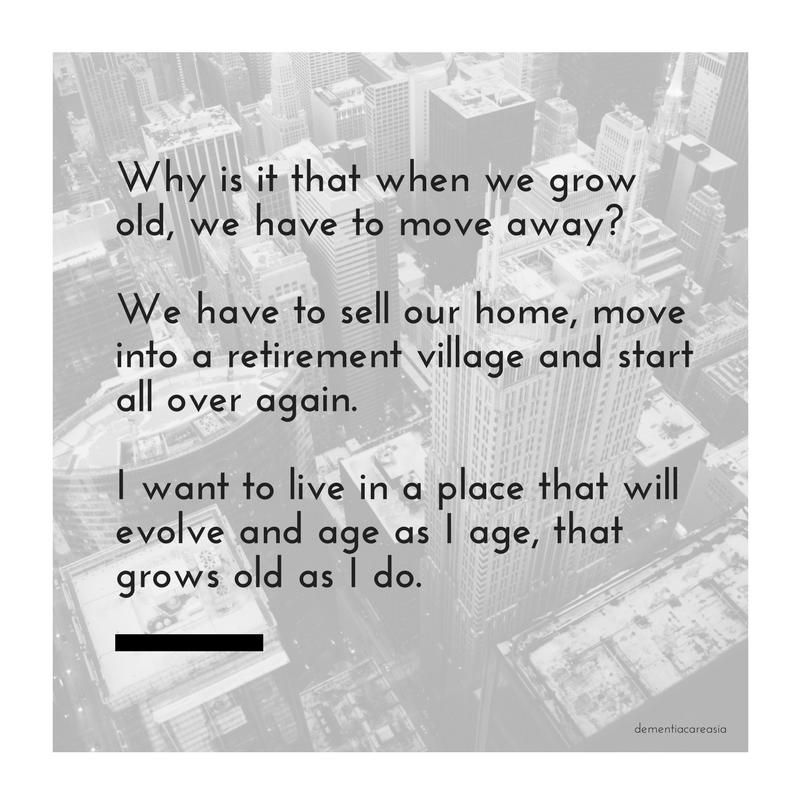
Why is it that when we grow old, we have to move away? We have to sell our home, move into a retirement village and start all over again. I want to live in a place that will evolve and age as I age, that grows old as I do.

Back to Yokohama, the Wakabadai public housing estate is just that, with slightly less than half of the residents 65 years and older, the people living in the estate are ageing in place together. To date, there is a total of 14,658 residents living in the estate in 6,304 units. To ensure that they needs are met, they have come together with organisations and council to organise a range of services.

wakabadai 1.png
Map of Wakabadai

Social Engagement for Older Adults:

The Wakabadai Non-Profit Organisation enables social activities such as health, music, cultural and sporting events to be held in the vicinity. Himawari provides a space for volunteers to interact with older adults over a cuppa. Residents are also keenly aware of “kodokushi”, which refers to people who are living alone and have passed away and their deaths have gone unnoticed by the community. In Wakabadai, residents band together and keep a keen eye out for the sudden build up of mail or newspaper in the mailboxes of older residents and the mail continues to be left unattended with no notice that the resident might be away.

A paid service is also available at the Himawari Community Centre where they can have a staff to ring their phones to ensure they are alright. They can also have a spare key stored at Himawari for approximately 500 yen.

In addition, celebrations during festive periods are arranged by the organisation to encourage engagement among the residents. Sports events are also organised regularly to encourage and promote a healthy lifestyle among residents.

wakabadai 2.png
Wakadabai Estate

Creating an Intergenerational Community:

To encourage engagement from children and younger adults, a facilty for mothers group known as Wakaba Family Plaza Soramame can be found in Wakadabai. A safe space for mother’s of infants and toddlers to interact, support and exchange vital parenting information with each other and older adults. Older adults with early childhood qualifications can find work as advisors, helping to support young mothers, sharing with them their years of wisdom. Coming into Wakaba Family Plaza Soramame, you may find three generations interacting and hanging out together.

Meaning Occupation:

The Wakabadai Non-Profit Organisation also helps to find jobs for older adults.

Older adults can also showcase their culinary skills at Haru Dining, a restaurant staffed by older women living in the area serving up old school, heartwarming home cooked meals.

japan-cuisine-2336228_960_720

Assistance with Activities of Daily Living:

Residents can also tap on a home help service at the cost of 490 JPY per hour which covers everything from house chores to transport to get their food or groceries delivered. Transport is highly efficient with buses running every 3 mins to the major train station, currently, residents are campaigning for a train station to be built close to their vicinity.

Other accessible facilities in the area include a post office, supermarkets, salons, restaurants, shops, gyms and parks.

Healthcare:

When it comes to healthcare, the Community Centre run by the Yokohama City Council also provides exercise classes for older adults, a care facility for older adults during the day, and medical staff such as nurses are available to provide older adults health and medical advice.

In addition, Asagao, a district nursing service consisting of nursing and medical staff from an acute hospital in the area man an emergency hotline that is accessible for residents in the estate at all times of the day or night. On top of the hotline, staff also provide and provide home care to the residents in the community.

When it comes to high care needs, residential aged care facilities are also located in the estate for residents who are too frail to reside in their own home.

With all the facilities to encourage a positive ageing in place, it is no wonder that the rates of older adults requiring nursing care much lower than the average rates found in other estates in Yokohama. In Wakabadai, the rates of nursing care currently stand at 12 percent whereas, on average 17.5 percent of older adults in each estate is found to require nursing care at home.

Wakadabai has shown that ageing in place is possible and it is achievable in the big cities with high-density living. With key elements in place, council and community support, we all can grow old gracefully in the luxury of our homes.

Posted in International Campaigns

What is ‘cognitive reserve’?

What is ‘cognitive reserve’? How we can protect our brains from memory loss and dementia

File 20170621 30190 rxtdo7
Engaging in cognitively stimulating activities can help build your resilience to cognitive decline.
Gene Wilburn/Flickr, CC BY

Michael Ridding, University of Adelaide

As we get older we have a greater risk of developing impairments in areas of cognitive function – such as memory, reasoning and verbal ability. We also have a greater risk of dementia, which is what we call cognitive decline that interferes with daily life. The trajectory of this cognitive decline can vary considerably from one person to the next.

Despite these varying trajectories, one thing is for sure: even cognitively normal people experience pathological changes in their brain, including degeneration and atrophy, as they age. By the time a person reaches the age of 70 to 80, these changes closely resemble those seen in the brains of people with Alzheimer’s Disease.

Even so, many people are able to function normally in the presence of significant brain damage and pathology. So why do some experience symptoms of Alzheimer’s and dementia, while others remain sharp of mind?

It comes down to something called cognitive reserve. This is a concept used to explain a person’s capacity to maintain normal cognitive function in the presence of brain pathology. To put it simply, some people have better cognitive reserve than others.

Evidence shows the extent of someone’s cognitive decline doesn’t occur in line with the amount of biological damage in their brain as it ages. Rather, certain life experiences determine someone’s cognitive reserve and, therefore, their ability to avoid dementia or memory loss.

How do we know?

Being educated, having higher levels of social interaction or working in cognitively demanding occupations (managerial or professional roles, for instance) increases resilience to cognitive decline and dementia. Many studies have shown this. These studies followed people over a number of years and looked for signs of them developing cognitive decline or dementia in that period.

As we get older we have a greater risk of developing impairments in cognitive function, such as memory.
from shutterstock.com

Cognitive reserve is traditionally measured and quantified based on self reports of life experience such as education level, occupational complexity and social engagement. While these measures provide an indication of reserve, they’re only of limited use if we want to identify those at risk of cognitive decline. Genetic influences obviously play a part in our brain development and will influence resilience.

Brain plasticity

The fundamental brain mechanisms that underpin cognitive reserve are still unclear.
The brain consists of complex, richly interconnected networks that are responsible for our cognitive ability. These networks have the capacity to change and adapt to task demands or brain damage. And this capacity is essential not only for normal brain function, but also for maintaining cognitive performance in later life.

This adaptation is governed by brain plasticity. This is the brain’s ability to continuously modulate its structure and function throughout life in response to different experiences. So, plasticity and flexibility in brain networks likely contribute in a major way to cognitive reserve and these processes are influenced by both genetic profiles and life experiences.

A major focus of our research is examining how brain connectivity and plasticity relate to reserve and cognitive function. We hope this will help identify a measure of reserve that reliably identifies individuals at risk of cognitive decline.

Strengthening your brain

While there is little we can do about our genetic profile, adapting our lifestyles to include certain types of behaviours offers a significant opportunity to improve our cognitive reserve.

Activities that engage your brain, such as learning a new language and completing crosswords, as well as having high levels of social interaction, increase reserve and can reduce your risk of developing dementia.

Regular physical activity increases cognitive reserve.
Jenny Hill/Unsplash, CC BY

Regular physical activity also improves cognitive function and reduces the risk of dementia. Unfortunately, little evidence is available to suggest what type of physical activity, as well as intensity and amount, is required to best increase reserve and protect against cognitive impairment.

There is also mounting evidence that being sedentary for long periods of the day is bad for health. This might even undo any benefits gained from periods of physical activity. So, it is important to understand how the composition of physical activity across the day impacts brain health and reserve, and this is an aim of our work.

The ConversationOur ongoing studies should contribute to the development of evidence-based guidelines that provide clear advice on physical activity patterns for optimising brain health and resilience.

Michael Ridding, Professor, University of Adelaide

This article was originally published on The Conversation. Read the original article.