Posted in Caregiving, Dementia

How To Stop Correcting a Person with Dementia

It’s not uncommon to see people trying to correct a person with dementia. It is a difficult task to accept that a person with dementia has difficulty with memory, and this is a common occurrence with not just caregivers, but the clinical staff, and professional carers as well.

We know that dementia results in memory loss, and yet we constantly find ourselves getting annoyed, upset and stressed out when the person with dementia does something we think is wrong by us. We are thrown stacks of fact sheets and brochures, clinical advice from staff and info graphs. We know we have to resist, and yet we give in all the time, walking away, hands in the air and shaking our heads. Stressing the person with dementia and ourselves. It’s hard to kick the habit; it’s part of our nature to want to correct and get things right, after all, we have been doing it all our lives. It’s tough!

The next time the need to correct someone with dementia comes up, here’s what these 2 videos on the ability to resist, self-control and delayed gratification can do for us. After all, when we laugh and learn, we remember better. What better way to do it then to have Sir Ian McKellen, Tom Hiddleston, Cookie Monster & cookies remind us about the ability to resist and to know that we will be happier for it later. 2 must see cute, meaningful and delightful videos that will keep us smiling instead of getting frustrated the next time we want to correct someone we care for with dementia.


This is part of a series of post that aims to help everyone learn through laughter. #LearnTLaughter

Posted in Caregiving, Dementia, International Campaigns, International Policies, Research & Best Practice

The Link between Hoarders, Brain Damage & the Research

In Asia, you would usually see a case about a hoarder which is a common reference for a person living in severe domestic squalor. In most cases volunteers would have gone in to help clean up the home only to have it return to the same steady state a few months after.

Image from Chinanew.com (Elderly resident in Qing Dao accumulates items that blocks the apartment entrance.)

With our high-rise living 2 recent cases caught my eye, a 78-year-old lady sleeping in a stairwell in Singapore for 3 months as a result of the clutter in her home and an apartment in Shanghai, whose entrance has been completely blocked as a result of a single resident’s collection of items.
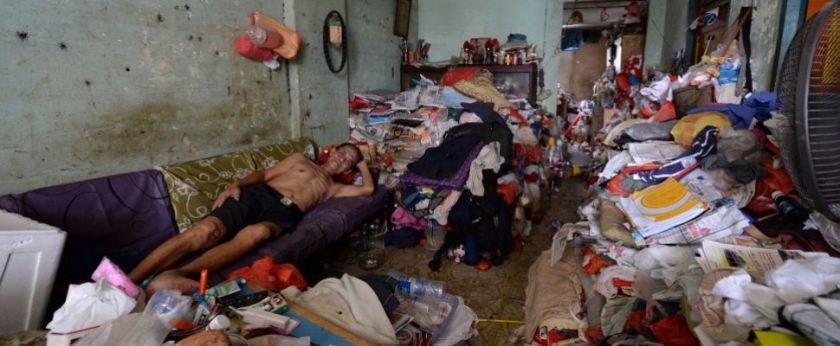
np_20150429_jnbug-nbm_848227_0

Image from The New paper (TNP, Singapore)

A lot of the time, these situations leave us confused, especially after a big clean up, they continue to build up and reside in unsanitary and highly dangerous living conditions. It is not uncommon for colleagues or friends to say that the individual was well articulated and seemed well presented. So why do they continue to live in conditions that endanger their lives and others?

In a study by Snowden et al. (2012), one in 700 elderly living alone in the community may be living in these conditions. Research by Lee et al. (2014) in Australia found that people living in squalor were mostly living with brain damage that is impacting their ability to accept that their living condition was highly unacceptable in society. To answer the question about the well-presented individual, their research have also found that most of these individuals score well on the Mini-Mental State Examination (MMSE) indicating a level of capacity resulting in the ability to remain well-spoken and presented individual.

Having helped out in some of these activities, it was and still is in hope; that a lot of the residents who were residing in these living conditions did not have the physical means to clean up their homes. For many of us living in high-rise apartments with our parents and children, a lot of us tend to turn a blind eye and only start to care when it begins to affect our living environments. The usual situation is when we start seeing a rise in the number of cockroaches, a bedbug infestation, or the smell of rotting garbage. By then it is too late.

In addition to the community, Sutherland and Macfarlene (2014), touches the inability of psychiatrists to view this as a psychiatric issue and yet psychiatrist are the key individuals that can assess and prescribe appropriate strategies.

Sutherland and Macfarlane (2014) advise that in these situations practitioners really only have 2 options.  To intervene against the wishes of the person in question or do nothing. People could argue that this is highly paternalistic, some may say prescriptive. However, when the situation may pose a risk of harm to the individual and the community living in these high-rise communities, can you really turn your back on the situation?

Some of us may risk inaction out of respect for the individual. We may not want our neighbours to “lose face”, we may want to be polite, to keep the peace or for some of us, we just haven’t had the time to look, and for a minority of us, we may not care.  to contact our local MP or town council for help; we are in fact abandoning these individuals as a society and putting everyone’s lives in jeopardy, their lives and our own. These environments are a huge fire hazard, in addition to the contributing unsanitary conditions when we allow bedbugs, cockroaches and other insects to spawn when we could have acted early and provided the right care for our neighbours and reduce the risk of harm to everyone.

“Our services should act in the best interests of the person where possible while bearing in mind the interests of others. When capacity is in doubt, decisions about intervention may be debatable. It may be easier to do nothing. Recognising our responsibilities, even if they distress us, is necessary. If we find the job impossible, it is important to refer to people or services who can take on the case (Snowdon, 2014, p682).”

These individuals are who may be found with diminished capacity may be able to be managed by services such as home help/care and other community services (Sutherland and Macfarlane, 2014). The researchers also suggest that in extreme cases, guardianship may e necessary. The person could be cared for in a residential home with clinical care such as an aged care home.

In the event that we may have seen such a situation, we should contact our local MP or town council for help. By remaining inactive, we are in fact abandoning these individuals as a society and putting everyone’s lives in jeopardy, their lives and our own. These environments are a huge fire hazard (Pending Road), in addition to the contributing unsanitary conditions when we allow bed bugs, cockroaches and other insects (Eunos Cockroach Infestation) to spawn when we could have acted early and provided the right care for our neighbours and reduce the risk of harm to everyone.

Video posted by Nur’Ashikin Fazlan Zainol on facebook.

By including the safety and lives of others in our daily lives, we include the safety of our family.


References:

Lee, S., Lewis, M., Leighton, D., Harris, B., Long, B., & Macfarlane, S. (n.d). Neuropsychological characteristics of people living in squalor. International Psychogeriatrics, 26(5), 837-844.

McDermott, S., Linahan, K., & Squires, B. J. (2009). Older People Living in Squalor: Ethical and Practical Dilemmas. Australian Social Work, 62(2), 245-257.

Snowdon, J., & Halliday, G. (2012). A study of severe domestic squalor: 173 cases referred to an old age psychiatry service. International Psychogeriatrics, 23(2), 308-314.

Snowdon, J., & Halliday, G. (2009). How and when to intervene in cases of severe domestic squalor. International Psychogeriatrics, 21(6), 996-1002.

Snowdon, J. (2014). Severe domestic squalor: Time to sort out the mess. Australian & New Zealand Journal Of Psychiatry, 48(7), 682.

Sutherland, A., & Macfarlane, S. (2014). Domestic squalor: Who should take responsibility?. The Australian And New Zealand Journal Of Psychiatry, 48(7), 690.



Posted in Caregiving, Dementia, Research & Best Practice, Therapeutic Activities

Animal-assisted therapy helps reduce BPSD

A successful pilot study that helped to reduced behavioural and psychological symptoms of dementia (BPSD) was conducted on 15 nursing homes residents living with dementia who were exhibiting agitation and aggression. The study was carried out over a period of nine weeks on weekdays (2.30pm – 3.30pm) in two nursing homes that offering recreation programs. The team providing the intervention consisted of therapeutic recreation staff, therapy dogs, and their handlers. Residents in the program could play, pet, feed. chat or just talk about pets that they had in the past or just chat with the handlers. At three weeks, changes in the reduction in behaviour were apparent and after nine weeks, it was found that agitated behaviours were reduced and the residents in the program have become more engaged.

dog-869022_1280

This study was published in the American journal of Alzheimer’s Disease and other Dementias by Nancy Richeson from the College of Nursing and Health Professions in the University of Southern Maine, Portland.

Reference:

Richeson, N. (2003). Effects of animal-assisted therapy on agitated behaviors and social interactions of older adults with dementia.American Journal Of Alzheimer’s Disease & Other Dementias, 18(6), 353-358 6p.

Source: Effects of animal-assisted therapy on agitated behaviors and social interactions of older adults with dementia

Posted in Caregiving, Dementia, Therapeutic Activities

Hand muffs for dementia

These remind me of the tactile blankets that I use to see at work, but smaller, cuter and cosier! Coming in a myriad of colours, this is reblogged from the St Joseph’s Health Care site – Therapeutic Hand Muffs


hand muff knittwear

hand muff

What is a Therapeutic Hand Muff?

It’s a basic knitted muff using different yarn textures and colours. Items, such as beads, buttons and ribbons, are then attached (inside and outside) to provide even more tactile stimulation. People with dementia often have restless hands and can be soothed by having something to keep their hands occupied. The muff provides a source of visual, tactile and sensory stimulation at the same time as keeping hands snug and warm.

Materials
Soft chunky or super chunky yarns and novelty yarns such as eyelash or faux fur yarns. Needles: 8mm circular (easiest) or 6.5mm straight needles.

The muff is knit in one long tube which is double the length of the final size. Once you are finished, you will push the interior up inside and sew the two ends together. If using straight needles you will knit a rectangle and sew up the sides first.

Instructions:
Cast on 40 stitches. The first half will be the inside of the muff– chenille or other soft/cozy yarns are best. Work rounds in knit stitch for 11 inches. If using straight needles, knit stocking stitch (knit a row, purl a row) for 11 inches. Continue knitting, but begin swapping out different yarns with interesting colours and textures, such as eyelash, mohair, and novelty yarns. Continue until the length measures about 23 inches and cast off.

If using straight needles: lightly iron the long strip, then neatly join the sides together using edge to edge stitch (with the knit side facing out). At this point you should have a tube.

hand muff full view

Now it’s time to sew on the tactile items. Suggestions include: buttons, beads (in strings or separately), ribbons, small wooden toys or shapes, patches of leather, knitted/crocheted pockets and flowers, zippers, loops, pompoms, etc. Avoid using delicate items such as feathers, items with sharp edges or points, heavy or large items or anything that could tear or break and cause harm. It’s best if items are washable.

hand muff showing how to sew it

It is very important to securely attach the items. Use fishing line, leather string or embroidery thread. Attach each item to a large button on the back of the work as an anchor. The muff will be doubled up so these anchor buttons won’t be visible on the end product.

Attach 2 or 3 items inside the muff (things to grab on to such as large wooden beads, pompoms, etc.) and a few things on the outside. When you have completed attaching items, push the inside half up inside the muff body and sew the two ends together using a neat edge to edge stitch.

hand muffs

Related:

What started as a search for a worthwhile project for a knitting group at St. Joseph’s to pursue in their leisure time, is resulting in creations that soothe and calm people with dementia.


Please check out their webpage for more information.

Source: Hand muffs for dementia | St. Joseph’s Health Care London


Posted in Ageing & Culture, Dementia, International Campaigns, International Policies, Research & Best Practice, The Built Environment

Living Tiny & the Psychological Issues that go with it

In Asia, it is not uncommon for us to be living in tiny living space. From Tokyo, Singapore, China and even Thailand, we’ve all heard, know or even are living in very tiny homes in a very overcrowded city. Cost of living is high, we pay a mint for our homes and we end up living in little shoeboxes in the sky. In a recent article by the Atlantic. The issues of micro apartments were discussed and the question is “how small can our living spaces get before it starts to impact on our physical and psychological health?”

The article talks about how these apartments serve their purpose for young, childless couples who had just started out in the world and wish to live close to the city or work or play. However, for people with children or living in a multigenerational family unit, how do people cope?

city-building-fire-escape-fire-ladder-medium

Looking back in Asia, for many in the sandwich generation, working long 10 to 14-hour shifts, caring for children and our parents. The home is suppose to be a safe haven, but when overcrowding occurs some people may feel a sense of dread befalling on them when it is time to go home. Trapped between the tortures of work and the stress of  claustrophobic home.

city-streets-skyline-buildings-large

The article talks about how living in small apartments can affect the concentration of children and in turn, impact on their studies. The article also talks about the lack of privacy and how it may cause children to become withdrawn. If these housing conditions can have such fundamental impacts on children the implications for older adults living in such apartments with cognitive impairment and dementia must be very challenging.

office-table-home-room-medium

However, in Japan, despite the overcrowding and challenging living conditions, strong community initiatives have risen to help support the physical and mental well-being of older adults living in these housing conditions. The Dementia Support Caravan (DSC), founded a decade ago help apartment managers to work with older tenants who may be living with dementia and require support from the community. As the number of people with dementia

The Dementia Support Caravan (DSC), founded a decade ago help apartment managers to work with older tenants who may be living with dementia and require support from the community. As the number of people with dementia continue to grow in Asia and housing conditions continue to remain unchanged; initiatives such as the DSC can help older adults with dementia age in place in their units within the community. It is in hope that more urban regions in Asia may develop similar programmes to support the people with dementia and their family living in the high-rise communities.


Source: The Health Risks of Small Apartments – The Atlantic

Source: Hand for dementia – Japan Times